


Please note: this article refers to French regulations and standards.
In the construction sector, many companies use subcontractors. By boosting their workforce, subcontractors are an essential part of their projects’ success. But for that, managing them well is fundamental. Let’s look at what subcontracting involves and the good practices to adopt to ensure a fruitful collaboration.
In brief
Subcontracting in construction links a main contractor and a subcontractor through a contract governed by law, the subcontractor reporting only to the main contractor. It provides extra labour or one-off skills, but requires rigorous management: define your needs, select qualified and insured companies, compare quotes, sign a precise contract, communicate in writing, monitor quality, safety and costs, then close out by checking the works comply. Shared software makes coordination between companies easier.
What is subcontracting?
In France, subcontracting is governed by law. It is based on a subcontracting agreement between two companies: the main contractor and the subcontractor. But a contract must also be drawn up between the client (the end customer) and the main contractor.
The subcontractor works for the main contractor. It reports to the main contractor alone, not to the end customer, the client. The main contractor therefore provides the subcontractor with very precise specifications, from which the subcontractor proposes a work schedule. There is no relationship of subordination between the two companies. They are linked solely by the performance of the assigned job.
The end customer, bound by contract to the main contractor
Provides the specifications to the subcontractor
Proposes a schedule and reports only to the main contractor
Why subcontract in construction?
A construction company responding to a call for tenders may need more manpower, or specific skills it does not have in-house. Subcontracting gives it access to them on a one-off basis and lets it be more flexible. With today’s tight labour market, this practice is growing fast.
The risks of subcontracting
Using subcontractors is not without risk. You have to make sure the work is of good quality, that staff follow safety measures, and that they are compliant and productive. For this, good subcontractor management is essential.
Selecting your subcontractors
Defining your needs
Before using subcontractors, you need to assess the workforce you have in-house and its availability. In which area is your company short-staffed? What skills and qualifications are required? This work defines the gap to be filled.
Finding subcontractors
To find subcontractors that meet your needs, you can look at professional directories and specialist websites, and also consider recommendations. Go through potential partners’ experience, reputation, technical skills, etc. with a fine-tooth comb. Check that the companies you approach employ qualified staff on proper employment contracts who are trained in safety standards.
Requesting quotes
Compare quotes from several subcontractors and choose the best value for money. Be careful not to go for the cheapest candidate without checking their references. Also make sure the company selected holds the necessary licences and insurance.
Drawing up a clear subcontracting agreement
To protect your project, draw up a precise subcontracting agreement. It should cover expectations, deadlines, costs, penalties for delays, quality standards, etc. Don’t forget to include a dispute resolution clause.
- 1DefineNeeds and missing skills
- 2SearchDirectories, websites, recommendations
- 3CompareQuotes, references and insurance
- 4ContractDeadlines, costs, penalties, disputes
- 5MonitorQuality, safety and costs
- 6Close outCompliance, payment, guarantees
Communicating and coordinating
Successful subcontractor management depends on good communication. This can take various forms, but must always be summarised in writing, in a shared digital environment. This is also where you can see that software can be very useful for improving your worksite management.
Meetings and transparency

To do this, hold regular meetings to discuss project progress, any issues and necessary adjustments. Communication between the parties must be transparent. At the slightest hitch, it must be reported so that corrective action can be taken quickly and the worksite does not fall behind.
Centralised management
For large worksites, it is often a good idea to appoint a project manager or someone in charge of managing subcontractors.
Digital management tools
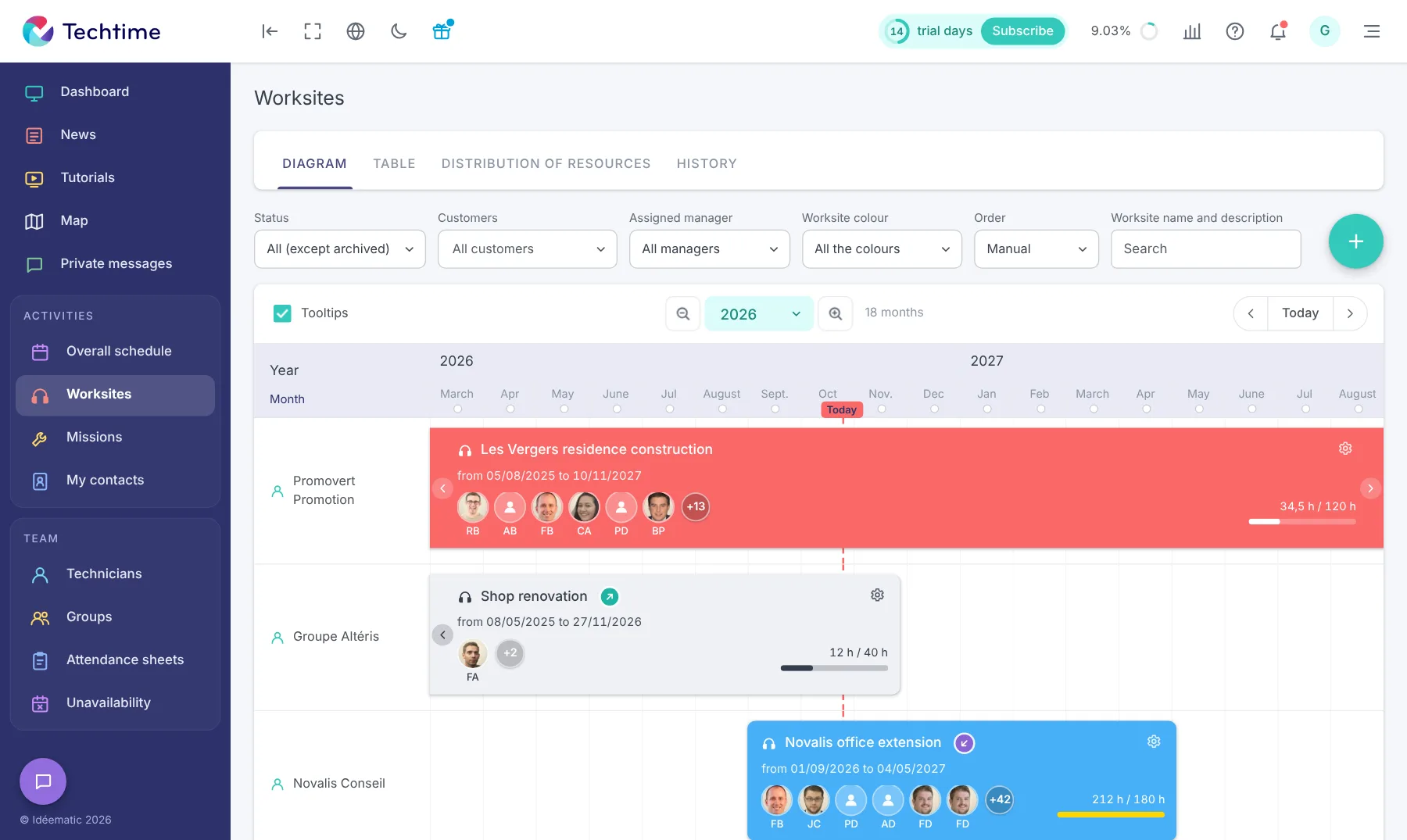
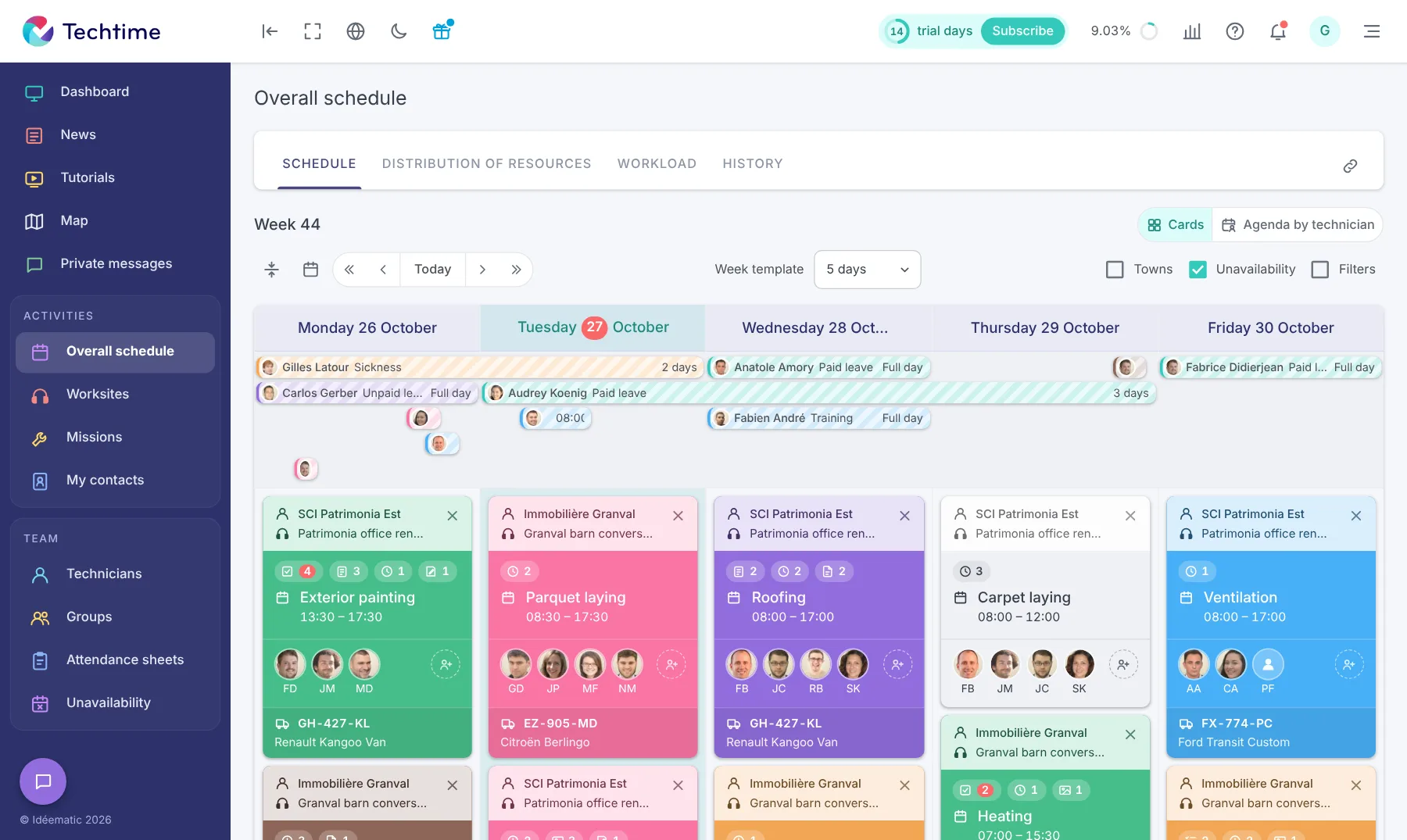
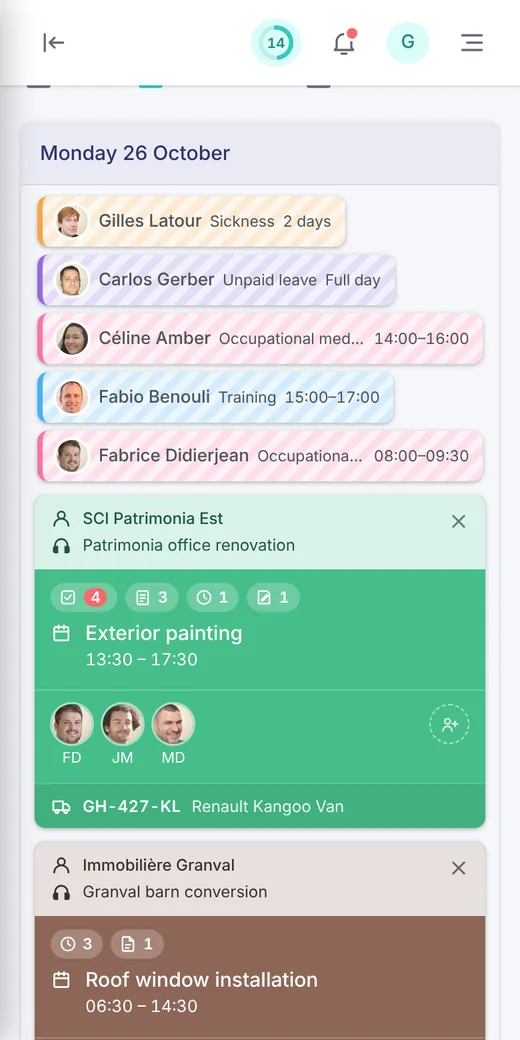
To help you, there are very effective project management software packages that centralise documents and make them easy to share, etc. They also let you track subcontractors’ attendance and movements on the worksite in real time.
Techtime is a unique tool that makes it easier for several companies to collaborate on the same project. Each company has its own software environment while being able to organise its schedule in a way that is visible to the other participants. To find out more, read our article.
Monitoring subcontractors’ performance
The quality and compliance of subcontractors’ work must be ensured. Regular inspections are carried out and compliance with deadlines is checked. A system of rewards and penalties for exceptional performance or breach of the contract terms can be planned and applied.
Managing problems and conflicts
To avoid any legal dispute or worksite delay, effective management of problems and conflicts is essential. Rigour and mediation are the order of the day.
As soon as an issue arises, it must be addressed and solutions found.
Rely on the dispute resolution clause in your subcontracting agreement. It sets out how conflicts are to be resolved. If a conflict drags on, you can turn to mediation and, if that fails, consider legal action.
Financial management of subcontractors
At every stage of the construction project, costs must be controlled to make sure they don’t spiral along the way! An accurate record of payments is kept, and any change to orders must be approved and checked.
Managing subcontractors’ safety
Safety on worksites is a priority. To this end, as mentioned above, it is essential to make sure workers are trained in safety standards. Regular inspections must then be carried out to check that everything is in order and to correct mistakes quickly. All incidents are recorded to ensure traceability. Their causes must be identified so that they don’t happen again.
Closing out subcontracting agreements
Once the worksite is finished, it is important to check that the works comply with the contract specifications and the agreed quality standards. Once it is clear that the subcontractors have fulfilled their contractual obligations, they are paid. Finally, they must provide the documentation relating to guarantees, certificates of compliance, etc.
Conclusion
Managing subcontractors properly in construction is complex, but essential to the success of a building project. It is also fundamental to your company’s reputation in the sector! To help you with this task and avoid mistakes, dedicated digital tools exist. They save time and improve precision.
Frequently asked questions
What is subcontracting in construction?
A contract governed by law between a main contractor and a subcontractor. The subcontractor carries out the job based on specifications and reports only to the main contractor, with no relationship of subordination between the two companies.
What should a subcontracting agreement contain?
Expectations, deadlines, costs, penalties for delays and quality standards, not forgetting a dispute resolution clause.
How do you choose the right subcontractor?
First define your needs, then look at the candidates’ experience, reputation and skills. Check that their staff are qualified and trained in safety, compare several quotes and make sure they hold the necessary licences and insurance.