


Faced with inflation and the housing crisis, construction contractors are increasingly teaming up to carry out worksites together. Construction and renovation projects are becoming ever more complex. Coordination is therefore needed to avoid errors and delays. From customer satisfaction to new business opportunities, discover all the benefits of collaboration between construction tradespeople on a worksite. At the end of this article, we will present an exclusive new feature in our worksite tracking app.
In brief
With worksites becoming ever more complex, construction tradespeople gain from working together: their skills complement each other, errors and delays decrease and new business opportunities open up. Good collaboration relies on communication, sharing expertise, trust and a clear division of responsibilities. Partnerships are formed at events, within tradespeople’s cooperatives or on social media. With Techtime, several companies share the same worksite, each in its own environment.
1The benefits of good cooperation between construction tradespeople
Collaboration is a beneficial strategy for construction contractors. It relies on the complementary skills of each building professional. Versatility is increasingly sought after because of changing techniques, regulations and the complexity of worksites. Nevertheless, nothing beats combining several areas of expertise to offer a comprehensive, consistent service in construction or renovation.
Good collaboration rests on four main pillars (Archimeet):
- Impeccable communication between contractors. Thanks to site meetings, exchanges are simpler and quicker when there is good synergy. Partners adapt better to the unexpected and avoid extra costs from remedial work.
- Exchanges between tradespeople who are experts in their field help develop tailor-made, creative projects. Such a comprehensive offer can only attract customers thanks to simplified, synchronised task management. This approach makes it possible to move into new markets and increase turnover.
- Trust in your partners’ expertise is the best guarantee of successful pre-handover inspections (OPR). It also reassures your customer as much as checking insurance and subcontracting contracts. Their satisfaction increases once the works are finished.
- Looking out for one another, a clear division of responsibilities and consistent task planning improve worksite safety.
2Different ways to form partnerships between building tradespeople
You have several ways to meet other construction tradespeople and invite them to work with you. Face-to-face meetings are the ideal opportunity to introduce yourself and take time to discuss your projects. The friendliness and authenticity of these meetings make a stronger impression than a virtual meeting. Don’t hesitate to attend professional events such as trade shows, fairs or exhibitions. Recommendations through word of mouth can still work if you are targeting a local market at first.
There are also groups of tradespeople who share your values or interests, namely keeping their independence and improving their business. These associations come in three forms (SynerCiel):
- Purchasing cooperatives: to optimise supply conditions.
- Marketing cooperatives: to access new markets.
- Production and services cooperatives: to share administrative tasks and investments.
Optimising supply conditions
Accessing new markets
Sharing admin and investment
To attract contacts on social media, you need to work on your brand image by publishing engaging posts that showcase your expertise through tips or short videos of your daily life as a tradesperson. A good strategy on these channels increases your number of followers, both professionals and customers. Working with construction influencers is a significant asset for quickly raising your profile.
35 examples of collaboration between tradespeople on their worksites
We have already looked at examples of good synergy between a landscaper and other construction professionals. Now let’s look at other examples of collaboration and how they can improve construction works or renovation.
Joiner and cabinetmaker: building the structure and refining the details
In our article on the joiner trade, we explain the differences between this professional and a cabinetmaker. The joiner builds the structural elements with robust construction timber. The cabinetmaker assembles and finishes decorative elements in fine or precious woods.
At the Toerana Habitat cooperative, a joiner and a cabinetmaker share the benefits of their collaboration. Not only does their relationship go beyond work, it also lets them earn more.
Ironworker and cabinetmaker: creating bespoke contemporary furniture
While the cabinetmaker works with wood, the ironworker makes elements in steel, brass, cast iron or wrought iron. They work on outdoor features (stair railings, gates, grilles, etc.) or indoor ones (lighting, furniture, ornaments, etc.). The two craftspeople can nevertheless team up to create contemporary furniture combining wood and metal. David and Pierre, two professionals featured on L’Artisanat en ligne, have reaped great rewards from their collaboration after winning several awards for their work.
Electrician, bricklayer and plumber: managing building safety
The electrician installs, repairs and maintains a building’s electrical systems. The plumber handles water pipes, heating systems, drainage and sanitary fittings. And as everyone knows, water and electricity don’t mix.
That is why the two construction professionals must coordinate to ensure building safety. Good synchronisation optimises time and quality on the worksite while reducing the risk of accidents (Atelier de l’Artisan).
Similarly, the installation electrician coordinates with the bricklayer to build conduits and cables into the formwork. This avoids drilling for remedial work. The building’s structural integrity is thus preserved once the works are finished (Onisep).
Painter and decorator, electrician and joiner: improving interior finishes
The painter and decorator handles the finishes on a building’s walls, ceilings and floors. They therefore come in after the construction workers. Once the joiner has fitted a door or window, the painter applies varnish or resin to enhance its appearance. They are also responsible for preparatory tasks, such as putting up scaffolding, protecting furniture and floors, and worksite safety.
This attention to finish is also found in collaboration between a joiner and an electrician. According to the services of the R&G Conseils group, the former fits out attractive workspaces with bespoke furniture. The latter installs smart lighting systems to make each workstation more comfortable, using the joinery to hide all the wiring.
Plumber and roofer: harvesting rainwater
As the FFB’s union of HVAC, roofing and plumbing trades shows, the plumber and the roofer often work together on renovation projects. The roofer designs a roof that channels rainwater into the gutters. The plumber installs a pipe network to store and redistribute the water. This project fits perfectly into an eco-district and helps save water.
4Worksite tracking software: a decisive tool for successful collaboration
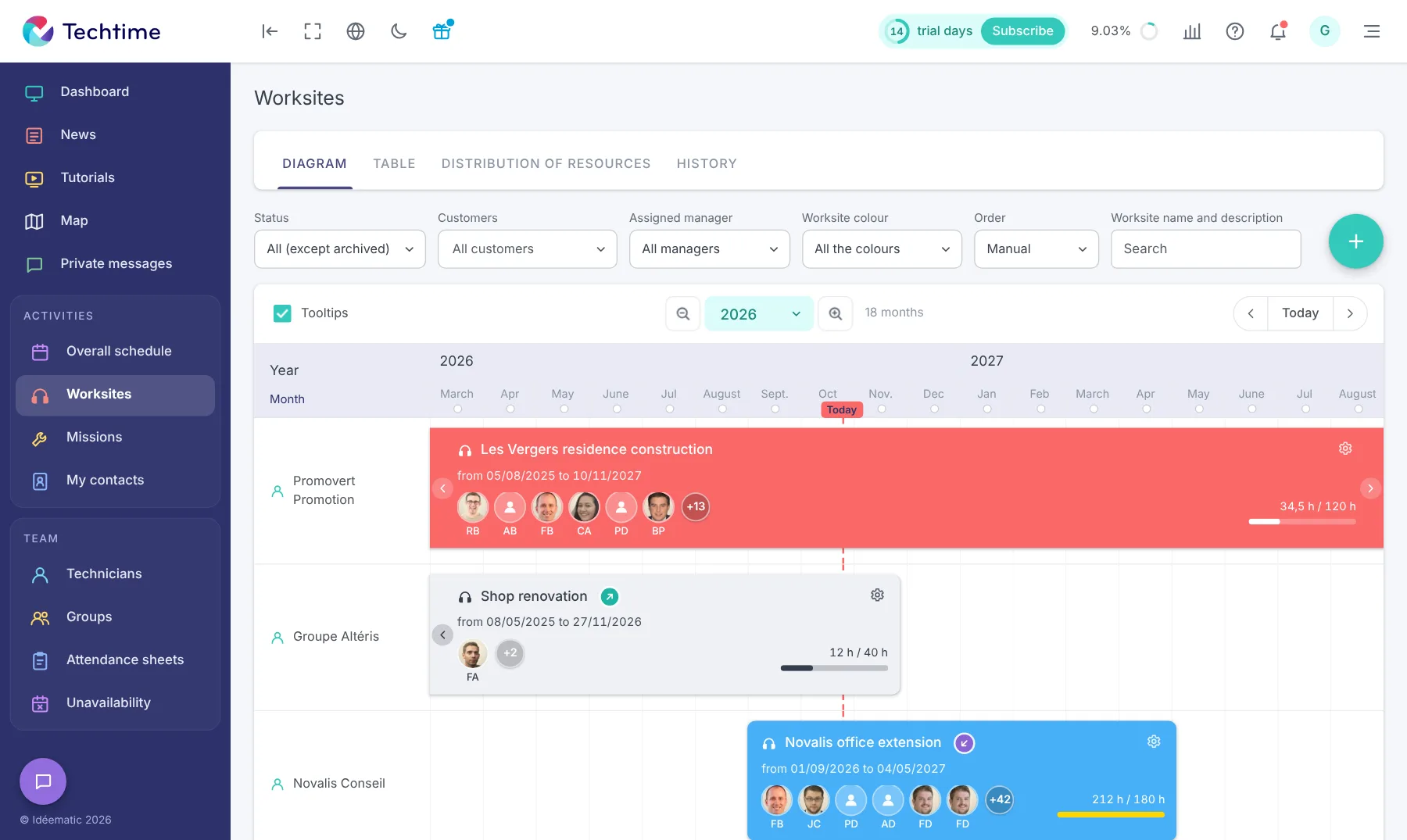
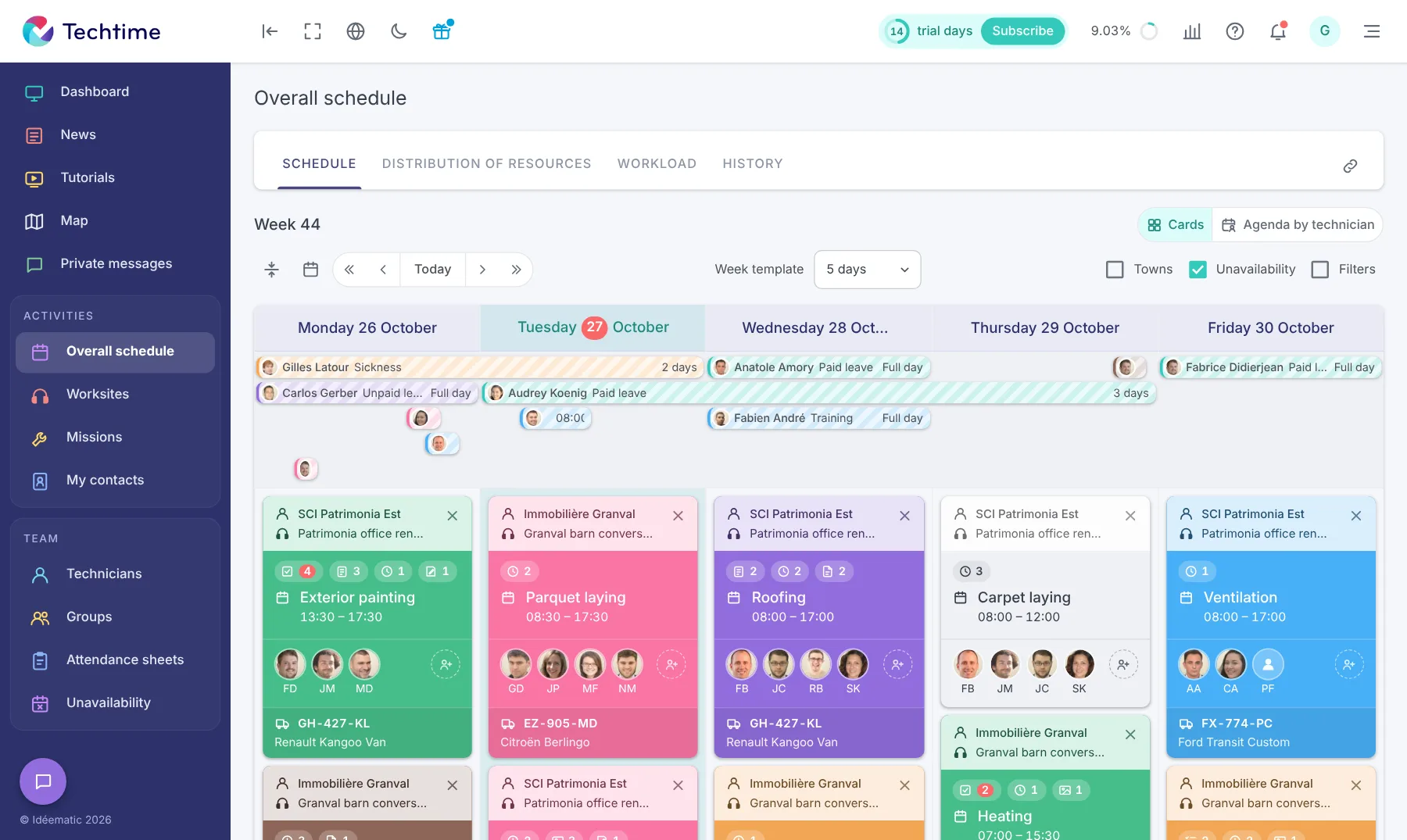
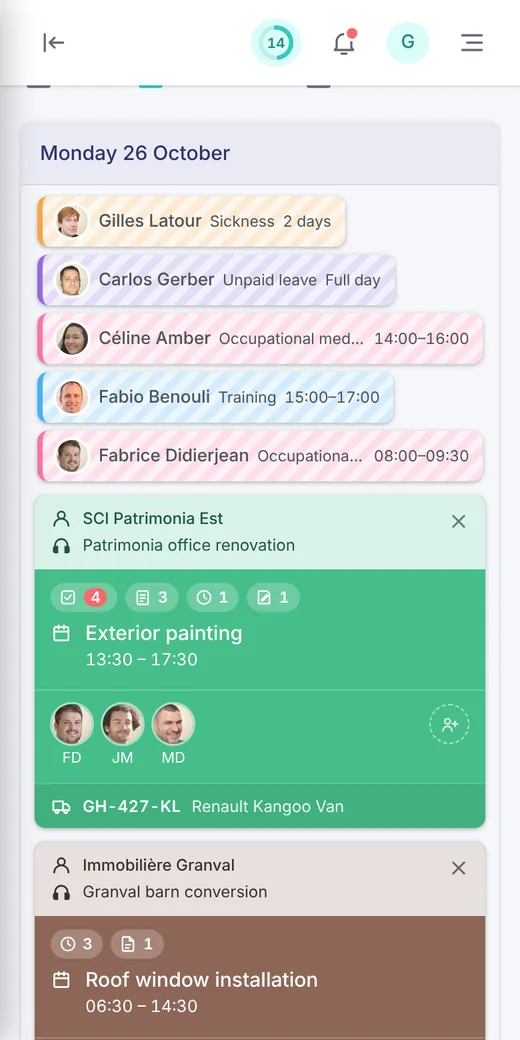
At Techtime, we are proud to present a feature that perfectly illustrates one of our major strengths: enabling several construction companies (tradespeople, subcontractors, architects, etc.) to work together on the same worksite while each keeps its own workspace.
In practice, each professional has their own Techtime account and can invite a partner to join the worksite they have created. When a company accepts the invitation, the project immediately appears in its own Techtime environment, where it can view, create or edit tasks on the schedule. The architect, the main contractor and the subcontractors thus share the progress of the works in real time, without being limited to a simple “guest role”.
- 1Creationeach company has its own account
- 2Invitationof a partner to the worksite
- 3Acceptancethe project appears in their account
- 4Synchronisationeveryone stays in control
This decentralised and two-way approach gives you true collaborative management: everyone stays in control of their projects while remaining perfectly in sync with the other contractors. Techtime offers this unique approach, designed to meet the new challenges of the construction sector.
Frequently asked questions
Why should construction tradespeople collaborate?
To combine complementary skills, carry out more complex projects, avoid errors and delays and access new business opportunities, while better satisfying customers.
How do you find partner tradespeople?
At face-to-face events, within tradespeople’s cooperatives (purchasing, marketing or production and services) or through social media, by working on your brand image.
How do you share a worksite between several companies with Techtime?
Each professional has their own Techtime account and can invite a partner to the worksite they have created. Once the invitation is accepted, the project appears in the partner’s environment, where they can view, create or edit tasks on the schedule.
Don’t wait any longer. Join us by booking a live demo of the app.