


Please note: this article refers to French regulations and standards.
Between 2021 and 2022, France’s construction bad-weather leave fund recorded a total of 4,650,180 hours of work stoppage due to bad weather. According to the report , “rain accounts for most of the compensated stoppage hours declared”, i.e. 3,906,608 hours. The 2023-2024 season brought above-average rainfall to most of the country, according to Météo-France. How do you compensate employees when they cannot work on outdoor worksites because of violent or prolonged bad weather? Find out how to benefit from bad-weather leave in construction.
In brief
Bad-weather leave compensates construction employees in France when weather conditions make work dangerous or impossible. The employer decides on the stoppage after consulting the works council (CSE), pays the employee 75% of their gross hourly wage from the second hour of stoppage, then is reimbursed by their bad-weather leave fund. The employee must have worked 200 hours in the previous 2 months, up to 9 hours a day, 45 hours a week and 55 days a year.
1Bad-weather leave in construction: which companies are concerned?
The sectors covered by the bad-weather scheme are set out in Article D5424-7 of the French Labour Code. The following businesses are among the activities covered by the bad-weather unemployment scheme (source):
- Masonry: moisture can weaken mortar or bricks.
- Earthworks: rain soaks the ground, making it hard to compact. Employees may also be exposed to landslides. These difficulties are felt in public works.
- Concreting: downpours can alter the water/cement ratio of concrete, making it less strong.
- Plumbing: water damages pipes at extreme temperatures (cracks or deformation). This can affect other equipment such as heating circuits.
- Metalwork: moisture causes iron or steel parts to rust or corrode. Temperature changes deform the metal by making it contract or expand.
Want to know more? Read our article on the NAF code to identify your construction trade more easily.
What are the construction employer’s obligations for paying bad-weather leave?
Bad weather means weather conditions that endanger the safety of construction employees. The employer or their representative on the worksite declares the work stoppage if the works council (CSE) agrees.
If so, the employer checks that their employees meet the conditions to receive their bad-weather allowances. They then send their construction bad-weather leave fund two additional documents within 1 month of resuming work:
- A declaration of the number of days already compensated since the start of the calendar year.
- The work stoppage declaration form, together with the request for reimbursement of the allowances paid to employees.
What are construction employees’ obligations during a bad-weather stoppage?
Even during a bad-weather stoppage, the employee must remain available at all times. They cannot refuse to carry out work, even during bad weather, if it takes place inside a building. Their employer may also ask them to carry out work of general interest on behalf of public authorities:
- cleaning and clearing roads or drains;
- repairing infrastructure;
- installing temporary barriers;
- etc.
If they refuse, the employee loses their right to compensation. The employer or the project manager’s representative on the worksite decides when work resumes once conditions are favourable again. The employee must keep informed by going to the company’s head office or the worksite entrance (source).
- 1Stoppagedecided by the employer, after consulting the CSE
- 2Allowance75% of gross hourly wage
- 3Declarationto the fund within 1 month of resuming work
- 4Reimbursementby the bad-weather leave fund
2How does the construction bad-weather leave fund work?
The bad-weather leave fund (CiBTP) is a regional body that manages paid bad-weather leave in the building sector. It pools losses and reimburses the allowances employers pay to employees whose work has stopped. It spreads the costs according to companies’ contributions, reducing their individual risks. The aim is to ease the company’s cash flow, which can suffer from delivery delays due to bad weather.
Bad-weather leave payments: conditions for employees
Employees must meet several conditions to receive their bad-weather allowance:
- Having worked 200 hours in the 2 months before the stoppage. This threshold ensures employees are genuinely active and therefore a fair distribution of resources.
- Proving they were present on the worksite when work stopped.
- Not holding another salaried job during the bad-weather leave.
- Not exceeding the maximum number of bad-weather allowances (55 days a year).
Worked in the 2 months before the stoppage
And 45 hours a week maximum
Maximum number of allowances per calendar year
On the worksite at the time of the stoppage
Calculating the bad-weather allowance
The daily bad-weather allowance is paid from the second hour of stoppage, after a waiting period. It amounts to 75% of the gross hourly wage received the day before the stoppage. Only ancillary bonuses and performance bonuses are included in the calculation. Bonuses covering expenses or risks, as well as overtime premiums, are excluded (source).
The number of compensable hours cannot exceed the following limits:
- 9 hours a day;
- 45 hours a week;
- 55 days per calendar year.
If several stoppages occur in the same week, the employer groups them in a single declaration. The waiting period applies only once (source).
Contributions required for reimbursement by the bad-weather leave fund
The employer must contribute to a construction bad-weather leave fund to be reimbursed for bad-weather allowances. Contributions depend on the company’s payroll and its risk of exposure to bad weather. A ministerial order sets the rates for each campaign from 1 March of year N to 31 March of year N+1.
For the 2024-2025 campaign, the allowance threshold is €93,204, €3,036 more than the previous campaign. If payroll exceeds this ceiling, bad-weather contribution rates vary by company (see table below).
| 2024-2025 campaign (source) | ||
|---|---|---|
| Type of company | Contribution rate | Contribution amount |
| Structural work or public works companies | 0,68 % | 633,79 € |
| Finishing trades companies | 0,13 % | 121,17 € |
Note: even if payroll is below the allowance threshold, the construction company must still file its declaration with its leave fund.
The fund reimburses the allowances paid by construction companies using the following formulas (source):
| Companies whose declared wages are less than or equal to 3 times the allowance threshold | Companies whose declared wages are more than 3 times the allowance threshold | |
|---|---|---|
| Reduced-rate coefficient (first 6 compensated hours of stoppage) | [(declared wages for the campaign – allowance) x 100] x 10% | |
| Full-rate coefficient (from the 8th hour of stoppage) | [(declared wages – allowance) x 100] x 90% | [(declared wages – allowance) x 100] x 85% |
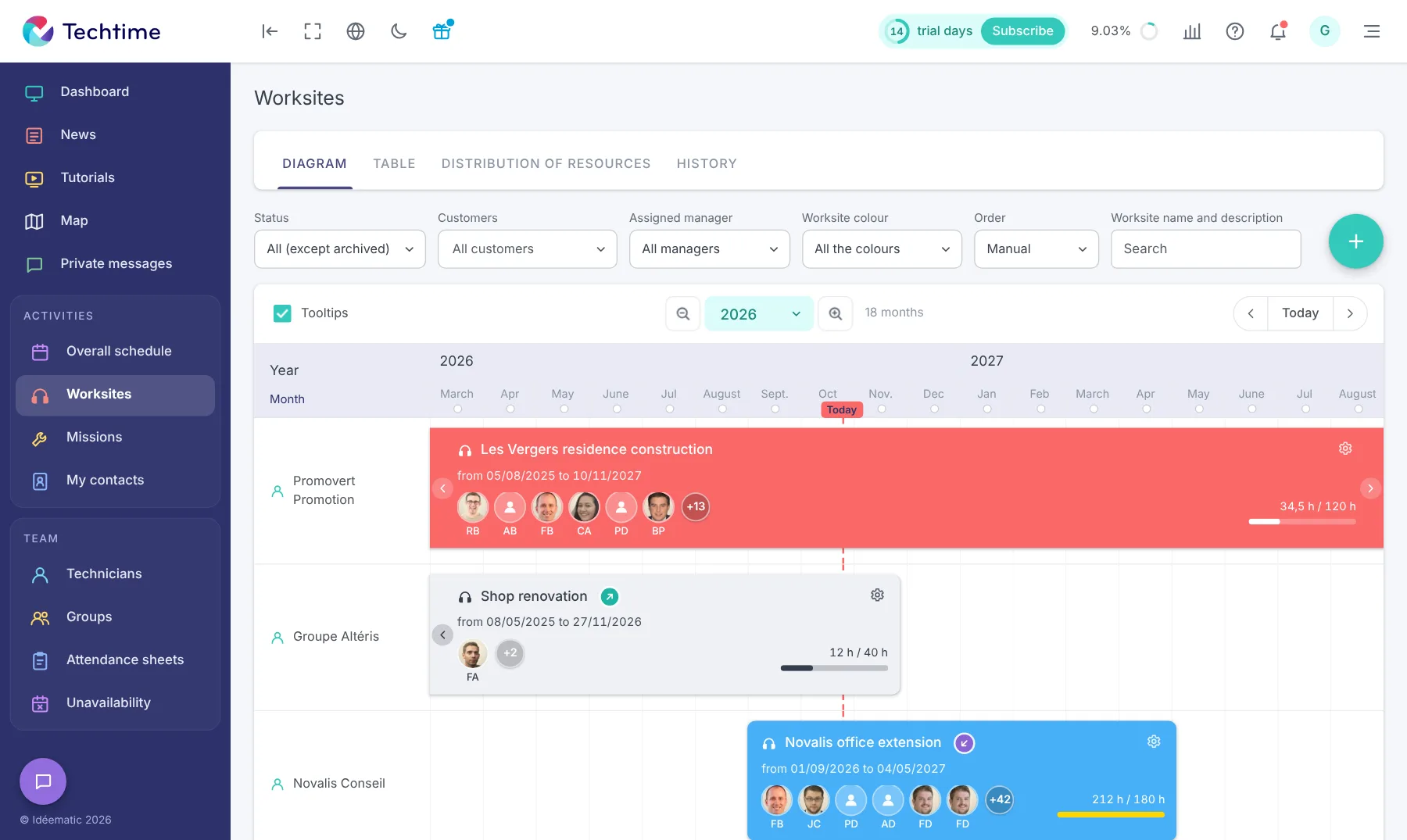
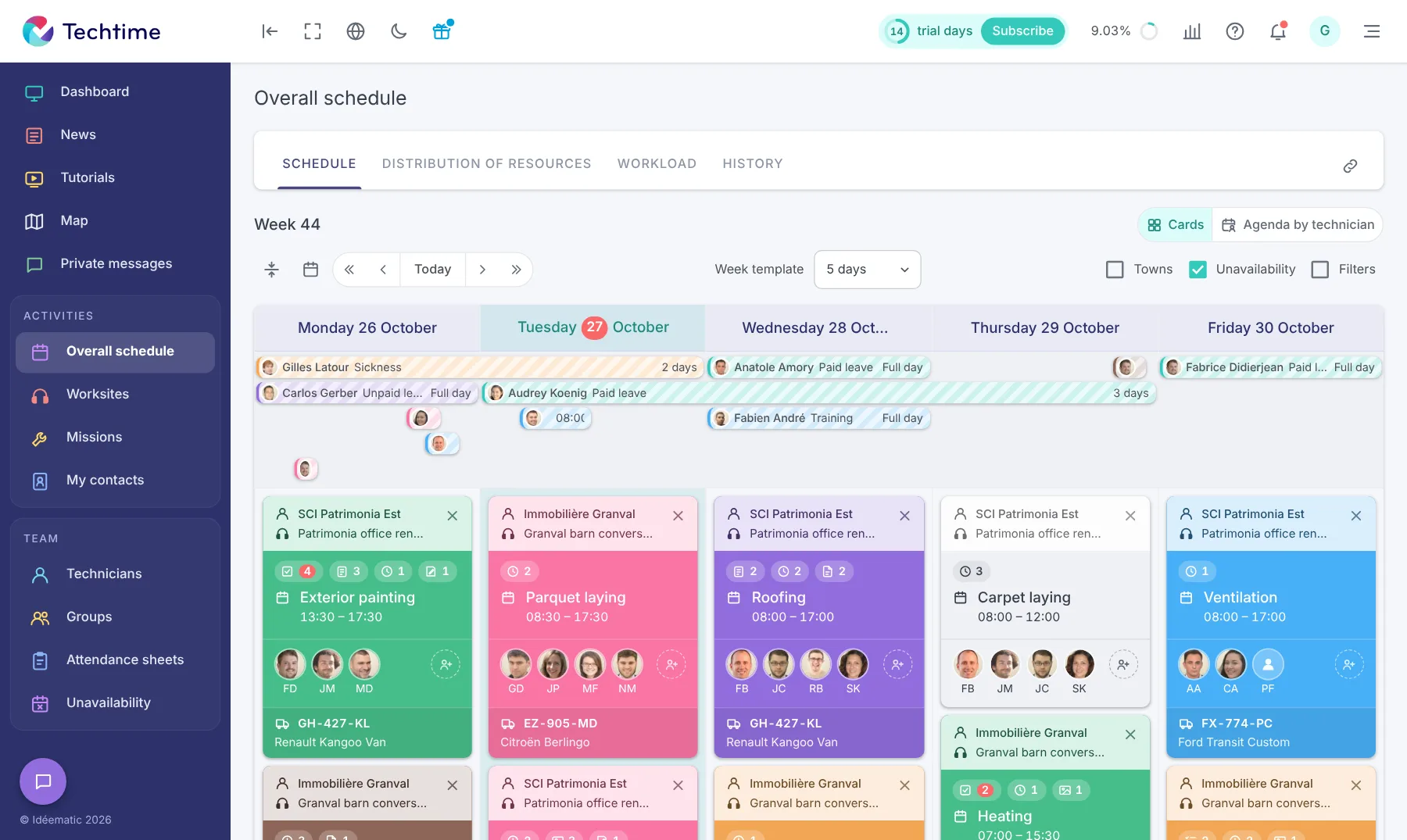
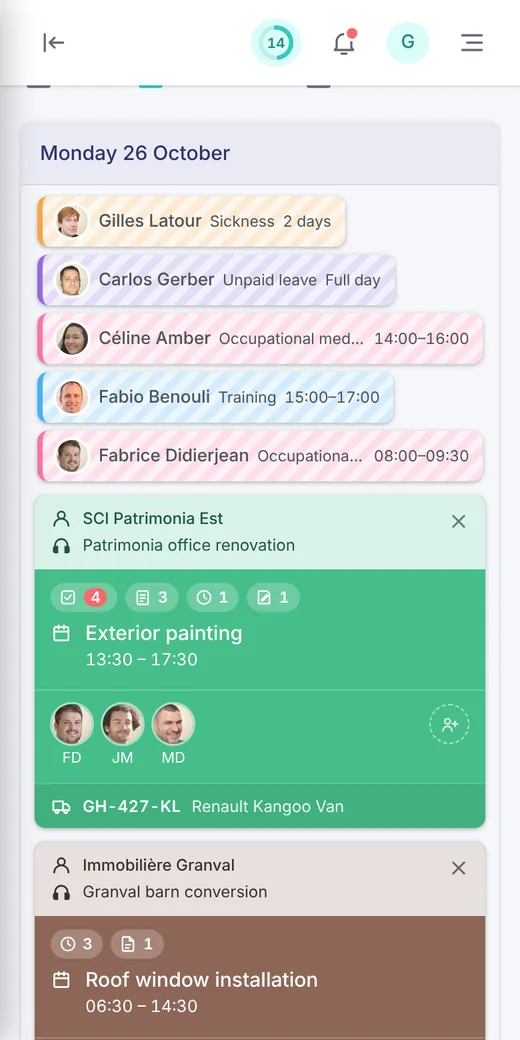
Bad-weather leave is paid when weather conditions make outdoor work dangerous for worksite employees. If you are an employer, declare your work stoppage to the construction bad-weather leave fund for your area. Reimbursements vary according to your contributions and the number of stoppage hours to be compensated. Approve your timesheets in real time and adapt your technicians’ work to the weather with our Techtime app.
Frequently asked questions
Who can receive the bad-weather allowance?
Employees of construction companies covered by the scheme who have worked at least 200 hours in the 2 months before the stoppage, were present on the worksite when work stopped and do not hold another salaried job.
How is the bad-weather allowance calculated?
It amounts to 75% of the gross hourly wage received the day before the stoppage and is paid from the second hour of stoppage, up to 9 hours a day, 45 hours a week and 55 days per calendar year.
How does the employer get reimbursed?
Within a month of resuming work, they send their bad-weather leave fund the declaration of days already compensated and the stoppage declaration form with the reimbursement request. To do so, they must contribute to the fund.