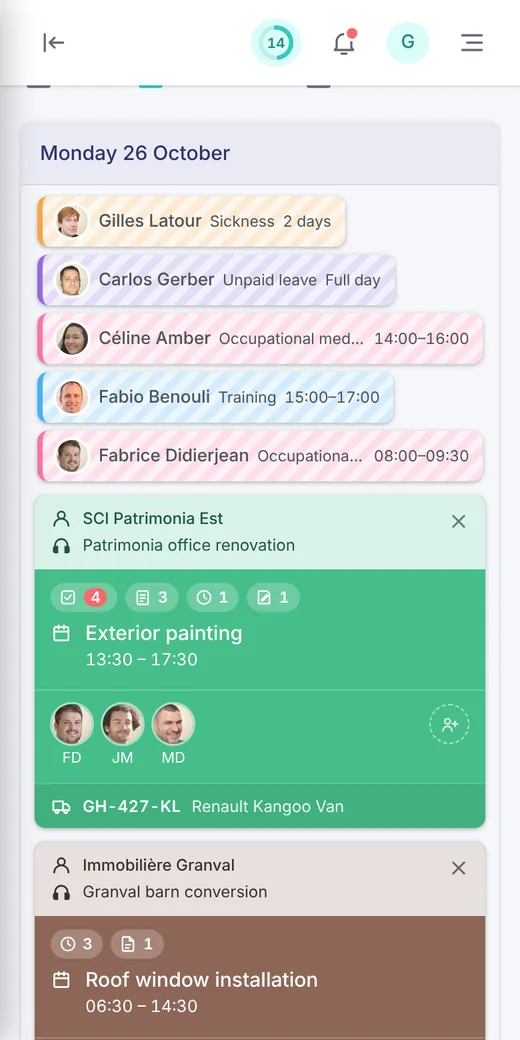



In the building trade, software is only worth something if teams actually use it. On a worksite or a job, nobody has time to dig through five menus for a piece of information or fill in endless screens. For a tradesperson, a good tool must save time, simplify team tracking and make communication between the office and the field easier. That is why simplicity has become one of the most important criteria for choosing construction software.
In brief
In construction, software is only worth something if teams actually use it. Overly complex tools that stack up modules push field teams to re-key information or go back to the paper notebook. Simple, mobile-first software puts everyday actions first (schedule, address, photo, hours, report), stays usable despite noise, gloves or a patchy connection, and makes data entered live reliable.
1When complexity holds back construction’s digital transition
The sector’s digital transformation is progressing, driven by the need to better organise schedules, teams, documents and worksite tracking. The FFB (French Building Federation) even has a section on digital construction and presents management software as a way to centralise several of building companies’ everyday tasks.
Yet many initiatives fail for lack of adoption: cumbersome interfaces, overloaded menus, endless configuration.
In the field, the site foreman has neither the time nor the connection to battle with complex screens. Field teams sometimes end up re-keying information by hand or going back to the paper notebook.
It is less a question of skills than of usability: a complicated tool, however powerful, will remain underused.
Whatever you don’t simplify at the start, you will pay for later in lost time and motivation.
2Too many features, not enough action: the “all-in-one” trap
In the name of centralising everything, some software stacks up modules: quotes, invoicing, scheduling, reporting, HR, stock, worksite tracking… On paper, it all looks manageable. On a real worksite, every extra screen can become an obstacle.
A typical building maintenance team illustrates the problem well: to log a job, you sometimes have to go through three menus and two screens. After a few days, only the most digitally confident people keep using it properly. The others look for shortcuts or go back to their old habits.
For many tradespeople, the priority need is simpler: knowing who is working where, tracking progress, collecting hours, passing on instructions and keeping a reliable record of jobs.
Simplicity is not about removing features: it is about focusing work on what really matters.
- Quotes, invoicing, scheduling, reporting, HR, stock…
- Complex screens that are hard to learn
- Re-keying or back to the paper notebook
- Knowing who is working where
- Tracking progress, collecting hours
- Passing on instructions, keeping a reliable record
3Simplicity, a lever for efficiency and buy-in
Building companies are no longer looking for “the most complete” but for “the most used”. Above all, simplicity ensures that the investment is actually used by teams.
Clean interfaces that encourage responsiveness
A simple application is understood from the first use. It puts first the actions that really come up every day: checking your schedule, finding an address, sending a photo, entering your hours, writing a report or flagging important information from the field.
On a worksite, that changes everything: data entered live stays reliable and usable. It is one of the principles of managing worksite and job activities: capturing information where it happens.
Mobile-first, the key to simplicity in the field
In the field, software is rarely used in ideal conditions: noise, urgency, gloves, outdoor glare, a patchy connection, moving between two worksites or two jobs. Simple construction software must therefore be designed for quick, sometimes partial, but always reliable use.
The smartphone has redefined usage standards. Thinking “mobile-first” means designing for field teams first: readable text, short actions, clear buttons and screens that can be understood in seconds.
A site manager or technician must be able to check their schedule, add a photo, enter important information or approve a stage without going back to the office. It is this ease of access that makes information reliable and saves time in day-to-day organisation.
Faster adoption, fewer errors
Research by Anact (the French agency for improving working conditions) on digital transformation points out that the success of a digital project depends not only on the tool, but also on the conditions in which it is used, how teams take ownership of it and how well it fits the real work.
Schedule, address, photo, hours, report: everyday actions first
Usable despite noise, gloves, glare or a patchy connection
Data entered live stays reliable and usable
4Smooth communication and real-time tracking: the visible gains
When everyone knows where to find information, calls to the office decrease and data entry errors go down.
Well-designed mobile screens can replace heavy Excel files. Management can see progress and field teams send their reports live.
This smoother flow of information lets the business owner, site manager or team leader manage the business with fewer calls, less re-keying and fewer oversights.
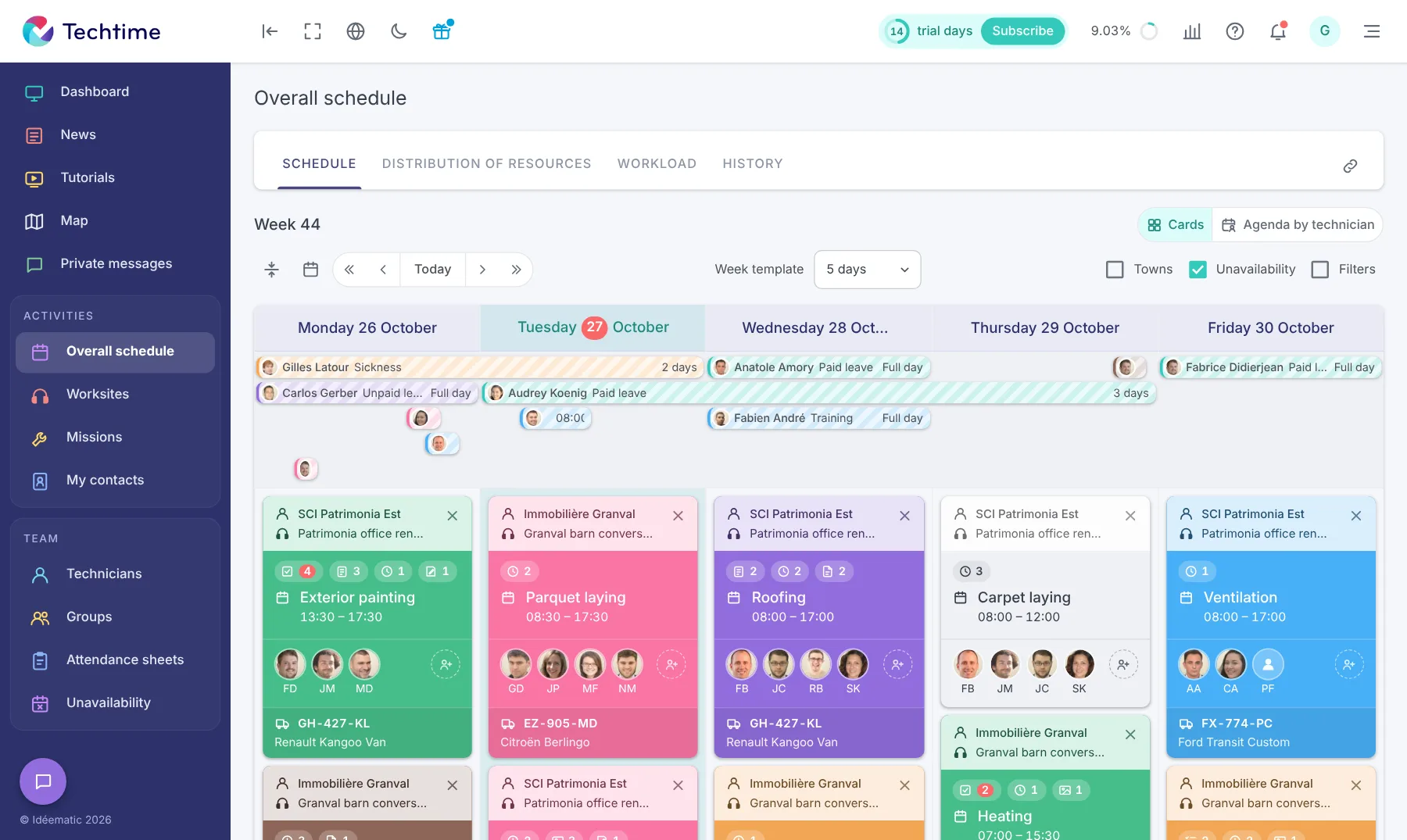
A concrete example: when a job is rescheduled, the office can update the schedule and automatically notify the teams concerned. The technician finds the address, instructions and customer information without waiting for a call, a text message or a new PDF.
5Techtime: simplicity as a design method
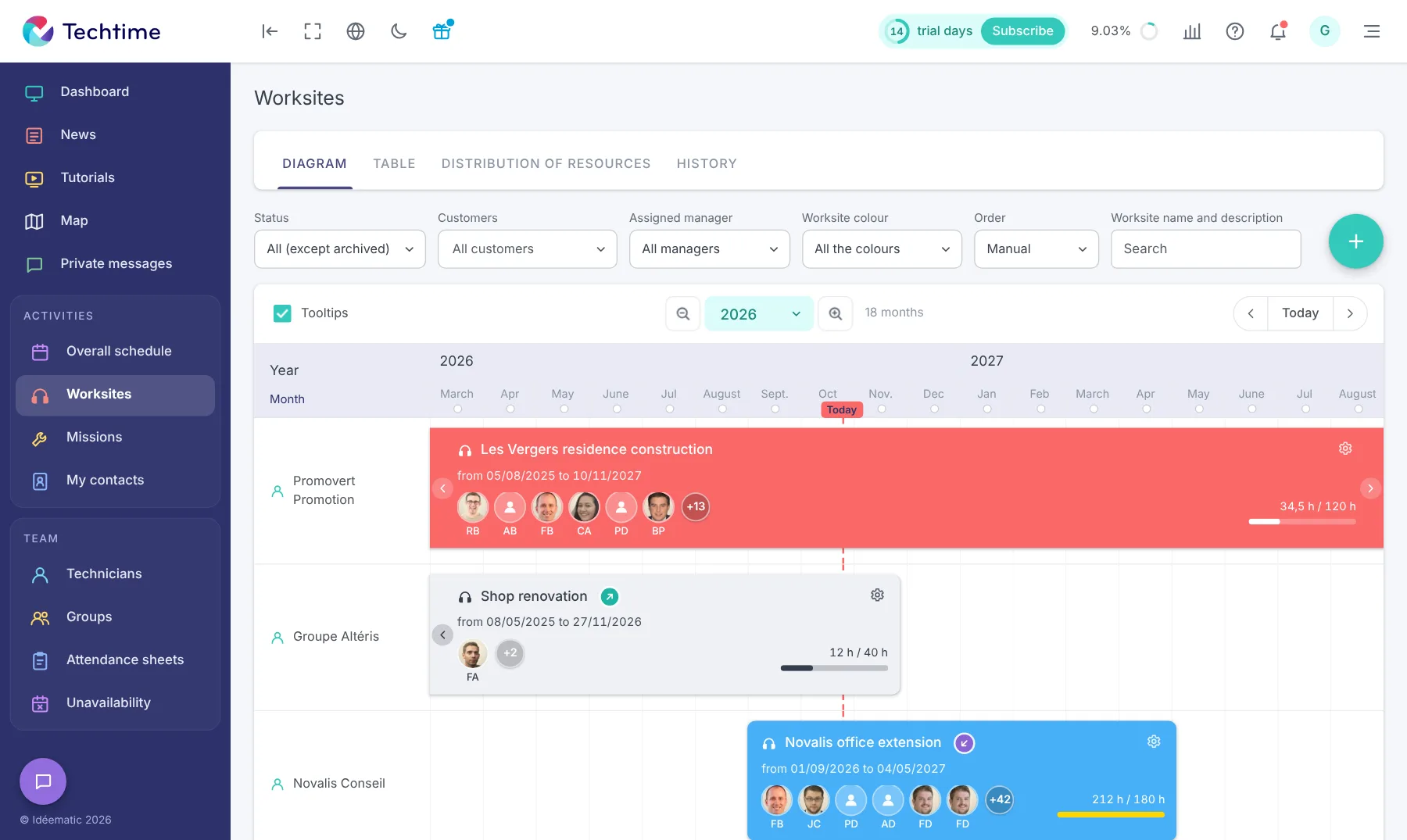
Designed in Strasbourg, Techtime embodies this philosophy. The application focuses on what is genuinely useful to construction tradespeople: sharing the schedule between the office and the field, tracking jobs, reporting hours, sending reports, adding photos and finding worksite information from a mobile.
The aim is not to stack up features, but to remove unnecessary steps, make communication between teams smoother and let everyone focus on the real work.
User feedback helps refine the tool over time: simpler screens, more logical shortcuts, better readability of important information. This continuous approach makes Techtime an application that evolves with the needs of the field, not against them.
Customer story: simplicity adopted from day one
Gaïa says as much in its customer story: the technicians took to the tool more easily than expected, with better real-time visibility of schedules, teams and jobs (GAIA x Techtime: better visibility in real time).
This kind of feedback shows that an accessible tool is not a watered-down version, but an environment suited to the reality of construction.
Key takeaways
For a construction tradesperson, the right software is not the one that promises everything. It is the one teams actually use, without wasting time, from the office as well as in the field.
Simplicity is therefore not a detail in software usability. It is an essential condition for bringing everyone on board, making information reliable, limiting re-keying, tracking worksites and jobs better, and saving time every day.
Before choosing a tool, the real question to ask is simple: will my teams be able to use it easily every day, and will they see the point of doing so?
To find out more, read our article on managing worksite and job activities with Techtime.
Frequently asked questions
Why is simplicity decisive in construction software?
Because software is only worth something if it is used. On a worksite or a job, nobody has time to dig through several menus for information: an overly complex tool gets bypassed, and information is re-keyed or written down on paper.
What is “mobile-first” software?
Software designed first for field teams: readable text, short actions, clear buttons and screens that can be understood in seconds, usable despite noise, gloves, outdoor glare or a patchy connection.
What does a tradesperson need most from software?
Knowing who is working where, tracking progress, collecting hours, passing on instructions and keeping a reliable record of jobs.
Article updated in May 2026.