


Please note: this article refers to French regulations and standards.
According to Le Moniteur, the French trade body Evolis reports a 21% drop in construction equipment sales. This fall in investment, which looks set to continue into 2025, is linked to political uncertainty and sluggish economic growth.
For your part, you want to counter falling orders but lack the equipment to take on new worksites? What if the solution lay in hiring rather than buying? Discover the features of a worksite equipment hire contract.
In brief
Hiring worksite equipment rather than buying it preserves cash flow: it suits small businesses or occasional needs, while buying makes sense for regular use. Hiring gives access to up-to-date, well-maintained equipment in flexible quantities and lets you try equipment before buying it. The hire contract must describe the equipment and its condition, the rent and payment frequency, the duration, and warranty, maintenance and dispute resolution clauses. Suitable insurance completes the protection.
1Hire or buy worksite equipment: which is best?
If your business has strong enough cash flow, it is better to buy your worksite equipment. Prices range from a few euros for simple accessories to several thousand euros for heavy equipment (concrete skip, air compressor, etc.).
Upfront costs can be high. However, buying becomes necessary if you plan to use the equipment regularly. If it has a long enough lifespan, you optimise its purchase cost through depreciation. Of course, you need a large enough, suitable storage space for your equipment (containers, sheds, warehouses, etc.). Maintaining and securing these spaces adds logistics costs, but your net book value (NBV) increases.
Worksite equipment hire is particularly suited to small businesses that lack sufficient cash flow. But it can also suit large companies that do not need equipment continuously, for reasons of flexibility or cash management. This service meets the needs of temporary construction projects, reducing storage and maintenance costs. However, costs can quickly add up if the hired equipment is used too often (Actemis Manutention).
- High upfront costs
- Cost optimised through depreciation
- Maintenance and storage at your expense
- Up-to-date, well-maintained equipment
- Flexible choice and quantities
- Try before you buy
2What are the benefits of hiring construction equipment?
Hiring worksite equipment does not just meet a temporary need. Whether your cash flow is tight or you don’t want to clutter your storage space, this strategy offers other benefits.
From reliable professionals, you get access to up-to-date, well-maintained worksite equipment that improves the quality of your worksite. These partners may be hire companies (such as Kiloutou or Loxam), online suppliers or colleagues in your network. Hire companies have quality equipment, but their rates are higher, although they decrease with the length of hire. On Kiloutou, a cordless impact driver costs €21.50 a day if you hire it for 1 to 4 days. Its rate then falls to €11.90 a day beyond 21 days. Online hirers offer more competitive prices, but no personalised service, unlike hire companies.
Hiring lets you be flexible in the choice and quantity of equipment you need. You can thus take on more ambitious worksites than would have been possible without the equipment (Travaux Chantier). In addition, you don’t have to worry about maintenance or repairs. These are the lessor’s responsibility.
Finally, hiring equipment is a good way to test it on site before buying it. As it is a long-term investment, you make sure it really meets your needs so you don’t waste your cash. This choice is also part of an eco-responsible approach, in particular to reduce worksite waste (Niçoise de Location).
3Worksite equipment hire contract: what should it contain?
A construction hire contract must be clear and cover every aspect of your use of the equipment. The following sections must be included to protect you from possible disputes.
Full description, condition report on delivery and return
Rent excl. VAT per calendar day, frequency, any deposit
Open-ended by default, unless a duration is stated
Warranty, maintenance and repair, dispute resolution
Description and condition of the hired equipment
After the description of the parties signing the contract comes the description of the hired equipment, with as many details as possible: technical specifications, model, year of manufacture, any accessories or parts supplied, or engine power. All these items can be accompanied by photos to certify the lessor’s good faith. This way, you make sure you have the right equipment to carry out your worksite efficiently and safely.
You can hire a wide range of equipment for construction or renovation (Batiadvisor):
- machinery (diggers, bulldozers, graders, etc.);
- machines (drilling rigs, mobile cranes, etc.);
- tools (hammers, circular saws, trowels, etc.);
- drones for the worksite OPC to manage the worksite schedule properly.
When the equipment is handed over to the hirer, or returned to the lessor, make sure you draw up a report on its condition. Any damage noted on the return report is the hirer’s responsibility (Juristique)
Hire price and payment of invoices
The parties agree on the rent expressed in euros excluding VAT per calendar day, with VAT added. They set the payment frequency (monthly or weekly) and method (cheque, cash or automatic transfer with a SEPA direct debit mandate).
The hire price may include delivery, installation, cleaning or maintenance costs payable by the hirer or the lessor. The lessor is entitled to ask for a deposit to protect against any damage to the equipment or its theft on the worksite.
Hire period and return of construction equipment
By default, the contract is open-ended unless the hire period is stated explicitly. It can range from several weeks to a few months, counted in calendar days, and may be renewable through extension terms. These clauses are essential to protect yourself from penalties if the worksite is delayed. If a party wishes to end the contract early, it must send a registered letter with one month’s notice.
Other clauses in the construction hire contract
Other clauses protect the parties in a long-term hire. The most important are (Notaire-nice):
- The warranty clause protects against hidden defects in the equipment.
- The maintenance and repair clause divides tasks between the lessor and the hirer.
- The dispute resolution clause sets out the different ways of resolving conflicts, from mediation to legal action.
4What are the parties’ obligations under the hire contract?
Depending on the contract terms, each party has its own obligations. These are defined in Articles 1708 et seq. of the French Civil Code. The lessor must supply the equipment on the agreed date and in good working order. In general, they are responsible for maintaining and repairing their equipment during the hire period.
For their part, the hirer must hold a licence to operate construction machinery. They ensure their own safety and that of their staff through a prevention plan or a PPSPS (specific health and safety plan). They may not use the hired equipment for purposes other than the works set out in the contract. Routine maintenance and minor repairs to the worksite equipment are their responsibility.
5Which insurance policies go with the hire contract?
Various insurance policies protect you against the risk of damage to or loss of equipment. The most recommended are:
- insurance against hidden defects;
- breakage and equipment theft insurance;
- contractors’ all-risks insurance (covering fire, explosion or bad weather);
- tenant’s third-party liability insurance (covering damage caused to third parties).
6Conclusion
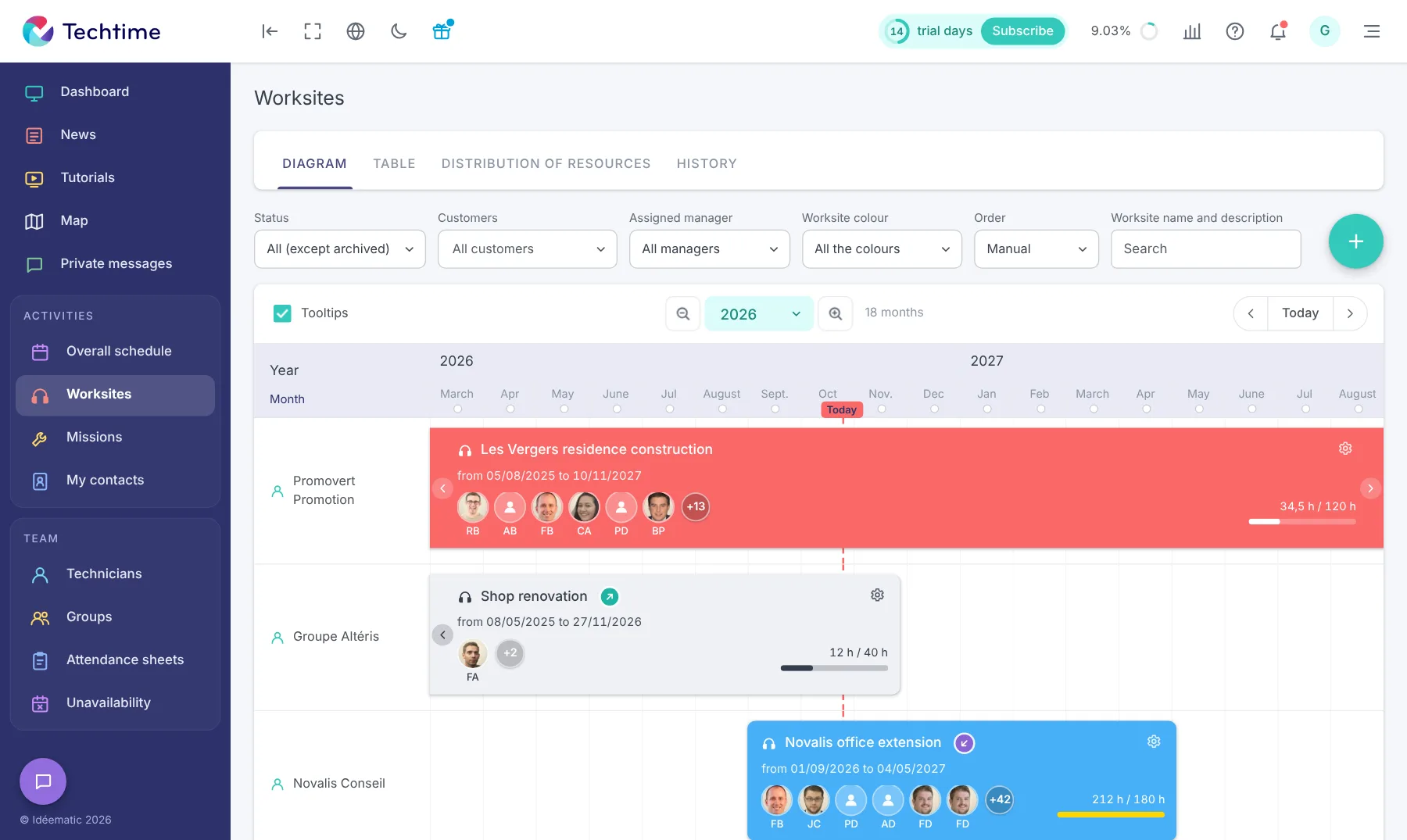
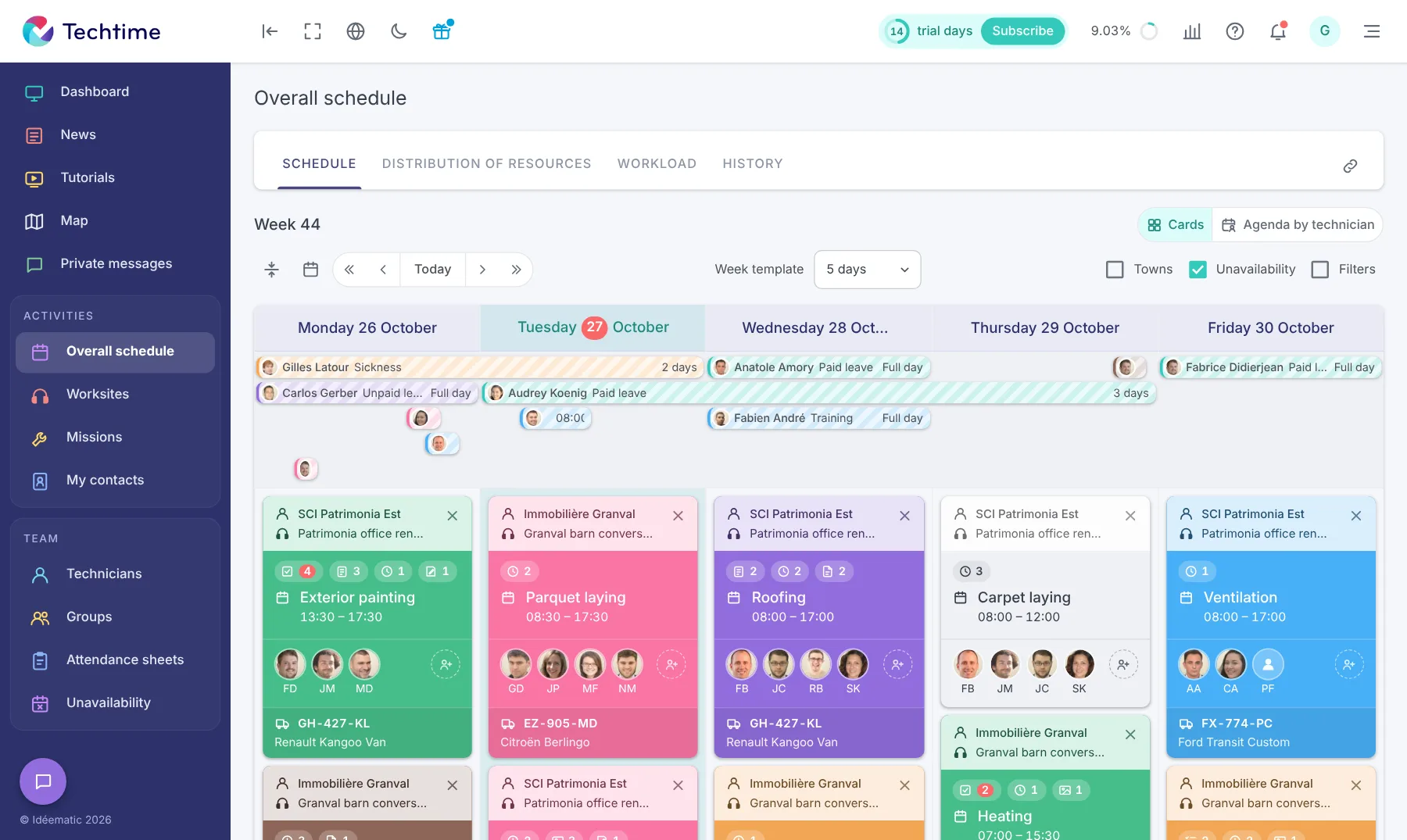
Hiring your worksite equipment is a winning strategy to preserve your cash flow and benefit from high-performance equipment without maintenance costs. It gives you considerable flexibility to stay competitive. However, for it to go smoothly, the hire contract must be well framed with essential clauses. And ask yourself: will you use this equipment in the short or long term? The worksite schedule in the Techtime app can help you plan your future worksites and investments more effectively. Don’t hesitate to contact our experts in supporting construction business owners.
Frequently asked questions
Should you hire or buy worksite equipment?
Buying suits you if your cash flow is solid and you use the equipment regularly. Hiring suits small businesses with limited cash flow, occasional needs or testing equipment before buying it.
What should a construction equipment hire contract contain?
A description of the equipment and its condition on delivery and return, the rent excluding VAT per calendar day and payment frequency, the hire period and return conditions, as well as warranty, maintenance and dispute resolution clauses.
Which insurance should you take out for hired equipment?
Insurance against hidden defects, breakage and theft insurance, contractors’ all-risks insurance and tenant’s third-party liability insurance.