


Please note: this article refers to French regulations and standards.
The CCAP (special administrative clauses) is a contractual document that adapts the general rules to a specific worksite. In French public contracts, it is part of the tender documents. In private contracts, it is one of the contract documents when it is provided for and accepted by the parties. On the ground, it applies from the signing of the contract and structures the whole life of the worksite: start, execution, payment and handover. When the worksite starts, certain administrative documents, such as the worksite opening declaration, also help secure the launch of the works when the project requires planning permission. It is generally drawn up on behalf of the client, often with the help of the project manager, a quantity surveyor, a legal expert or a specialist lawyer.
The CCAP is organised into articles and must cover every situation encountered on a worksite. In particular, it specifies (Ercolé Immobilier):
- the purpose of the contract;
- the identity of the parties;
- the hierarchy of contract documents;
- payment terms;
- completion deadlines;
- penalties;
- management of subcontractors;
- insurance;
- handover conditions.
On a multi-package worksite, it clarifies responsibilities between contractors and helps you make your worksite a success through collaboration between tradespeople.
According to the French Building Federation (FFB), the NF P 03-001 standard can serve as a contractual basis in private building contracts, provided it is expressly included in the contract documents. Otherwise, it does not automatically apply to the parties.
In brief
The CCAP (special administrative clauses) adapts the general rules to a specific worksite: purpose of the contract, parties, hierarchy of documents, payments, deadlines, penalties, subcontracting, insurance and handover. In private contracts, it falls under the French Civil Code and freedom of contract; the NF P 03-001 standard only applies if it is included in the contract. Before signing, check above all the order of priority of documents, deadlines and penalties, financial terms, subcontracting, handover and the balance.
1What other specifications can apply to a worksite?
Other specifications exist in construction, and it is important to tell them apart correctly to avoid serious contractual errors.
The CCAG: general administrative clauses
The CCAG (general administrative clauses) sets out the general administrative terms applicable to public works contracts that expressly refer to it. It is approved by ministerial order. In private building contracts, the role of general administrative framework can be played by the NF P 03-001 standard when it is included in the contract documents.
The key point lies in derogations: when a CCAP clause departs from the general framework, it must be clearly identified, usually in a summary article at the end of the document. Otherwise, some clauses may be challenged (Batiprix).
On a commercial building worksite, the general framework provides for standard payment terms. The CCAP introduces a specific rule linked to the progress of the technical packages, but without clearly identifying it as a derogation. Without this explicit wording, the clause may be challenged by the company. In case of ambiguity, interpretation will depend in particular on the nature of the contract: a negotiated contract or a standard-form contract. In the latter case, doubt may be interpreted against the party that proposed the contract, as stated in Article 1190 of the French Civil Code.
The CCTG: general technical clauses
Under Article R2112-2 of the French Public Procurement Code, the CCTG (general technical clauses) brings together the general technical rules applicable to a type of works. On the technical side, it plays a role comparable to the CCAG on the administrative side: it sets general terms, but only when a contract refers to it.
In private contracts, it is rarely used as a direct contractual document. It mainly operates in the background, through the CCTP, which adopts its requirements or adapts them to the project.
The difference with the CCAP is twofold: the CCTG is neither specific to the worksite nor contractual by default. It serves as a technical basis, while the CCAP sets the legal rules binding on the parties.
The CCTP: special technical clauses
The CCTP defines precisely the works to be carried out: materials, construction methods, expected performance. It is the technical reference for site teams.
The difference with the CCAP lies in their nature: the CCTP describes what must be built, while the CCAP specifies how the contract is performed contractually (Obat).
In the event of a contradiction between documents, the order of priority set in the contract is decisive. Hence the importance of checking that the CCAP clearly sets out this hierarchy. It means that a contractual point (deadline, liability, approval) can take precedence over a purely technical interpretation.
General administrative clauses for public works contracts
How the contract is performed on this specific worksite
General technical rules, rarely contractual in private contracts
What must be built: materials, methods, performance
2Public or private contract: what differences in performing the CCAP?
The main distinction between a public contract and a private contract lies in their legal framework.
In public contracts, the CCAP falls within the framework of the French Public Procurement Code, which imposes strict rules for awarding and performing contracts (equal treatment, transparency, formal procedures). It is generally based on the CCAG Travaux, approved by order (in particular the order of 30 March 2021), which sets a common contractual base.
Conversely, in private contracts, the CCAP falls under the French Civil Code, in particular Articles 1103 et seq. on the binding force of contracts. The parties have wide freedom to define their commitments, provided they comply with mandatory public-policy provisions. In practice, this freedom of contract makes the CCAP essential to secure the conditions of performance, often alongside the NF P 03-001 standard.
Here is a summary table:
| Point | Public contract | Private contract |
|---|---|---|
| Main framework | French Public Procurement Code | French Civil Code + contract |
| CCAG | Possible if the contract refers to it | NF P 03-001 possible if included in the contract |
| Freedom of contract | Regulated | Wider |
| Documents | RC, AE, CCAP, CCTP, BPU/DPGF, etc. | Quote, contract, CCAP, CCTP, drawings, general terms… |
| Main risk for the tradesperson | Strict procedure, deadlines, formalities | Unbalanced clauses, contractual vagueness, no written record |
3The 5 CCAP clauses that can cost a construction company dearly
Some CCAP clauses have a direct impact on profitability and on how the worksite runs. They must be analysed carefully before signing.
The order of priority of documents
In private contracts, the order of priority of documents must be set in the contract. Otherwise, a contradiction between the quote, drawings, CCTP, schedule or general terms can become a source of dispute.
In practice, the deed of commitment (AE) and the CCAP often rank above the technical documents, but this order depends on the terms of the contract. A company that disregards this hierarchy risks carrying out unplanned works without being able to get paid for them.
Deadlines and penalties
The CCAP sets the contractual timetable and the penalties for delay. In private contracts, the parties are free to define how they are calculated. Some contracts provide for a daily penalty calculated as a percentage or fraction of the contract value. The rate must always be checked in the CCAP. Likewise, there is no automatic cap: if there is one, it must be provided for in the contract.
On the worksite, applying penalties depends on several factors:
- the starting point for deadlines (service order);
- additional works;
- bad-weather leave;
- the client’s responsibility.
In the event of a dispute, only causes of delay attributable to the company can justify a penalty, subject to proof and traceability. The site manager must therefore anticipate these factors from the preparation stage.
Financial terms
The CCAP governs worksite cash flow: advances, interim payments, retention and pricing arrangements. In private contracts, payment terms and price adjustments are a matter of freedom of contract.
In a context of high materials price volatility, highlighted by several sources such as Forgestik, the price revision clause becomes decisive. Without a mechanism in the contract, the price is generally fixed, leaving the company to bear cost changes alone, except in exceptional cases that are hard to invoke, such as unforeseeability (hardship).
Additional works must also be precisely regulated. The CCAP must state who can order them, how they must be approved and how they will be priced. For a construction company, the rule of caution remains simple: never start additional works without written approval, except in a properly documented emergency.
Managing subcontracting
The CCAP specifies how subcontractors are declared and accepted. In practice, approval by the client is generally required to secure the worksite and responsibilities, although it depends on the contract terms.
In private contracts, subcontracting must be strictly regulated. The subcontractor must be declared and accepted by the client, and its payment terms approved, in accordance with the French law of 31 December 1975. Depending on the contract set-up, its protection may take the form of direct payment, direct action, delegation of payment or a guarantee. The CCAP must therefore clearly set out the applicable procedure.
Handover and the contract balance
Handover is the act by which the client accepts the works, with or without snags. It is an essential legal milestone: in particular, it triggers the statutory guarantees, organises snag clearance and can have consequences for custody of the work. The CCAP sets out the arrangements: deadlines, formalising the report and managing snags.
Financial close-out then follows with the contract balance, often in the form of a final account or final statement. How it is presented, approved and challenged must be provided for in the contract, particularly when the NF P 03-001 standard is included. If there is disagreement over the balance, especially where additional works or penalties are involved, disputes can arise.
- 1Signatureorder of priority of documents
- 2Service orderstarting point for deadlines
- 3Executionprogress valuations, additional works
- 4Handoverreport and snags
- 5Balancefinal account or final statement
4Practical tips for drafting or analysing a CCAP
An effective CCAP must be usable on the ground and understandable by everyone involved in the worksite.
- Build on solid foundations: in private building contracts, the NF P 03-001 standard can be a useful basis when included in the contract. The CCAG Travaux 2021 can serve as a methodological benchmark, but it should not be transposed as is to a private contract.
- Draft precisely: every clause must be clear, unambiguous and workable. Vague terms should be avoided, as they lead to diverging interpretations during the works. Including a glossary is worthwhile on complex projects.
- Anticipate application on the ground: a CCAP is only worth something if it is actually applied. It must be understood by site managers, site foremen and contractors.
- Digitalise contract monitoring: management tools let you track hours, jobs and approvals. Service orders, reports, photos, time records, written approvals and progress valuations are the key milestones of contract monitoring.
- Ensure consistency with safety documents: documents such as the PPSPS or prevention plan must be aligned with the CCAP obligations to avoid any inconsistency in the event of an inspection or accident.
- Secure financial management: using suitable quoting and invoicing tools helps you comply with the CCAP’s financial clauses, make progress valuations more reliable and limit end-of-worksite disputes.
Before signing a CCAP, always check the following points:
- the order of priority of documents;
- the starting point for deadlines;
- the amount and cap of penalties;
- payment terms for progress valuations;
- the retention;
- the approval procedure for additional works;
- the subcontracting rules;
- the arrangements for handover and snag clearance;
- the documents to hand over at the end of the worksite;
- the conditions for paying the balance.
5Conclusion
The CCAP is not just a contractual document: it is a real management tool in private construction contracts. It sets the rules of the worksite, but it is evidence from the ground that makes it possible to enforce them: reports, photos, time records, written approvals, jobs, snags and progress valuations.
Reading the CCAP before signing is therefore essential. It helps you identify the deadlines to meet, the applicable penalties, payment terms, subcontracting rules and handover conditions. But applying it properly day to day is just as important. Without traceability of decisions, approvals and work carried out, even a well-drafted clause can become hard to defend in a disagreement.
For construction tradespeople, the challenge is simple: secure the contract, but also keep evidence of what actually happens on the worksite. This rigour is what limits disputes, protects cash flow and preserves margins.
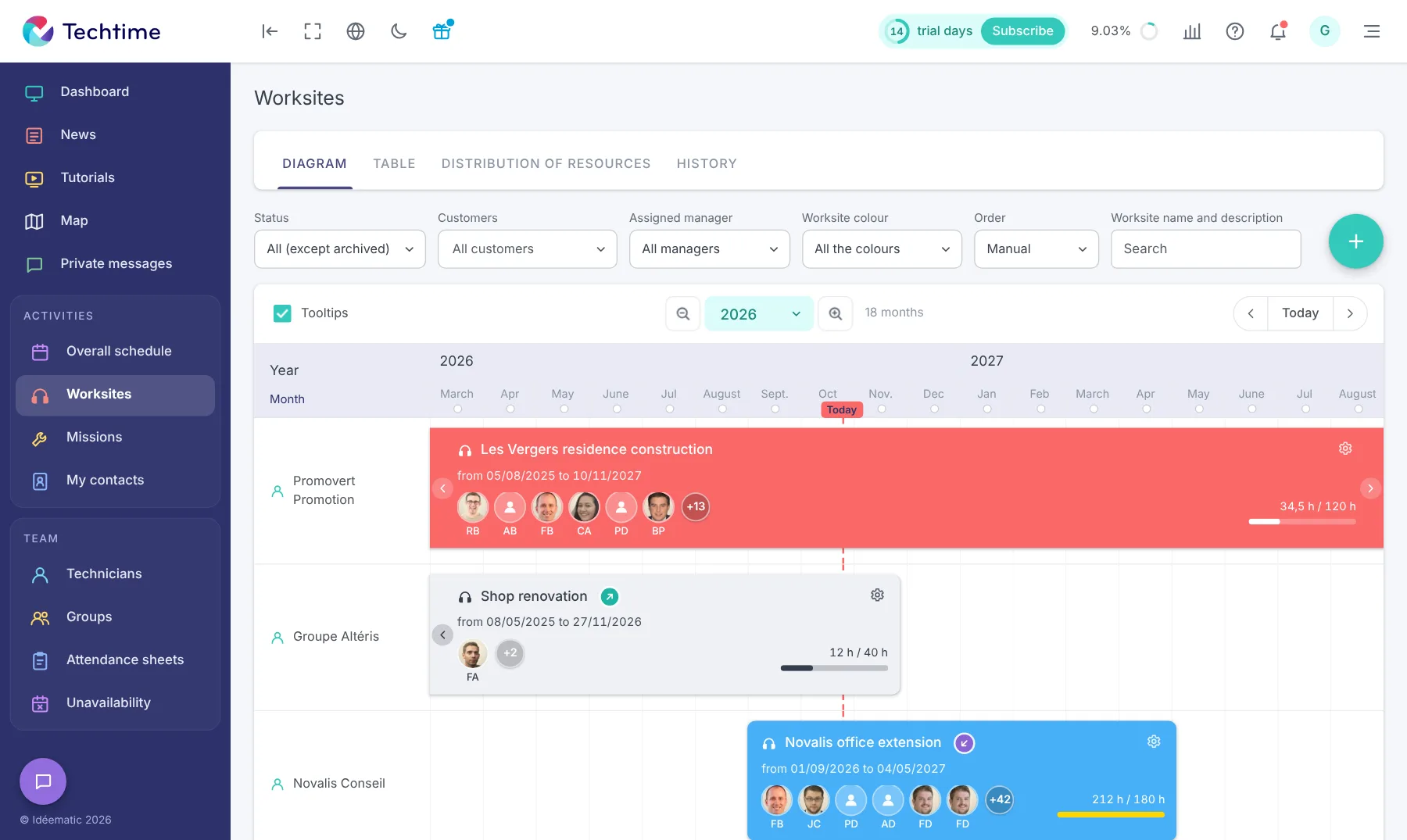
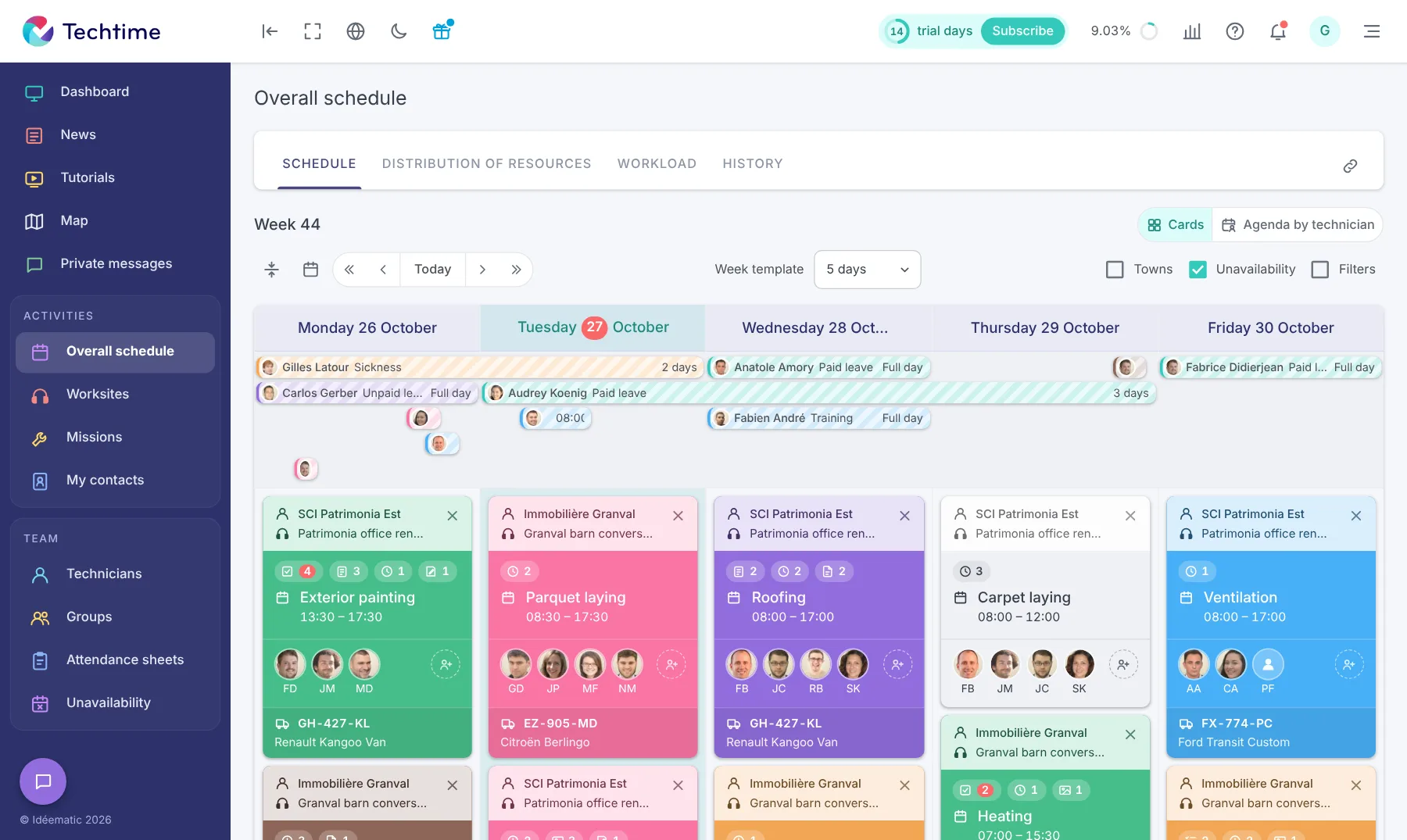
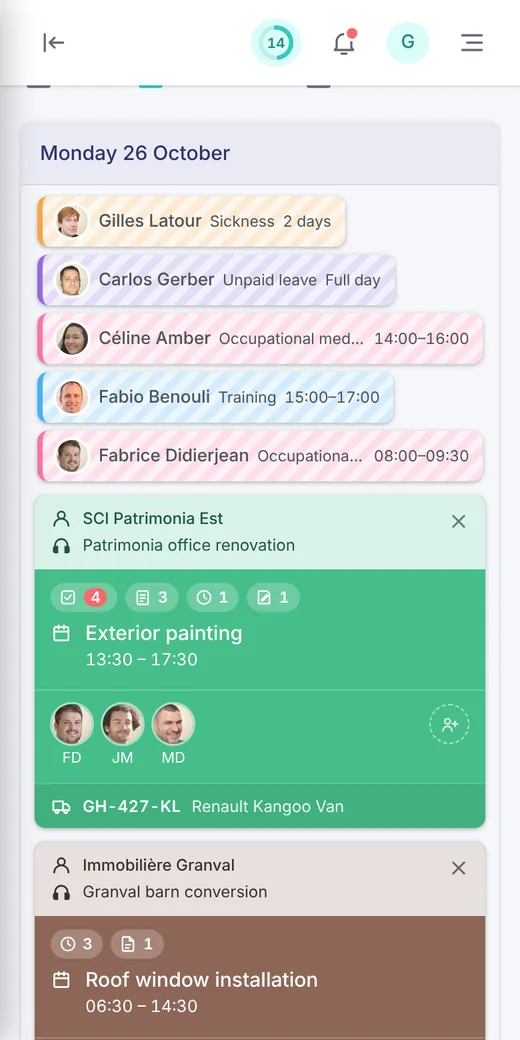
With Techtime, you centralise your documents, track your jobs, record your approvals and secure your progress valuations. The contract stays under control, and so does the worksite.
Frequently asked questions
What is the difference between the CCAP and the CCTP?
The CCTP describes what must be built: materials, construction methods, expected performance. The CCAP specifies how the contract is performed: deadlines, payments, penalties, subcontracting, handover.
Does the NF P 03-001 standard apply automatically in private contracts?
No. According to the French Building Federation, it can serve as a contractual basis in private building contracts, provided it is expressly included in the contract documents. Otherwise, it does not apply automatically.
Which CCAP clauses should you check before signing?
The order of priority of documents, the starting point for deadlines, the amount and cap of penalties, payment terms for progress valuations, the retention, approval of additional works, subcontracting rules, handover and snag clearance, and the conditions for paying the balance.