


Please note: this article refers to French regulations and standards.
Construction workers don’t count their hours when it comes to finishing worksites on time. According to France’s Dares (labour ministry statistics), construction is one of the sectors that relies most on overtime (source). Employees can work a maximum of 180 hours of overtime over 12 consecutive months (source). However, some activities are not included in this annual quota, in particular urgent work or on-call duty compensated with extra rest. To protect your employees’ health and safety, here are some tips for better managing on-call duty in construction.
In brief
On-call duty requires employees to be able to step in to do their work, without being permanently and immediately at the employer’s disposal (Article L3121-9 of the French Labour Code). Call-outs count as working time: overtime carries a 25% then 50% premium, and compensation is set by the collective agreement or company agreement. On-call periods are limited to 72 hours over 15 days and 21 per month. To organise them well, plan a fair rotation, track call-outs in real time and centralise job sheets.
1On-call periods: definition and regulations
Article L3121-9 of the French Labour Code defines the on-call period as follows. The employee “must be able to intervene to carry out [their] work”, but “without being permanently and immediately at the employer’s disposal”. It is not standby duty requiring presence on the worksite. In fact, the on-call period counts as the worker’s rest time when they remain inactive.
Who organises on-call periods in the construction sector?
The employer decides on on-call duty in line with the company’s collective agreement or with representatives of the social and economic committee (CSE, the French works council). The labour inspectorate must be informed. Joint agreements with regions or départements may also apply (source).
Construction employees’ rights and duties regarding on-call duty
Employees accept the on-call conditions if they are set out beforehand in their employment contract. They must respond quickly to the employer’s requests using a reliable means of communication (mobile phone, computer, etc.). They must be able to get to the worksite within a reasonable time. If they do not meet these conditions, they can be dismissed for misconduct.
As their rest time becomes working time, they are entitled to several benefits in return:
- Overtime worked during on-call duty is paid with a premium if weekly working time exceeds 35 hours. The rate is 25% from the 36th to the 43rd hour inclusive; beyond that, it is 50% (source).
- Compensation can take different forms: a flat-rate allowance, benefits in kind (company housing, for example) or compensatory rest. This is set in the collective agreement or company agreement. On-call allowances are subject to social security contributions and income tax.
Construction employers’ rights and duties regarding on-call periods
Your right to impose on-call periods depends on the size of the company. If you have fewer than 11 employees, you can organise them freely. Above that, a collective agreement or a clause in the contract is mandatory. If you do not follow the legal procedures, an employee may consider dismissal for refusal to be unfair. You must also take certain constraints into account, such as part-time contracts (source).
Statutory rest periods remain 11 consecutive hours a day and 24 consecutive hours a week (Articles L3132-1 and L3132-2, French Labour Code). However, exceptions to these minimum periods are provided for in Article L.3132-4 of the Labour Code. They apply in the case of “ urgent work ” for safety reasons. Nevertheless, this article provides that each employee affected by the exception is entitled to “compensatory rest equal in length to the rest lost.”
On-call periods are limited in time and number. They cannot exceed 72 hours of work over a 15-day period. They are also limited to 21 per month, Sundays included, public holidays excluded (source). Make sure you inform the employees concerned at least 15 days in advance, reduced to one clear day for urgent work (source).
Consecutive daily and weekly rest
Maximum working time on call
Sundays included, public holidays excluded
Notice to give the employee (one clear day if urgent)
2Some tips for organising on-call duty in construction
Managing on-call duty in construction can become a headache without the right tools. You have to deal with unexpected events on the worksite while meeting your legal obligations to your employees. To avoid conflicts or accidents in your teams, here are some practical tips to improve your monitoring.
- 1Schedulea fair rotation
- 2Trackjobs in real time
- 3Centralisejob sheets
- 4Payhours and allowances
Automate on-call scheduling
The worksite schedule for on-call duty is complex because you have to take everyone’s skills and availability into account, not to mention personal constraints such as childcare. If the employer does not respect the statutory working or rest periods, they can put their employees’ health and safety at risk.
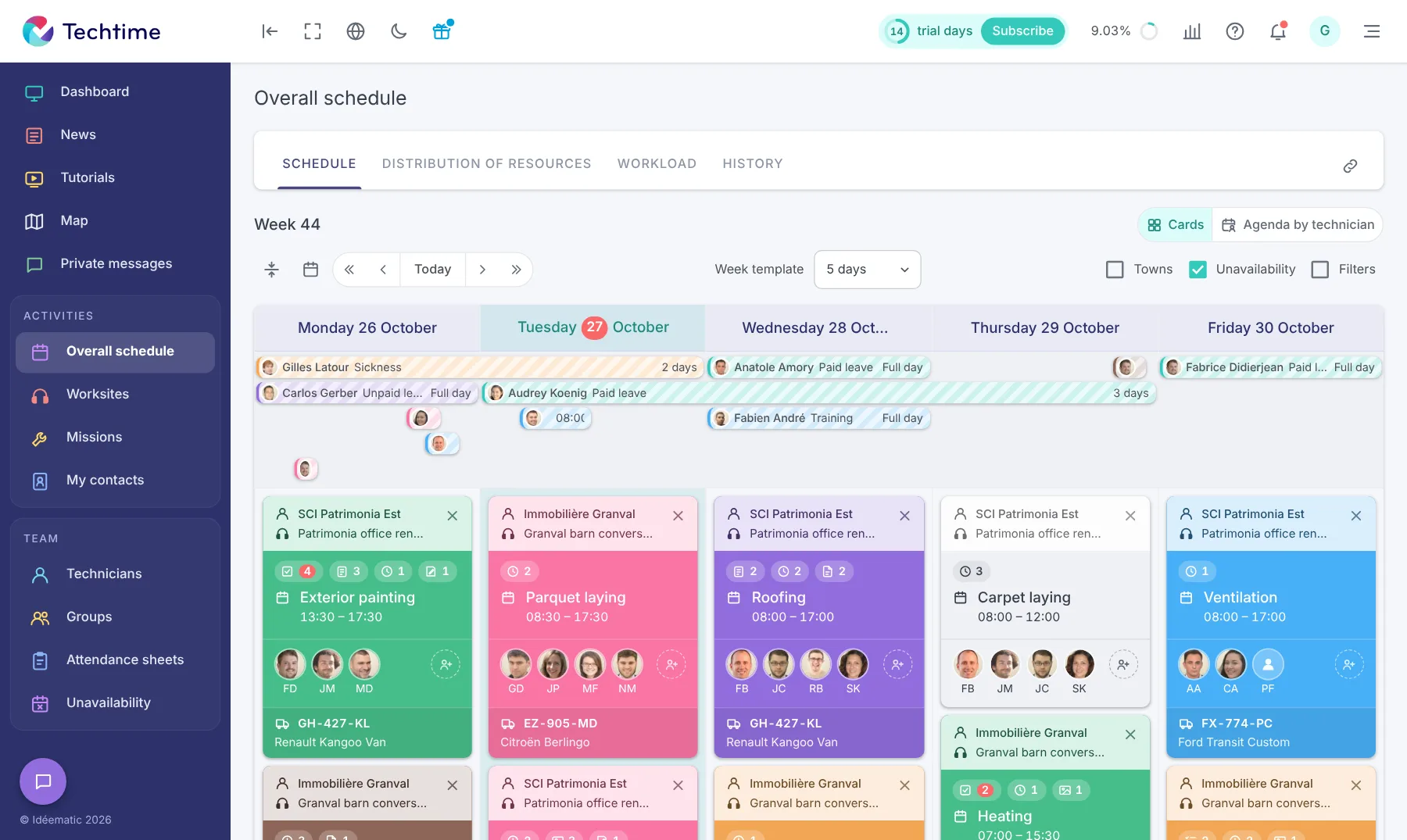
That is why you need an efficient and fair rotation schedule that complies with the law and respects work-life balance. Automation software can work out how many employees are available for on-call duty based on reported unavailability. It can also prepare a standard letter to inform them at least 15 days in advance, the time needed to obtain their prior agreement.
Track your on-call workers’ call-outs in real time
Real-time tracking of your employees working during on-call periods lets you pay them more fairly. Failing to provide a financial allowance or a compensatory day off can lead to conflicts in your team.
Various features of tracking software are designed to confirm workers’ presence on the worksite. You can contact them by instant messaging or ask them to send photos of the site to assess the situation in real time.
Centralise job sheets to simplify on-call pay
Every employee on call must fill in a job sheet with the following information:
- time of the call from the project manager;
- time of leaving home and time of arrival on the worksite;
- nature and duration of the job;
- mileage between home and the worksite where the job takes place;
- etc.
These sheets are compatible with electronic document management (EDM). Processing this paperless data saves you time and increases productivity. Calculating pay and on-call allowances is more accurate because no data is missing. Consider adding an evaluation system to your tracking system to improve your tool day by day.
3Why subscribe to our worksite tracking app to manage on-call duty?
Construction managers who have adopted an app to manage on-call duty appreciate how accessible and accurate the digital tool is. With a similar app, the company AGS BTP brought together several separate functions, such as schedules and report writing. Document processing times have been shortened and customer relations have improved.
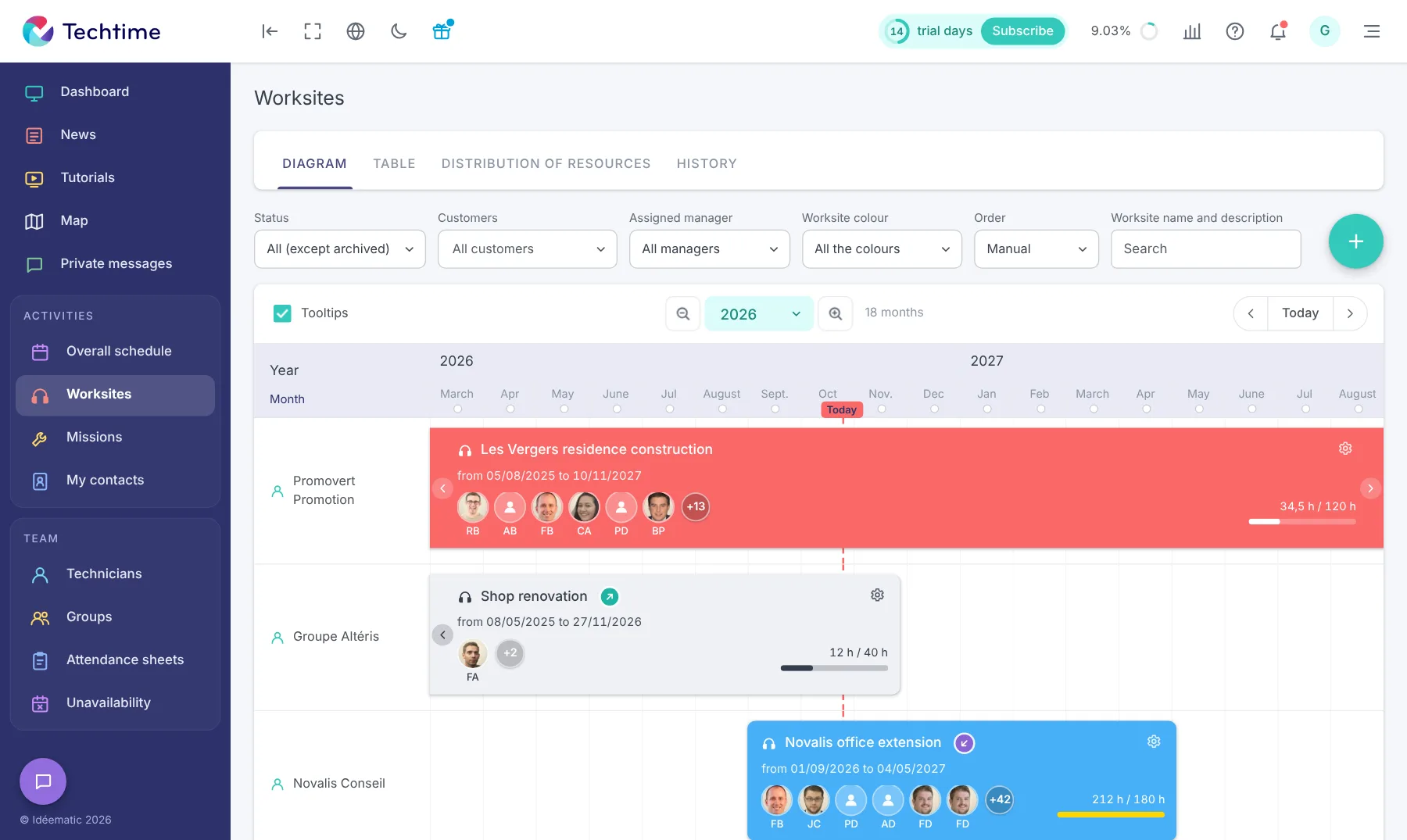
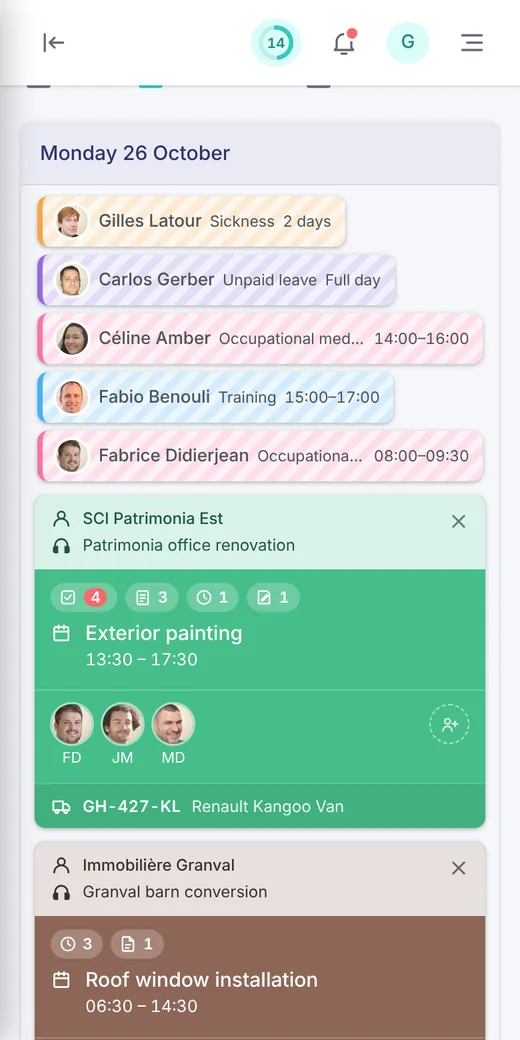
Techtime handles job scheduling by customer and uploading the corresponding documents. Your technicians fill in their timesheets in seconds once the on-call period is over, so they get their pay and allowance quickly. With an optimised schedule, your workers become more productive and meet worksite deadlines despite the unexpected.
On-call periods are rest time that becomes working time in the event of an urgent call-out to the worksite. Your employees cannot refuse them, but you must respect their statutory rest time and their work-life balance. To get all your workers on board with this shared effort, it is best to automate your on-call schedule and centralise your information. Worksite tracking software such as Techtime is designed to help you with these tasks.
Frequently asked questions
What is an on-call period in construction?
Under Article L3121-9 of the French Labour Code, during on-call duty the employee must be able to step in to do their work, without being permanently and immediately at the employer’s disposal. Time spent on call-outs is working time.
How many on-call periods can a construction employee work?
On-call periods cannot exceed 72 hours of work over 15 days and are limited to 21 per month, Sundays included, public holidays excluded. The employee must be notified at least 15 days in advance, or one clear day for urgent work.
How are on-call call-outs paid?
Beyond 35 hours a week, overtime carries a 25% premium from the 36th to the 43rd hour, then 50%. On top of this comes compensation (flat-rate allowance, benefits in kind or compensatory rest) set by the collective agreement or company agreement.