


Please note: this article refers to French regulations and standards.
Value added tax (VAT) brought in €184 billion for the French Treasury in 2022, according to the Directorate General of Public Finances (source). It concerns all business activities, including construction. It varies according to the type of worksite, not to mention the equipment or materials used. For certain types of work, the VAT rate in construction can be reduced. Find out how a worksite management app lets you collect VAT without errors.
In brief
In construction, VAT is 20% for new build and most major works. It falls to 10% for improvement, fitting-out or maintenance works, and to 5.5% for energy-efficiency works, on homes completed more than 2 years ago. To apply a reduced rate, the customer certifies the age of the home and the nature of the works on the quote or invoice: since 16 February 2025, this statement has replaced certificates no. 1300-SD and 1301-SD.
1What is the standard VAT rate for construction work?
The standard VAT rate in construction is 20%, under article 278 of the French General Tax Code. It mainly applies to new-build construction work. Extension work is concerned if the floor area increases by at least 10%.
Standard VAT applies to renovation work under certain conditions. The premises must not be used as a home. They are for business use, such as offices or farm buildings (source). For tax purposes, the building is considered new if it meets one of the following two conditions:
- The renovations affect more than half of an element of the structure. This means the foundations, the non-foundation elements that contribute to the building’s rigidity (roof structure, load-bearing walls), or the substance of the façades excluding resurfacing. For a detached house, this amounts to restoring a roof structure to 100% new condition over a 2-year period.
- The works restore two thirds of the finishing elements to new condition. These elements are non-load-bearing floors, external frames, internal partitions, plumbing and electrical installations, and the heating system. This condition must be checked for a detached house. For a flat, on the other hand, invoicing may be done at a reduced VAT rate if not all the elements are restored to new condition (source).
The following works are also invoiced at 20% VAT:
- fitting-out, building cleaning and grounds maintenance;
- raising the height of the building;
- demolition of the building that is independent of renovation work;
- equipment bought by a private individual and then installed by a company (swimming pool, spa, sports ground, air-conditioning system, sanitary installation).
2Reducing the VAT rate in construction: what are the conditions?
VAT in construction benefits from rates below 20% for maintenance or energy-efficiency works. The buildings where these works are carried out must be more than 2 years old. This applies to houses and blocks of flats alike, under article 279-0 bis of the French General Tax Code.
Standard rate: new build, extension, raising the height
Improvement, fitting-out, maintenance of a home over 2 years old
Energy-efficiency works and associated works
Intermediate VAT rate (10%) for improvement or maintenance works
The 10% VAT rate applies to improvement, fitting-out, maintenance or conversion works. These works must not make the building new for tax purposes or increase the floor area. Both conditions are assessed over a 2-year period.
The intermediate VAT rate covers the following tasks:
- Emergency works (repairing a lift or a shared boiler). These tasks repair the existing equipment rather than replacing it with new equipment.
- Works facilitating the supply of water, gas or electricity.
- Rainwater drainage works.
- Works to open or close homes (fitting a fence, a door, a window, a French window or an alarm with keypad entry) (source).
- Heating, kitchen, bathroom or storage equipment. It must be adapted to the home, and contractors cannot remove the old equipment without damaging the building.
- Light supplies essential to the works: cement, roof tiles, floor tiles, glass wool, etc.
Raw materials, equipment and labour are eligible for 10% VAT, provided the professional handles the purchases. If the private individual buys their own supplies, they must pay VAT at the standard rate. As well as reduced VAT, reassure your customer about the reliability of your choice of materials based on your expertise.
Reduced VAT rate (5.5%) for energy-efficiency works
Energy-efficiency works, and the other tasks they involve, benefit from a reduced VAT rate. Reduced VAT applies to both materials and labour, provided the company supplies and installs the equipment. The RGE label (“Recognised Environmental Guarantor”) is not required for 5.5% VAT, but it is a condition for your customer’s grants, such as MaPrimeRénov’.
The works eligible for reduced VAT are set out in article 278-0 bis A and article 200 quater of the CGI. They cover the fitting, installation and maintenance of equipment and materials that help save energy. They must meet precise technical criteria to achieve minimum energy performance (article 18 bis of Annex 4 to the CGI). Among the equipment concerned (boilers, thermal insulation materials, renewable energy production equipment, etc.), only photovoltaic panels are excluded. Your customer does not need to be eligible for MaPrimeRénov’, which replaced the energy transition tax credit (CITE), to benefit from the reduced VAT rate.
Associated works eligible for the reduced VAT rate are linked to the installation of the equipment or materials mentioned above. Their sole purpose is energy improvement; they have no aesthetic function. However, they must be invoiced within three months of the date the works were carried out. Otherwise, they are declared as independent works and are therefore not eligible for the 5.5% rate.
Which statement allows reduced VAT rates to be applied?
Since 16 February 2025, the certificates your customers had to fill in to benefit from reduced VAT rates have been abolished (source):
- the standard certificate no. 1300-SD, which covered structural or finishing works;
- the simplified certificate no. 1301-SD, reserved for lighter works.
- Separate certificate filled in by the customer
- Abolished on 16 February 2025
- The customer certifies the age of the home
- and the nature of the works
They have been replaced by a statement on the quote or invoice that your customer signs. In it, the customer certifies that the works concern a home completed more than 2 years ago and are not excluded from the reduced rate. The customer keeps the quote and invoices until 31 December of the 5th year following the works; for your part, keep them with your accounts.
3Why does worksite tracking software make VAT management easier?
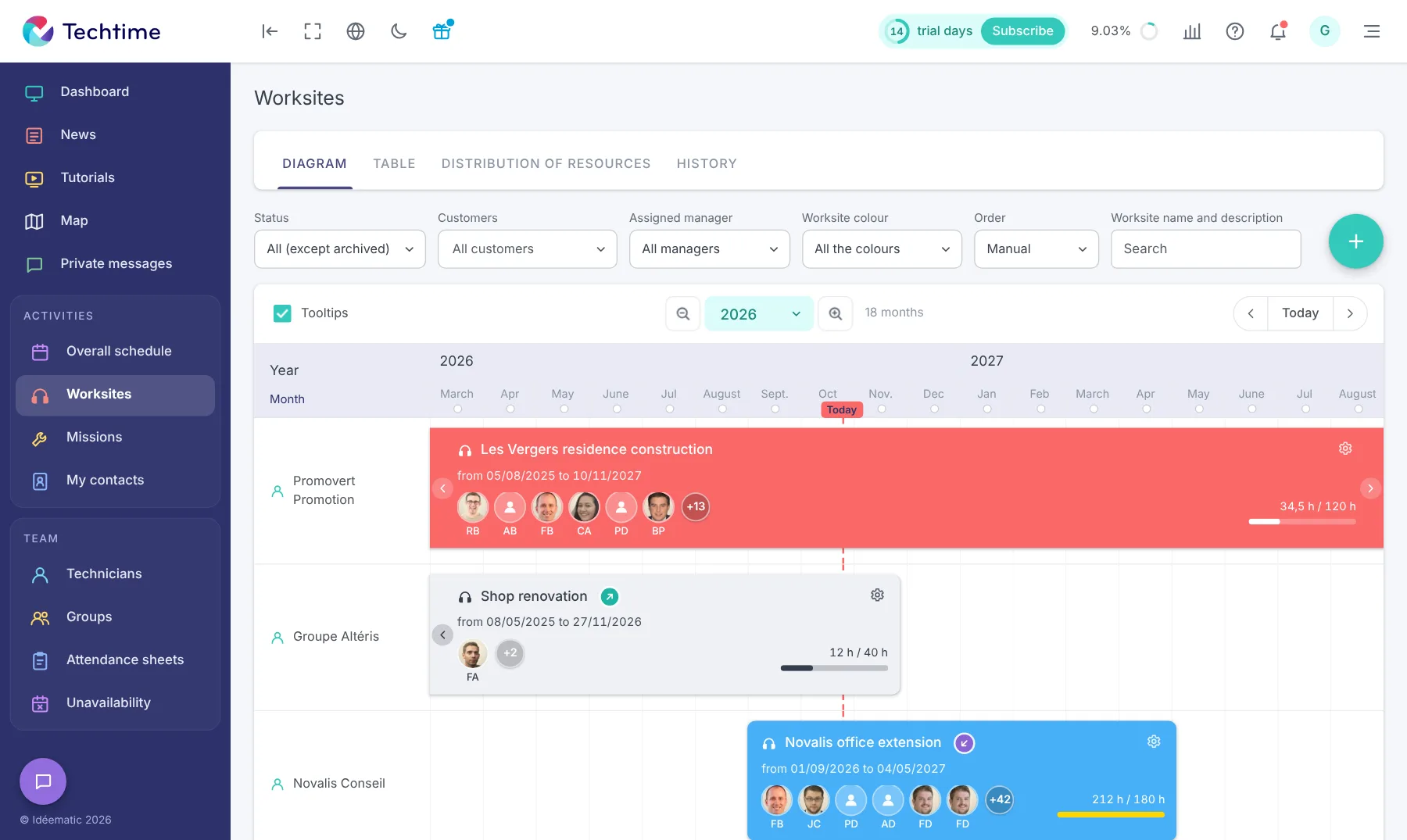
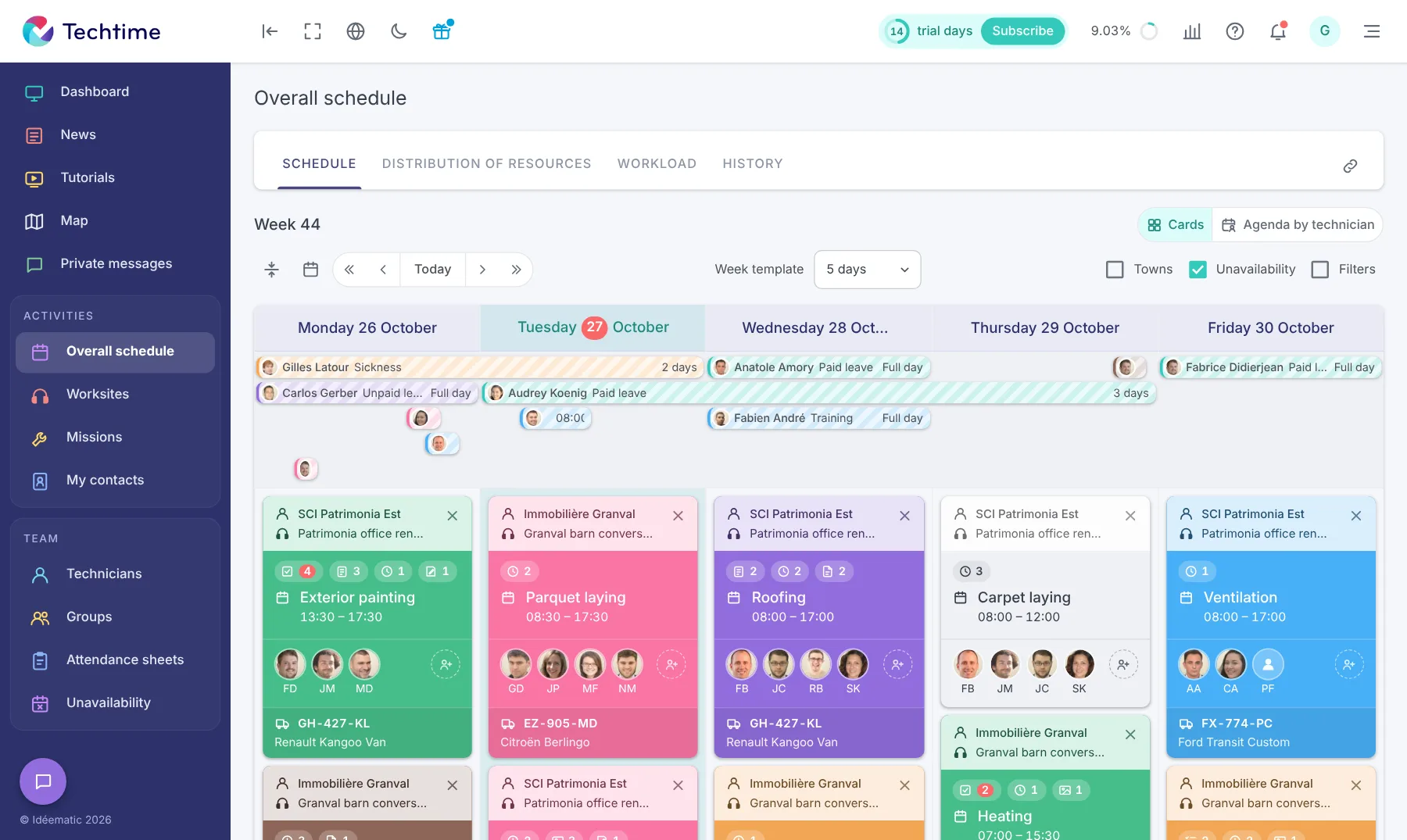
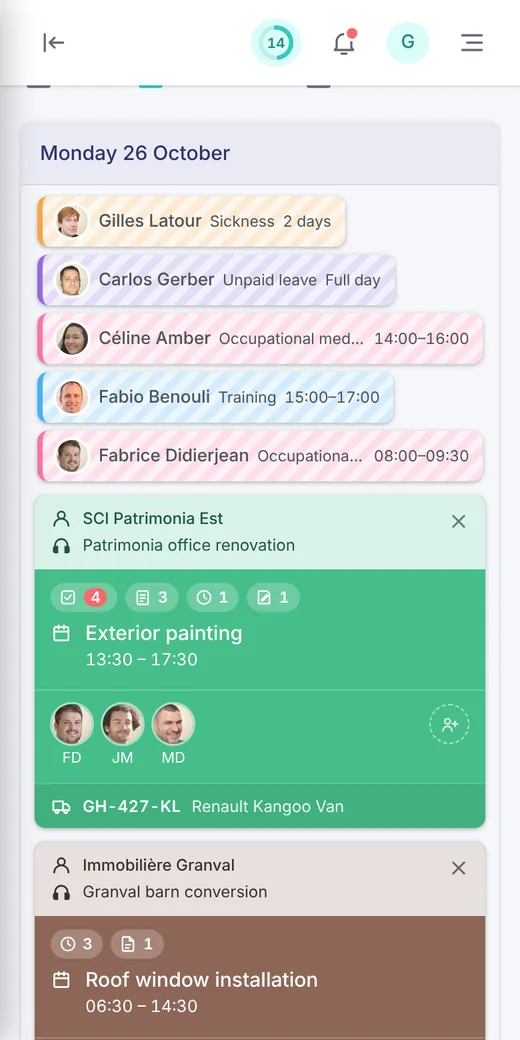
Techtime, your worksite tracking software, centralises your working documents (quotes, invoices, contract, specifications) in its schedule management. You can measure in real time the time spent on a worksite or the cost of your labour. Thanks to electronic document management (EDM), you centralise all this data in easily accessible software.
Even though Techtime does not calculate your VAT rates automatically, centralising invoices greatly simplifies your administrative work. You stay in control of checking each completed task so you can apply the right VAT rate. By calculating your costs in real time, you give yourself the means to better assess the price and margins of your worksite.
Reduced VAT rates in construction apply to maintenance works and energy renovation. Do not wait to let your customers benefit: abolishing the 10% rate has already been considered as a way to increase State revenue (source). This measure would push up worksite prices, not to mention job losses. With Techtime, let your customers benefit from these advantageous rates without making mistakes in their invoicing.
Frequently asked questions
What is the VAT rate for renovation work?
10% for improvement, fitting-out, maintenance or conversion works on a home completed more than 2 years ago, and 5.5% for energy-efficiency works. The standard 20% rate applies if the works make the building new.
Is a certificate still needed to benefit from reduced VAT?
No. Since 16 February 2025, certificates no. 1300-SD and 1301-SD have been abolished. The customer certifies, through a statement on the quote or invoice they sign, that the home was completed more than 2 years ago and that the works are not excluded from the reduced rate.
Does reduced VAT apply to materials?
Yes, provided the professional supplies the materials and carries out the works. If the private individual buys their own supplies, they pay VAT at the standard rate on those purchases.