


A call-out at a private home, a maintenance visit for a business customer, a small repair between two worksites: every visit needs a record of what was done, the time spent and the customer’s agreement. That record is the job sheet. Long filled in on a carbon-copy pad, it is now moving to the technician’s phone. Here is what it should contain, what it really proves and how to go digital without making life harder in the field.
In brief
The job sheet is the document that certifies a job took place: who did the work, where, when, what work, how long it took, with the customer’s signature. It serves as evidence in the event of a dispute and as the basis for invoicing. French law does not impose a template, but for private customers the prior quote and the end-of-service note are regulated. In digital form, the technician fills it in and has it signed on their phone: the information reaches the office without re-keying, together with photos and hours.
1What is a job sheet?
The job sheet (also called a work order, service ticket or job card) is a document drawn up each time a technician visits a customer. It describes the work carried out and is signed by the customer at the end of the visit.
It should not be confused with two related documents:
- the quote, drawn up before the work, which sets the price and the content of the service;
- the service report, more detailed, which documents the diagnosis, the work, the measurements and the recommendations, often for a business customer or a main contractor.
In many businesses, the job sheet and the report are one and the same: a single document filled in on site, which summarises the work and collects the signature. What matters is less the name of the document than what it contains.
- Who, where, when, how long
- Work done in a few lines
- Customer’s signature on site
- Findings and diagnosis
- Work, measurements, parts, photos
- Recommendations and follow-up
2What is a job sheet for?
The job sheet plays three roles, for the customer and for the business alike.
Proof that the job took place
Signed by the customer, it certifies the technician’s visit, the arrival and departure times and the work carried out. In the event of a dispute (“nobody came”, “the work wasn’t done”, “you stayed one hour, not three”), it is the first document you bring out. Photos taken before and after the job are a useful addition.
The basis for invoicing
The time spent, travel and supplies noted on the job sheet are used to prepare the invoice. An incomplete or lost job sheet means an approximate invoice, a late one, or one that is never sent.
The history of the customer and the address
On the next call, knowing what was done last time, by whom and what still needed doing saves valuable time. That only works if job sheets are filed and easy to find, which is rarely the case with a paper pad.
3What should a job sheet contain?
No regulation imposes a job sheet template. In practice, a complete job sheet includes the following:
- The business: company name, contact details, company registration number (SIRET in France).
- The customer and the location: name, job address, on-site contact.
- The job: date, start and end times, any break, name of the technician or technicians.
- The reason: the customer’s request or the fault found.
- The work carried out, in a few clear lines, and the parts or supplies used.
- Follow-up: a new job to schedule, an additional quote to send, a part to order.
- Observations from the technician and, where applicable, the customer’s reservations.
- Signatures of the customer (with their name) and the technician.
At a private home in France, the job sheet replaces neither the quote nor the note
For breakdown, repair and maintenance services at a consumer’s home, the French order of 24 January 2017 (in French) requires a detailed quote to be provided before the work is carried out, whatever the amount (the €150 threshold of the former regulations has been abolished). After the service, a note (invoice) must be provided before payment as soon as the price reaches €25 including VAT, under the order of 3 October 1983, as restated by the DGCCRF, the French consumer protection authority. The job sheet comes on top of this: it proves what was done. Rules checked in November 2026.
4Paper job sheets: where things go wrong
The carbon-copy pad has the advantage of simplicity. But in a business that handles job after job, it causes losses at every stage:
- job sheets come back to the office at the end of the week, sometimes stained, illegible or forgotten in the van;
- each job sheet is re-keyed for invoicing and to prepare payroll hours, with errors as a result;
- photos stay on the technician’s personal phone, with no link to the job sheet;
- finding a customer’s history means digging through binders.
The result shows up in cash flow: jobs invoiced days or even weeks late, and office time spent copying rather than organising.
5The digital job sheet: how does it work?
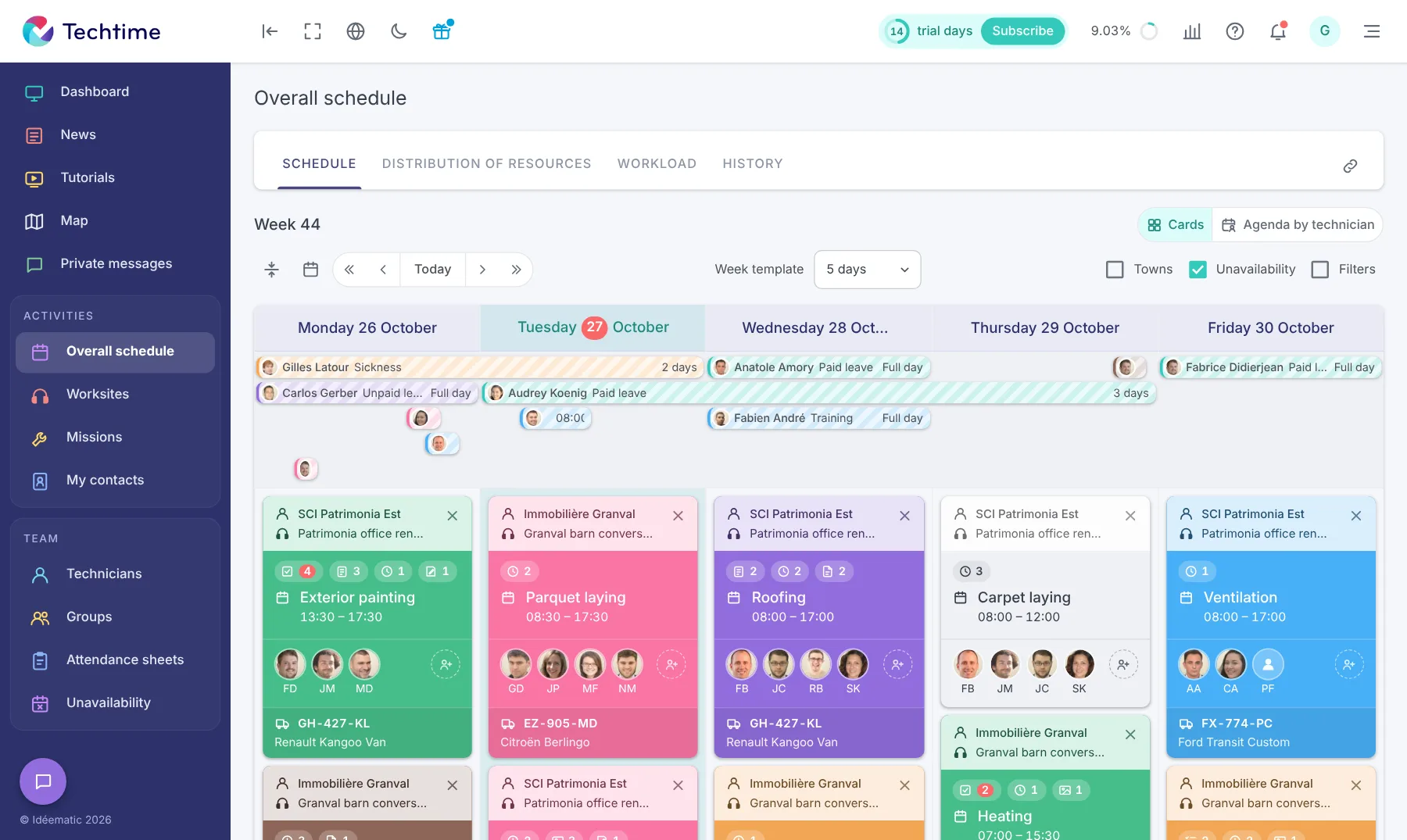
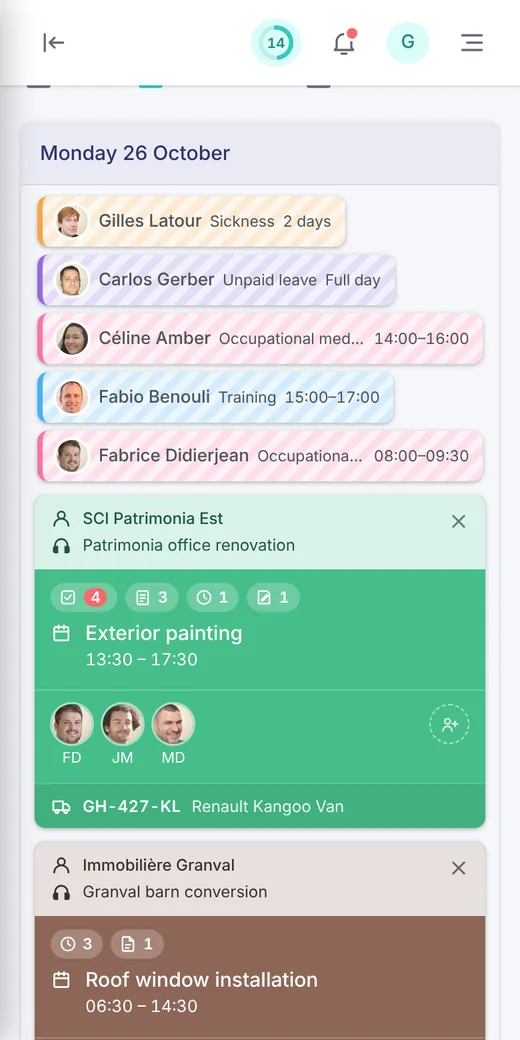
With job management software, the job sheet is no longer a form to fill in but a step in the job itself. The office creates the job (customer, address, work, times), the technician finds it in their schedule on their phone and, at the end of the visit, completes the report and has the customer sign on the screen.
- 1CreationThe office creates the job: customer, address, work, times
- 2SchedulingThe job appears in the technician’s schedule, on their phone
- 3On siteStart and end times, report, photos, follow-up
- 4SignatureThe customer signs on the screen, with their name; so does the technician
- 5At the officeEverything is available without re-keying, linked to the job
The benefits are immediate: no more lost paper, legible and complete information available at the office as soon as the job is finished, and a history filed by customer and by address.
And is a signature on a phone valid?
Yes. Article 1367 of the French Civil Code recognises electronic signatures, provided they use a reliable identification process that guarantees their link with the signed document. A signature drawn on the screen, together with the signatory’s name, the date and the times of the job, is a far stronger record of acceptance than a lost paper job sheet. For high-stakes contracts, higher levels of electronic signature exist (advanced or qualified signature): the ANSSI guide (in French) helps you choose.
6The job sheet in Techtime
In Techtime, the job sheet takes the form of the report filled in from the mobile app. For each job, the technician enters:
- the start time, end time and break time, from which the duration of the activity is calculated;
- the report on the work carried out;
- what needs to be planned: a new job, a new activity or a new quote;
- the customer’s signature, with their first and last name, and the technician’s signature.
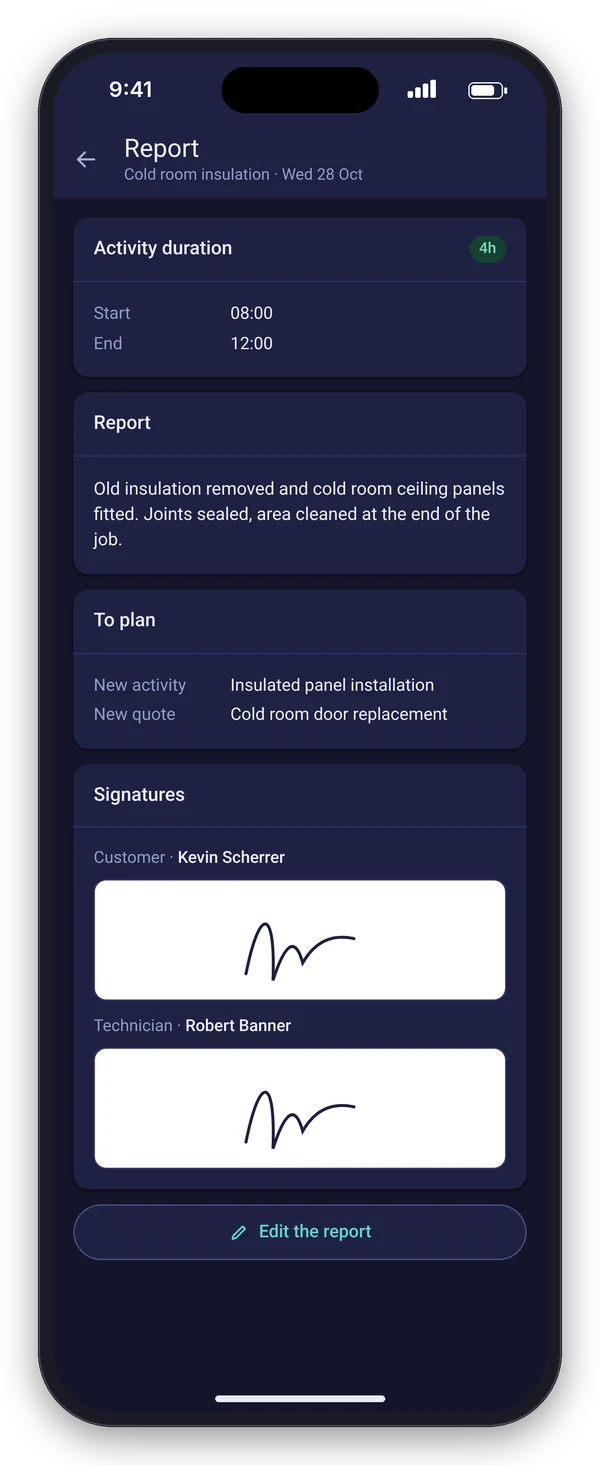
Photos taken on site and recorded hours are linked to the same job. At the office, everything can be viewed immediately, and the address history lets you find previous visits. Hours feed into timesheets, which you approve and then export to prepare payroll.
Techtime handles operations (scheduling, carrying out and reporting on jobs) and does not replace your quoting and invoicing software: the two complement each other, and Techtime can exchange data with your other tools via Zapier.
Key takeaways: 5 habits for flawless job sheets
- Fill in the job sheet on site, before leaving the customer, never in the evening from memory.
- Note the actual arrival and departure times.
- Describe the work in simple sentences the customer can understand.
- Take before and after photos, linked to the job.
- Have the customer sign, with their name, and note any reservations.
FAQ
Is a job sheet mandatory?
No French regulation requires a job sheet as such. In practice, however, it is essential to prove the visit and to invoice. At a private home in France, the detailed quote before the work and the note after the service are regulated.
What is the difference between a job sheet and a service report?
The job sheet certifies the visit and the work carried out, with the customer’s signature. The report is more detailed: findings, diagnosis, measurements, recommendations. In many businesses, a single document filled in on site plays both roles.
Is a signature on a phone legally valid?
Yes, French civil law recognises electronic signatures when they use a reliable identification process linked to the document. A signature drawn on the screen, with the signatory’s name and the date, is a record of acceptance. For high-stakes contracts, higher signature levels exist.
How long should job sheets be kept?
The job sheet supports the invoice: it is wise to keep it as long as accounting records, which is ten years under the French Commercial Code. A digital job sheet linked to the job is kept and found without any binder.
Article published in November 2026.