


Please note: this article refers to French regulations and standards.
The worksite opening declaration (DOC) marks the start of a construction project. It secures the legal start of the works and protects the validity of the building permit.
Although it is mandatory, construction project managers sometimes forget this step. They focus on equally important tasks such as preparing the worksite schedule or managing the other documents (permits, insurance, etc.). According to Batimaz, planning departments estimate that a quarter of worksite irregularities stem from a forgotten or late DOC.
This mistake has consequences for the construction company: financial penalties, administrative suspension of the works or difficulties getting the insurer to pay out. How can a worksite management app help you never forget to file the worksite opening declaration ?
In brief
The worksite opening declaration (DOC) is a mandatory formality in France (Article R*424-16 of the French Planning Code): the holder of the building or development permit informs the town hall that works have actually started, using Cerfa form no. 13407*11. It proves the worksite opening date, which is decisive for the validity of the permit (3 years) and for ten-year and structural damage insurance, which must be taken out beforehand. Failing to file it exposes you to a halt to the works and fines of €1,200 to €300,000.
1What is the worksite opening declaration (DOC)?
The worksite opening declaration (DOC) is a mandatory formality provided for in Article R*424-16 of the French Planning Code. The holder of the building permit or development permit must inform the town hall that the works have actually begun. The declaration is sent on paper or electronically, depending on local arrangements.
Since there is no legal definition of the start of works, this step serves as legal proof of when they began (Capital). The DOC must be sent as soon as the works actually start. The authorities and insurers recognise this reference date in the event of a dispute with a neighbour or worksite disputes. The declaration determines several regulatory deadlines, in particular those relating to compliance checks and the period of validity of the permit.
Good to know: this period of validity is 3 years from the date the authorisation is notified (French Planning Code, Art. R*424-17).
Which works require a worksite opening declaration?
The projects concerned by the DOC are mainly new builds, extensions requiring a building permit and development operations. The first two require a building permit, while the last require a development permit.
Conversely, works that do not require a building or development permit are exempt from the DOC. This includes, for example:
- Building a terrace;
- Digging a swimming pool with an area of between 10 m² and 100 m²;
- Loft conversions;
- The energy renovation works;
- Installing solar panels;
- Façade restoration outside a protected area.
These works generally require a prior declaration (DP) and a declaration of completion of works, except in specific cases requiring a building permit.
Good to know: the worksite opening declaration does not apply to demolition works alone. These only require a demolition permit, unless a construction project starts after the demolition.
What is the difference between opening the worksite and displaying the permit?
Displaying the building permit on the plot and the worksite opening declaration follow distinct legal logics. Displaying the permit informs third parties and starts the two-month period for legal challenges, under Article R*600-2 of the French Planning Code. The DOC, for its part, makes the actual start of works official with the authorities.
In practice, displaying the permit protects the project against late challenges, while the DOC secures its administrative and insurance timeline. The two steps complement each other and must be carried out together to avoid weakening the file with insurers and the legal authorities.
- Sign on the plot
- Starts the two-month appeal period
- Protects against late challenges
- Cerfa no. 13407*11 sent to the town hall
- Makes the actual start of works official
- Secures the administrative and insurance timeline
2Who should take responsibility for this formality?
Responsibility for the worksite opening declaration lies with the permit holder, in other words the client. In the day-to-day reality of worksites, however, the project manager prepares and handles this administrative formality as works coordinator.
This informal split explains why the DOC is sometimes forgotten. With no clearly identified owner and no shared tracking tool, it can slip through the net. Including it in a shared digital tool ensures traceability and proper completion.
Find out the difference between a project manager and a client.
3How do you fill in and send Cerfa form no. 13407*11 without errors?
The worksite opening declaration is made using Cerfa form no. 13407*11. This official document can be sent on paper or electronically, depending on what the municipality offers.
Filling in this form requires particular care, as any inconsistency can call the validity of the declaration into question. The main steps are:
- identifying the permit holder;
- the exact references of the planning authorisation;
- the location and nature of the project;
- the actual start date of the works;
- the work packages or phases concerned;
- the authorised floor area.
The worksite opening date is the key item on the form. It triggers the legal deadlines and serves as a reference in the event of an inspection or a claim. An imprecise or inconsistent date can undermine the declaration’s value as evidence. Likewise, any discrepancy between the permit references and the administrative documents attached can lead to a request for regularisation.
Once completed, the form is sent to the relevant town hall:
- either by handing it in,
- or by post,
- or electronically, where available.
If the works and the procedure take place in Paris, the DOC must be filed on the online portal of the BASU (the City of Paris public reception office).
Online filing offers a decisive advantage in terms of traceability. The electronic acknowledgement of receipt, time-stamping and archiving make it easier to prove filing in the event of a dispute. More generally, the challenges of going paperless in construction are about making exchanges more reliable and reducing the risk of things being forgotten.
- 1Permit obtainedvalid for 3 years
- 2Insuranceten-year and structural damage cover taken out
- 3Cerfa no. 13407*11actual start date of works
- 4Submissiontown hall: in person, by post or online
- 5Worksite openingworks started
4Why is the DOC the vital trigger for your construction insurance?
The worksite opening declaration is a major piece of evidence for establishing the worksite opening date. This date is decisive in assessing insurance cover for the ten-year guarantee and structural damage insurance (Assurup).
The French Insurance Code requires builders’ ten-year liability insurance (Art. L241-1) and structural damage insurance (Art. L242-1) to be taken out before the worksite opens. In practice, the worksite opening date is assessed in light of the DOC for operations requiring a permit. Consistency between this reality and the declared date is sensitive, and the slightest inconsistency can weaken a compensation claim.
What is the impact of the declaration date on your ten-year cover?
In the event of a defect covered by the ten-year guarantee, the insurer always examines the worksite timeline. The DOC date makes it possible to check that the works started under a valid contract.
If the declaration is not made at the right time, the consequences can be as follows:
- DOC before the contract: the insurer refuses to cover the worksite;
- No DOC: it is very difficult to prove that the claim falls within the period of cover. The expert relies on invoices or reports to determine the actual start date;
- Late DOC: in-depth investigation into whether the defects pre-date cover, as the delay may be seen as an attempt at “after the fact” regularisation.
If the insurer refuses to pay or the construction company is not covered, the company must compensate the client from its own funds (Articles 1792 et seq. of the French Civil Code). In a recourse action, the client’s insurer pays for the repairs but can turn to the uninsured company to be reimbursed.
The insurer refuses to cover the worksite
The actual start date has to be proved with invoices or reports
In-depth investigation into whether the defects pre-date cover
What happens if the declaration to the insurer is late?
A late declaration can lead to reservations when a claim is processed, or even a partial refusal to pay. These situations lead to long and costly disputes, often avoidable through rigorous administrative management.
5What are the penalties for failing to file or for a false declaration?
Failing to file a worksite opening declaration is a breach of planning rules. The authorities have inspection powers and can order the works to stop in the event of a breach (French Planning Code, Art. L 480-2.).
Good to know: these administrative visits can take place without the company being present on the worksite.
Possible penalties include:
- fines ranging from €1,200 to €300,000;
- up to 6 years’ imprisonment in specific aggravated cases, such as environmental offences (French Planning Code, Art. L.480-4);
- administrative suspension of the worksite;
- in the most serious cases, a halt to the works and criminal prosecution, without the permit granted being automatically called into question.
A false declaration, particularly regarding the start date, directly engages the liability of the permit holder and the companies involved.
These risks are part of a broader issue of managing safety on a worksite, where every administrative document contributes to securing the project as a whole.
6What are the practical consequences of poor DOC management?
To illustrate the scope of these regulations, three typical scenarios from everyday construction work deserve a closer look.
Starting early without a declaration
A construction company starts an extension at a private home at 7.30 in the morning. The machinery is on site and earthworks begin, but no DOC has been filed with the town hall.
If the neighbour, bothered by the early-morning noise, asks the municipal police or the gendarmerie to come and make a report, they will check that the building permit is displayed. On finding that the town hall has not received the DOC, the mayor will be alerted immediately.
In this case, the consequences for the company are as follows (PY Conseil):
- An order to stop work from the very first day;
- The absence of a DOC can make it harder to prove the actual worksite opening date, which weakens the file in the event of a claim;
- Managing conflict with the customer and administrative proceedings with the town hall.
The surprise inspection during earthworks
A sworn officer from the departmental planning authority (DDT) makes a routine visit while the foundations are being poured. He finds that the DOC has been forgotten. He therefore draws up an offence report for breaching planning procedure rules. This report is sent to the public prosecutor. It can lead to the works being stopped. In the event of criminal prosecution, the court can impose penalties up to and including restoring the site or demolishing the structures built illegally.
The ten-year claim after 9 years
A major crack appears in a load-bearing wall nine years after handover. The builder’s ten-year insurer is called in and scrutinises the project timeline. If it finds that the DOC was filed with a falsified date (to make it look as if the works started after the insurance contract was signed), it invokes the nullity of the contract for fraud, if the fraud is established.
If the expert’s investigation proves that the worksite opened during a period of suspension or before the contract started, the insurer will refuse to pay. As a result, paying damages to the customer will be the construction company’s responsibility, which could lead to its bankruptcy.
7How do you automate the management of your worksite administrative documents?
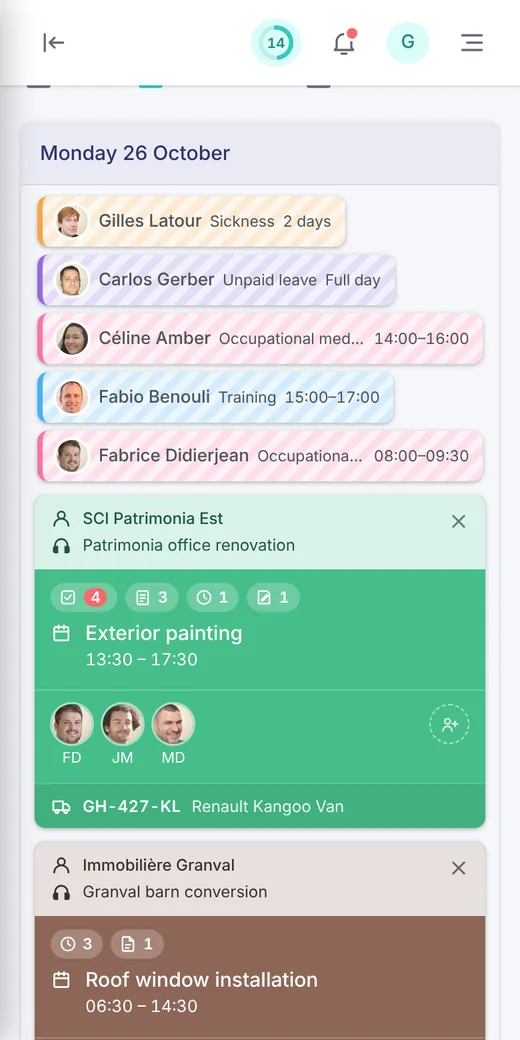
The worksite opening declaration is best included in a worksite tracking app. By centralising the permit documents, insurance certificates and schedule, it becomes a structuring milestone in the worksite’s life cycle.
A solution such as Techtime brings all your administrative documents together in electronic document management (EDM). It also gives you a chronological record of who did what, for whom, when and how. In addition, thanks to syncing your software with Zapier, you make day-to-day management easier by connecting Techtime to your other applications.
Frequently asked questions
Which works require a worksite opening declaration?
Works requiring a building or development permit: mainly new builds, extensions requiring a permit and development operations. Works requiring a prior declaration (terrace, loft conversion, solar panels, etc.) and demolition alone do not require one.
Who must file the DOC?
Responsibility lies with the permit holder, that is, the client. In practice, the project manager often prepares and sends the declaration.
How do you send the DOC?
Using Cerfa form no. 13407*11, handed in at the town hall, sent by post or submitted electronically where the municipality offers it. In Paris, it is filed on the BASU online portal.