


Please note: this article refers to French regulations and standards.
Split-leave days in construction compensate for not being able to take all of your leave in one go. The company has to keep its worksites running all year round, including in summer. Nevertheless, like any employee, the construction tradesperson keeps their right to genuine rest.
In France, Chapter 1 of Title IV of Book 1 of Part Three of the Labour Code governs paid leave. Every employee is entitled to two and a half working days of leave per month worked, i.e. 30 working days a year (Article L3141-3).
In any French company, the legal leave period runs from 1 May to 31 October (Art. L3141-13). However, in construction, paid leave is generally taken between 1 May and 30 April of the following year. It is managed by the Construction and Public Works Leave and Bad Weather Fund (CIBTP). These conditions are set out in the national collective agreements (CCN) that supplement the Labour Code.
However, the constraints of construction scheduling and emergencies in the field make it difficult to take 4 consecutive weeks off. General law and collective agreements allow holidays to be split into several periods. Construction employees earn extra days of leave, called split-leave days, under certain conditions. Techtime explains which ones and how to calculate this bonus rest time.
In brief
Split-leave days compensate for being unable to take all your leave in one go. A construction employee in France who has taken 12 consecutive working days before 1 November, then 3 to 5 days of their main leave between 1 November and 30 April, earns one extra day of leave, and two days from 6 days. Depending on the agreements, managers and ETAM may receive 2 extra days. These days are paid by the CIBTP or CNETP and can be combined with RTT days.
1Split-leave days in construction: the French Labour Code definition
Under Article L3141-19 of the French Labour Code, main leave can be split with the employee’s agreement. This applies if the leave is longer than 12 working days. This leave is generally granted in the period from 1 May to 31 October each year.
If there is still leave to be granted after the 12th day, it can be given in several instalments. In construction, days outside the legal period (1 May – 31 Oct.) are often taken between 1 November and 30 April. The CIBTP sets a leave period up to 30 April, as its form points out. This can be outside the reference period, up to 30 April of the following year (Labour Code, Article L3141-23).
Split-leave days are possible from the first year of employment if the employee has accrued enough leave and meets the conditions. However, they can waive them by collective agreement, in exchange for other benefits, or by individual written agreement. If they accept them, the conditions are as follows (CIBTP):
- Having taken 12 consecutive working days before 1 November;
- Then having taken, out of the first 24 days, 3 to 5 days between 1 November and 30 April to earn one extra day of leave. If the employee takes at least 6 days, they earn 2 extra days of leave.
An employee may join the construction company during the year. In that case, they may not be entitled to split-leave days (Factorial).
Note: public holidays within the 12 days of paid leave make no difference to the extra split-leave days. However, only the first four weeks of paid leave are taken into account when calculating split-leave days.
Good to know: a labour shortage in the building trade does not allow the employer to refuse an employee their split-leave days, on pain of employment tribunal proceedings. However, the building industry collective agreement or a company agreement can change the splitting rules. The employee may refuse this with their agreement or end up with less favourable terms than general law (French Labour Act of 8 August 2016).
2What is specific about split-leave days for construction managers and ETAM?
Some collective agreements or practices applicable to managers and ETAM (clerical staff, technicians and supervisors) provide for specific splitting arrangements or additional benefits.
According to Article 5.13 of the 2006 collective agreement, they may receive 2 extra days of leave when their leave is split. In addition, the company can pay them a flat-rate travel allowance equal to 8/100 of their gross monthly salary. However, these provisions are neither automatic nor uniform across the construction sector.
3Who pays for split-leave days?
The Construction Leave and Bad Weather Fund (CIBTP) and the National Fund of Public Works Contractors (CNETP) handle payment for split-leave days. However, they manage it differently in several respects.
The CIBTP pays the employee their holiday pay and deducts it from the company’s overall contribution. The CNETP advances payment to the employee, then the employer reimburses this allowance and the corresponding social security contributions. The first fund is introducing increasingly automated management, while the second keeps a more explicit process. Employers who are members of the CNETP must include the statement “Request for payment of split leave” on their contribution slip.
The funds pay for the statutory extra days. Companies affiliated to the CNETP reimburse their fund after it has paid the workers on leave.
- Pays the allowance to the employee
- Deducts it from the company’s overall contribution
- Advances payment to the employee
- The employer reimburses the allowance and contributions
- “Request for payment of split leave” stated on the contribution slip
4Can split-leave days be combined with RTT days?
Working time reduction days (RTT) are extra days or half-days off. They are granted to employees whose weekly working time exceeds 35 hours.
The building workers’ collective agreement provides for an increase in the hourly wage if the employee works overtime in construction. It is set at 25% from the 36th hour and 50% from the 44th hour (Weblex).
As RTT days and split-leave days are independent of each other, they can be combined.
5Does taking split leave entitle you to a bonus?
Independently of splitting, construction employees can also receive a 30% construction holiday bonus. This right is granted if the following thresholds are reached (Culture RH):
- 1,675 hours for building workers (or 1,503 hours if their weekly working time is 35 hours);
- 1,200 hours for public works workers;
- 6 months’ service for ETAM or managers.
1,675 hours (1,503 hours on a 35-hour week)
1,200 hours
6 months’ service
6How do you handle split-leave days in the worksite schedule?
Managing annual leave and split leave is not always easy for the employer, who has to cope with staggered absences that complicate worksite organisation and meeting the client’s timetable. Yet activity must continue, especially in spring and summer.
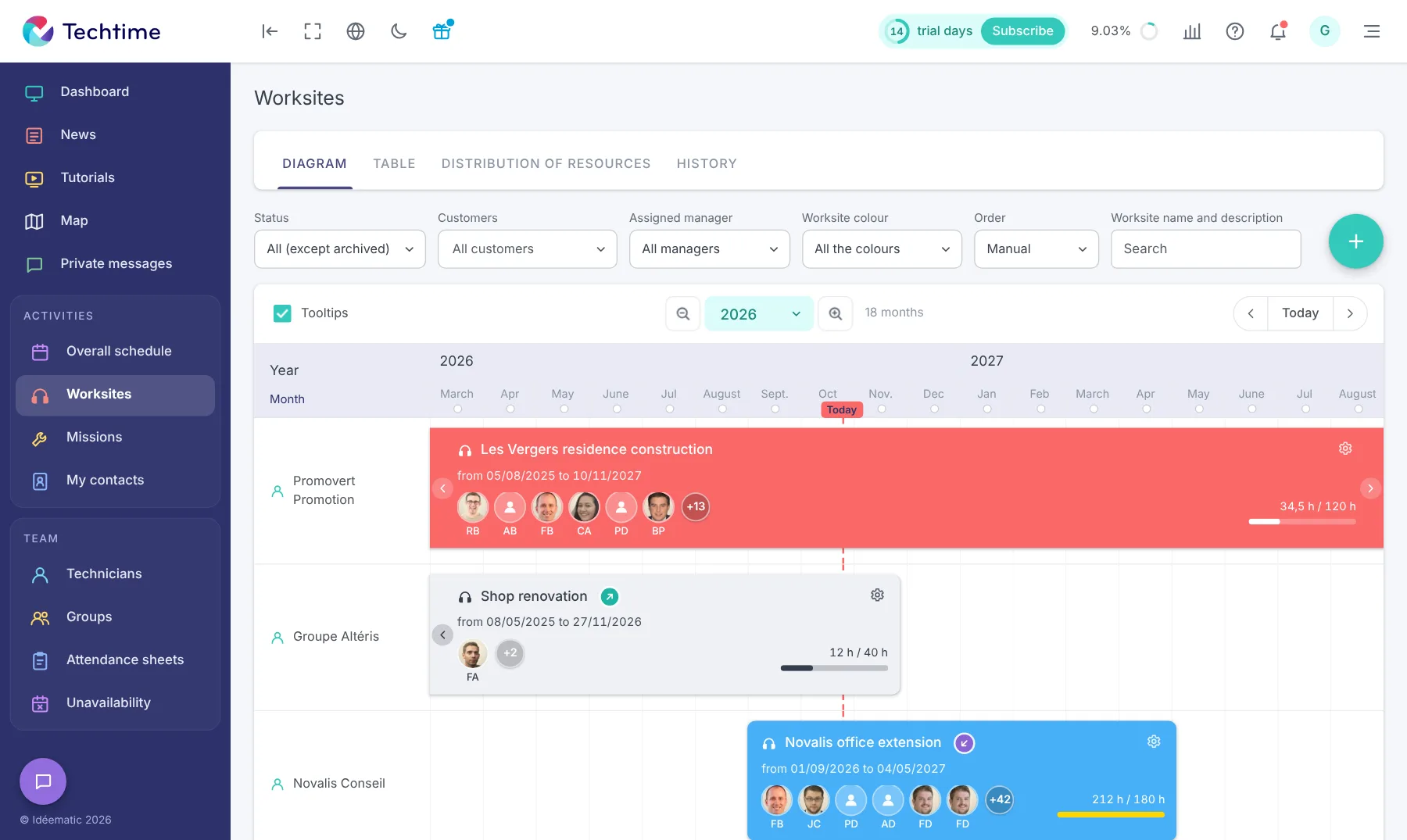
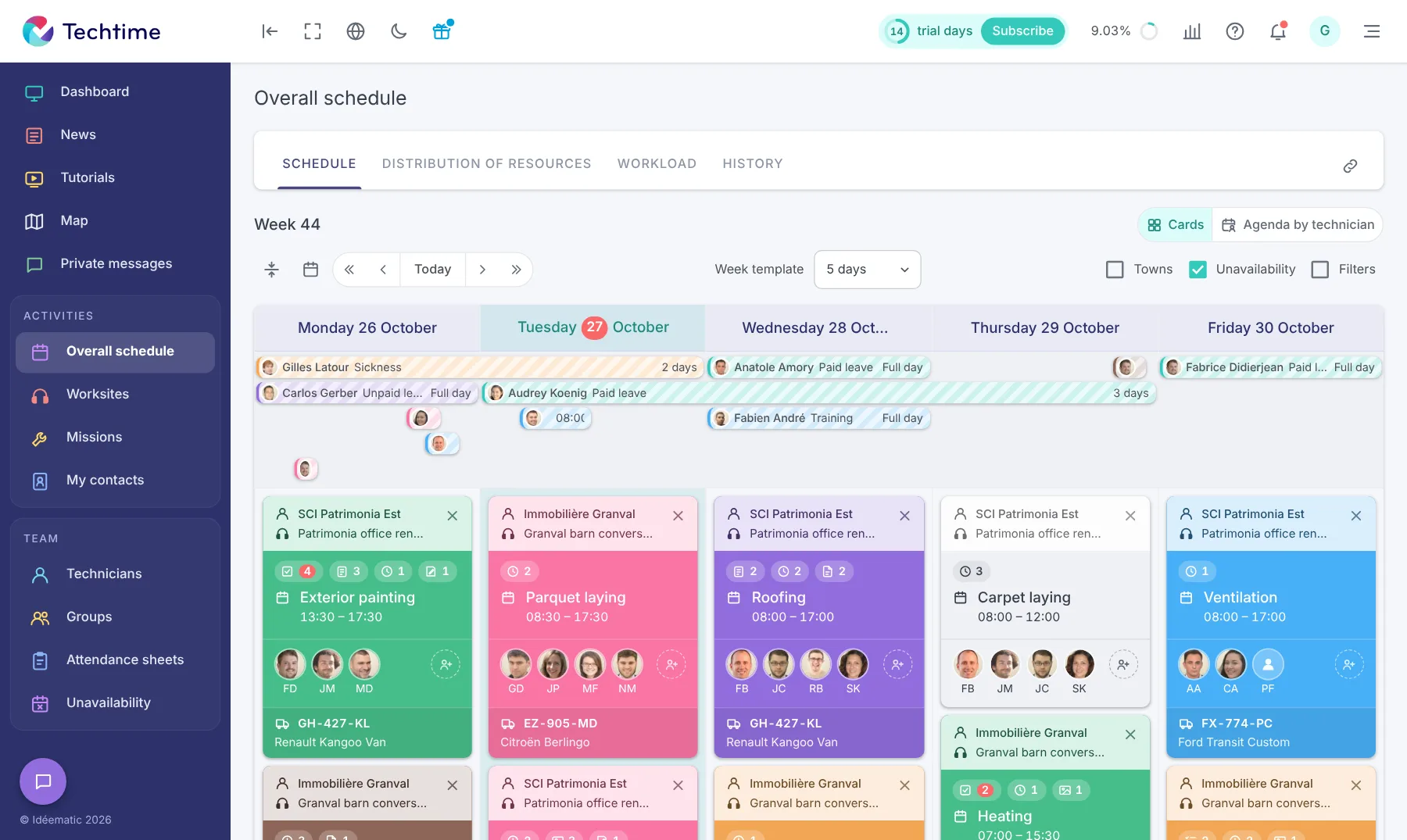
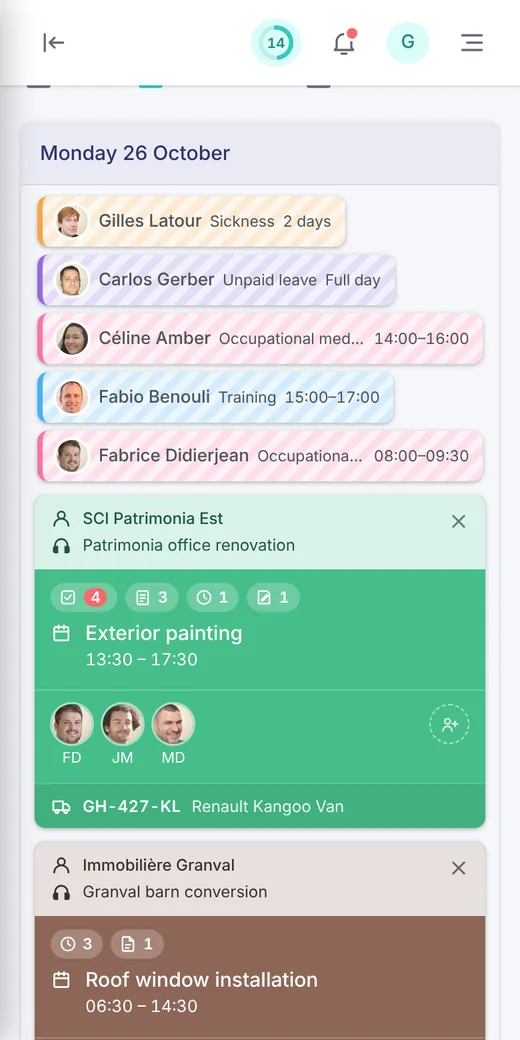
The Techtime mobile app turns an HR constraint into a controlled scheduling decision. Its electronic document management (EDM) lets you centralise all the information on your technicians and tradespeople, including when they are unavailable. By entering their timesheets in the mobile app, they let managers see unavailability on the worksite schedule. Thanks to real-time synchronisation of data, site managers can act quickly on how teams are organised in the field.
The sharing of worksites between companies proves invaluable in case of high absence, to meet project deadlines. Feel free to discover other features that will help you keep your business running efficiently while respecting your technicians’ rest.
Frequently asked questions
How do you earn a split-leave day in construction?
The employee must have taken 12 consecutive working days before 1 November, then 3 to 5 days of their first 24 days of leave between 1 November and 30 April: they then earn one extra day of leave. From 6 days, they earn two.
Who pays for split-leave days?
The Construction Leave and Bad Weather Fund (CIBTP) or the National Fund of Public Works Contractors (CNETP). The CIBTP pays the allowance to the employee and deducts it from the company’s overall contribution; the CNETP advances payment, then the employer reimburses the allowance and contributions.
Can split-leave days and RTT days be combined?
Yes. RTT days and split-leave days are independent of each other, so they can be combined.