


Please note: this article refers to French regulations and standards.
Managing a worksite waste skip is subject to ever-stricter regulations and to the need for economic performance. According to resources from ADEME and SDES, French construction companies produced 227.5 million tonnes of waste, or 70% of all waste generated in the country. Every skip becomes a cost item to be managed precisely.
Poor management leads to extra costs, delays and penalties. Conversely, rigorous organisation improves profitability and secures your operations. This guide sets out the technical, logistical and regulatory choices to master.
In brief
Managing a worksite skip well limits extra costs and penalties. Sorting at source is mandatory: inert, non-hazardous and hazardous waste. Under the REP PMCB, correctly sorted streams can be taken back free of charge, whereas mixed waste gets the skip requalified as unsorted DIB, which is more expensive to treat. Choose the skip according to the waste and access (hook-lift from 8 to 30 m³, chain-lift in town), size it taking density and bulking into account, and plan ahead for the street occupation permit, which can take up to 2 months to process.
1Why does your choice of worksite waste skip matter so much for profitability in 2026?
Choosing a worksite skip is no longer just a question of volume. It directly affects your removal costs, your deadlines and your regulatory compliance.
The direct financial impact of sorting
Sorting worksite waste at source is governed by decree no. 2021-950 of 16 July 2021 and articles D.543-278 et seq. of the French Environment Code. The producer or holder must sort non-hazardous construction and demolition waste into the applicable regulatory streams: paper/cardboard, metal, plastic, glass, wood, mineral fraction, plaster and, since 2025, textiles. However, depending on recovery conditions, some streams can be kept together without losing their recyclability.
To better identify recycling potential and hazards, this waste falls into 3 categories:
- Inert waste: concrete, bricks, roof tiles (sent to an inert waste storage facility, or ISDI)
- Non-hazardous waste: wood, plastics, metals, cardboard, non-hazardous insulation, etc. (often still called DIB, ordinary industrial waste, on site)
- Hazardous waste: asbestos, solvents, contaminated soil
The cost of a skip generally covers transport, the equipment hire period and treatment at the sorting centre. This expense can vary by area and by the company that owns the skip. However, a poorly sorted skip is downgraded to mixed waste (DIB), at a much higher cost.
The REP PMCB scheme
The REP PMCB (extended producer responsibility) scheme directly changes how waste treatment costs are managed. Since it came into force, waste from building products and materials can be taken back free of charge at partner collection points, provided the sorting instructions are strictly followed.
This scheme is financed by an eco-contribution built into the price of products placed on the market. For the construction company, this cost is therefore already included in the purchase of materials.
Under this scheme, the following streams can be taken back free of charge when correctly sorted:
- Mineral materials: concrete, bricks, roof tiles, floor tiles
- Non-mineral materials: wood, metals, plastics
Since 1 January 2025, some platforms can accept a residual skip free of charge for PMCB waste that does not meet the detailed sorting instructions. This applies to certain insulation or damaged joinery. However, as the French Building Federation (FFB) points out, this tolerance remains regulated and depends on the outlets.
Conversely, mixing waste in the same skip leads to requalification as unsorted DIB. For example, a few sheets of plasterboard mixed with rubble are enough to exclude the skip from recovery (Koncrete).
Field example: a structural works company removes 10 skips of clean rubble at €350 excl. VAT each, i.e. €3,500. If these skips are requalified as DIB, the cost rises to around €460 to €485 excl. VAT per skip. The bill reaches nearly €4,800, i.e. +30% with no extra volume.
The risk of legal and administrative penalties
Failure to comply with the regulations can lead to a formal notice, a daily penalty of up to €1,500 and an administrative fine of up to €150,000 (source: Légifrance). Some criminal offences, such as abandoning waste, transporting it without following the applicable requirements or handing it over to an unauthorised facility, can be punished by 4 years’ imprisonment and a €150,000 fine.
The producer remains liable until the final outlet. Every sorting or traceability error can lead to an inspection or requalification of the waste.
Compliance no longer relies on paper documents. It is based on digital tracking systems, with a requirement for continuous traceability. According to the Trackdéchets FAQ:
- Hazardous waste requires a regulatory, paperless waste tracking form (BSDD);
- The treatment of non-hazardous waste is recorded in reliable proof of drop-off, weighing and removal, to document the final destination of the streams.
2How do you choose the right type of skip for your works?
The choice of equipment depends on the type of waste, the volume and the site access constraints. A poor choice makes handling harder and increases costs.
The hook-lift skip: versatility for large volumes
The hook-lift skip (Ampliroll) works with a hydraulic hook arm. It takes large volumes, generally from 8 to 30 m³. It suits worksites generating continuous waste streams. Its fast turnaround limits waiting times. It works just as well for rubble as for non-hazardous waste.
This type of skip makes logistics easier on long projects. It reduces interruptions caused by collections.
The chain-lift skip: the solution for tight urban access
The chain-lift skip uses a system of side arms. It offers better manoeuvrability in urban areas or narrow access. It is often used on town-centre worksites. It needs less space than a hook-lift skip.
It is suited to intermediate volumes. It makes operations safer in constrained environments.
- Hydraulic hook arm
- Generally 8 to 30 m³
- Fewer collections on long projects
- Side arms, better manoeuvrability
- Ideal in town centres and narrow access
- Intermediate volumes, less space needed
Specialist skips: heavy rubble, DIB and hazardous waste
Some situations call for specific equipment. The choice of skip must take into account the density and type of materials. The most common options include:
- Reinforced skips for heavy rubble
- Large-volume skips for light DIB
- Watertight skips for hazardous waste
- Lidded skips to prevent fly-tipping
A lidded skip prevents outsiders adding waste overnight. It avoids an unexpected increase in weight and in the bill.
3How do you size your needs and avoid extra transport costs?
Sizing a skip relies on precise physical data. A rough estimate leads to unnecessary rotations or overloading.
Calculating the real volume: density and bulking factor
Material density varies widely depending on the type. Several professional sources, such as Ecodrop or Aquibenne, give the following figures:
- Between 1.4 and 1.7 t/m³ for soil and rubble;
- Between 0.1 and 0.6 t/m³ for DIB.
This difference directly affects the choice of skip and the transportable load. On top of this comes the bulking factor. After demolition, the volume of materials increases because air gets in between the fragments. Demolished concrete can thus increase in volume by 30% to 50% (Travaux Béton).
An accurate calculation avoids common mistakes on site. For example, 100 m³ of concrete in place produces around 150 m³ of waste once loaded into skips, taking bulking into account. On a demolition worksite, a tradesperson who orders 10 skips of 10 m³ for 100 m³ of concrete quickly runs out of capacity. They have to add around 5 extra skips, leading to a temporary build-up of rubble and slowing the worksite down.
The choice of skip volume must also take into account the truck’s payload. A 30 m³ skip is not always suitable for heavy materials. Filled with rubble estimated at 1.4 to 1.7 t/m³, its load could in theory reach 42 to 51 tonnes, excluding the weight of the vehicle and skip. This load far exceeds the gross vehicle weight (PTAC) of 32 tonnes for a 4-axle rigid truck. The haulier then refuses the collection, which forces rotations to be split and disrupts worksite logistics.
Optimising fill rates and rotation cycles
The fill rate directly affects your transport costs. An under-filled skip increases the cost per tonne removed. An overloaded skip blocks collection, leading to delays and penalties.
To optimise your rotations, it is advisable to:
- Plan collections according to actual progress;
- Put heavy waste at the bottom of the skip;
- Monitor filling visually.
Field example: a tradesperson doing interior renovation removes DIB in 30 m³ skips. Because they fill them only halfway, they pay for two rotations instead of one. By optimising filling, they halve their transport costs.
With Techtime, site teams can photograph skips and share them via instant messaging. The site manager approves the fill level before ordering a collection.
4What are the regulatory obligations for skip placement and traceability?
Managing a skip is not just about filling it. It involves administrative procedures and precise regulatory follow-up.
Obtaining a street occupation permit: timescales and Cerfa procedures
Any skip placed on the public highway requires a specific temporary occupation permit (AOT):
- Either a parking permit (permis de stationnement) to place a rubble skip on the pavement or road;
- Or a roadworks permit (permission de voirie) for works that alter the ground or subsoil.
Processing times vary by municipality. In practice, some applications are handled in a few days or weeks, but processing can take up to 2 months. Planning ahead is essential to avoid any hold-up.
No permit means a fine and immediate removal of the skip. For example, a renovation tradesperson places a skip in a town centre without a permit. The municipal police require it to be removed within 24 hours. As a result, the worksite is halted and incurs extra redelivery costs.
Good to know: applications are increasingly made online via municipal platforms.
The Trackdéchets revolution: towards 100% digital traceability
Waste traceability is now part of a gradual move to digital. How these new practices apply depends on the type of worksite waste. In line with the 2021 decree, paperless tracking forms via Trackdéchets are now standard for hazardous waste and certain specific streams, notably asbestos, refrigerants, infectious healthcare waste (DASRI) and end-of-life vehicles (VHU).
The platform can also be used for non-hazardous waste, but its use is not generally required for all streams.
Traceability through to the final outlet must be documented to a standard that varies with the type of waste and the regulations applicable to each stream. Requirements are currently stricter for hazardous waste, for example, but are gradually extending to all streams. This transition calls for rigorous organisation and suitable tools.
5How do you integrate worksite skip management into your Techtime tracking app?
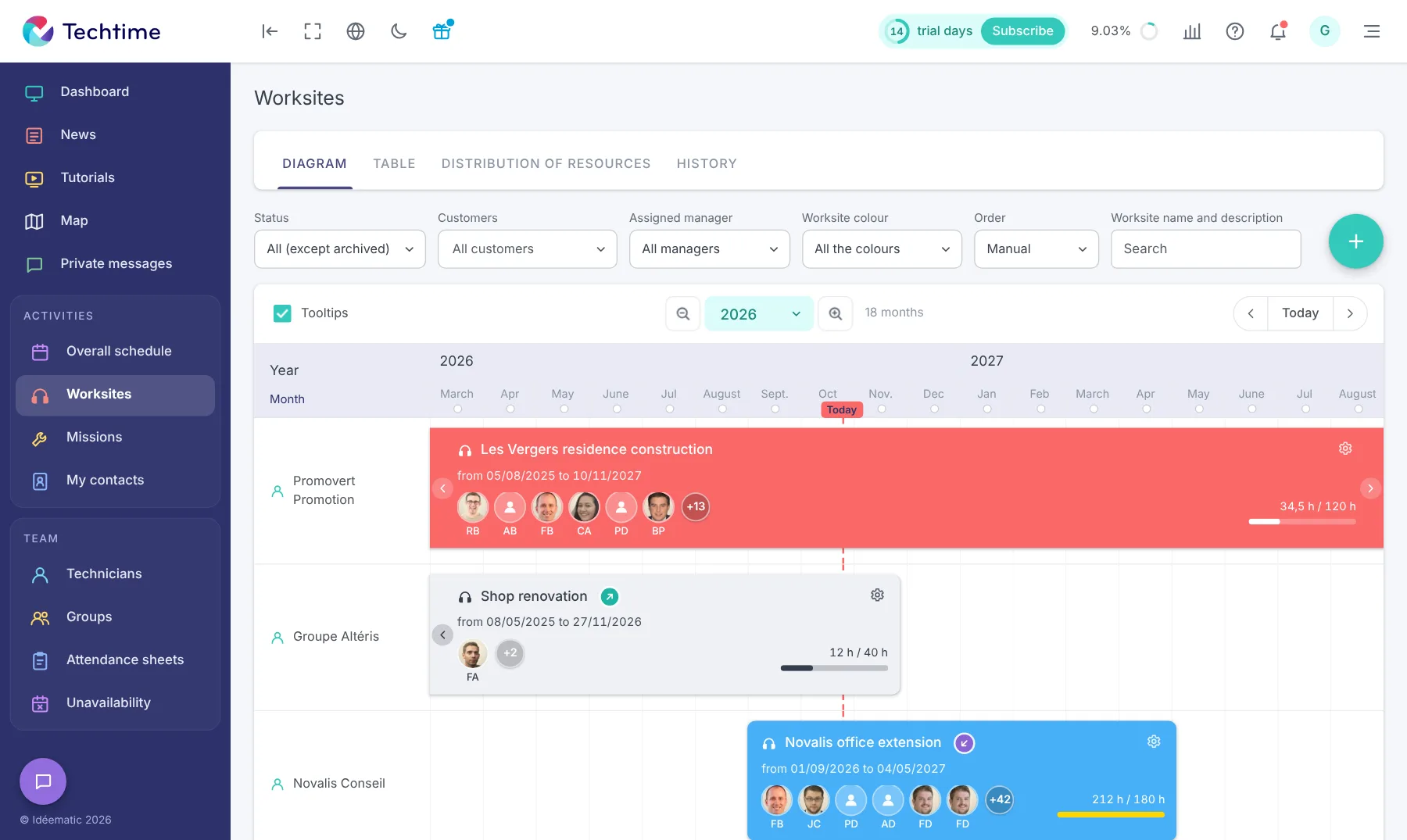
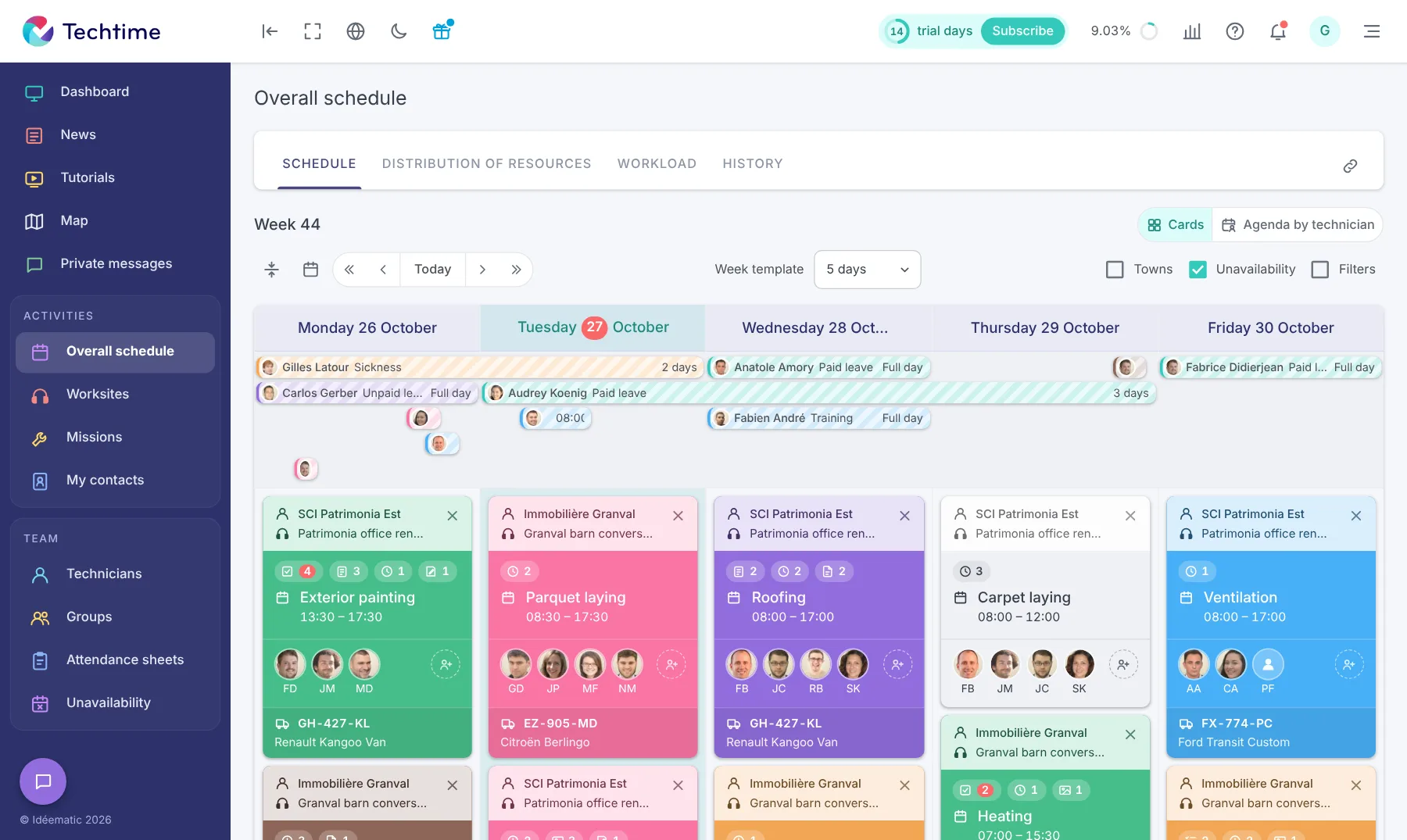
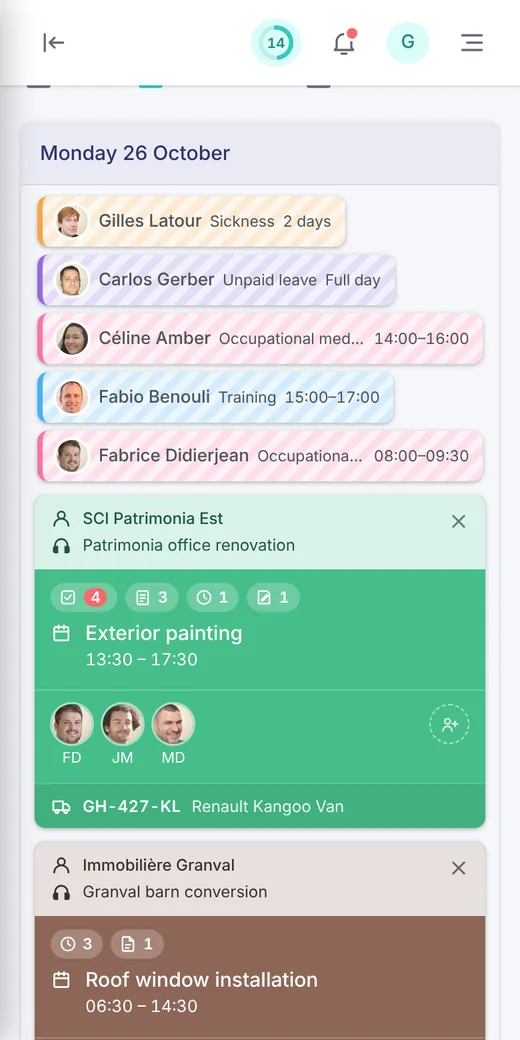
Worksite skip management must be part of your overall worksite management. It can no longer be kept separate from the rest of your operations. On the ground, skip management involves several people: team leader, site manager, haulier, sorting centre. Without a shared tool, supporting documents are quickly lost and collections are harder to manage. Techtime centralises waste-related data directly in worksite tracking. Thanks to Electronic Document Management (EDM), teams have real-time access to essential information such as:
- Tracking skip rotations;
- Centralising weighbridge tickets;
- Archiving regulatory documents;
- Viewing on the site layout plan.
This approach reduces errors and secures your operations. It also makes inspections easier in the event of an audit. By integrating waste logistics into your tracking tool, you gain visibility and responsiveness.
Frequently asked questions
What types of worksite waste need to be sorted?
Inert waste (concrete, bricks, roof tiles), non-hazardous waste (wood, plastics, metals, cardboard, non-hazardous insulation) and hazardous waste (asbestos, solvents, contaminated soil).
Which skip should you choose for your worksite?
The hook-lift skip, generally 8 to 30 m³, suits large volumes and continuous streams. The chain-lift skip is easier to manoeuvre in urban areas and narrow access. Specialist skips exist for heavy rubble, light DIB and hazardous waste.
Do you need a permit to place a skip on the public highway?
Yes: a parking permit for a skip placed on the pavement or road, or a roadworks permit if the works alter the ground. Processing can take up to 2 months; without a permit, the company faces a fine and removal of the skip.
Optimise your worksite management with other tailor-made features