


Please note: this article refers to French regulations and standards.
Electronic invoices are invoices issued and then sent in a dematerialised, structured form (article 289 bis of the French General Tax Code). Unlike a scanned invoice, an e-invoice is processed on a dematerialisation platform such as the public portal Chorus Pro for construction work. Since 2017, 140 million electronic invoices have been processed on this platform (source). After public-sector professionals, this obligation will gradually extend to private companies from 2026. How can you make a successful transition to e-invoicing in construction?
In brief
E-invoicing is becoming mandatory between VAT-registered companies in France: from 1 September 2026 for large and mid-sized companies, and from 1 September 2027 for SMEs and micro-entrepreneurs. Invoices must carry new mandatory details, including the SIREN number and the type of transaction. Non-compliance carries a fine of €50 per invoice, capped at €15,000 per year. In return, dematerialisation saves time and money and reduces errors and unpaid invoices.
1E-invoices: what are the key points to remember?
Mandatory e-invoicing addresses several issues. The first challenge is economic: the aim is to improve business productivity by simplifying administrative tasks. The French Ministry of the Economy and Finance expects savings of €4.5 billion a year for 4 million companies (source).
The second issue concerns VAT (value added tax). By pre-filling VAT returns (e-reporting), the State intends to step up its fight against tax fraud. Invoices must go through an approved platform (PA), with the public invoicing portal now serving only as a central directory (formerly PDP). Platforms are registered for a renewable three-year period (source).
Who is affected by e-invoicing?
The timeline provides for a gradual roll-out of e-invoicing for private companies. E-invoicing rules are phased in according to company size (source):
- Large companies and mid-sized companies must issue digital invoices from 1 September 2026. From that date, all companies, whatever their size, must also be able to receive electronic invoices.
- Small and medium-sized enterprises (SMEs) and micro-entrepreneurs must do the same from 1 September 2027.
- 11 September 2026large and mid-sized companies
- 21 September 2027SMEs and micro-entrepreneurs
Invoice dematerialisation covers all transactions between VAT-registered companies based in France. These may be:
- purchases or sales of goods, as well as services;
- deposits on transactions;
- transactions with operators abroad, unless customs collect the data.
What new mandatory details will appear on your construction e-invoices?
An e-invoice has the same legal value as a conventional paper invoice because it carries the same mandatory details. These include the invoice number, the date of issue, the total amount excluding VAT and the date of the transactions. However, new mandatory details will have to appear on your electronic invoices:
- your company’s SIREN number;
- the type of transaction (supply of goods, services or mixed transactions);
- the delivery address of the goods if it differs from the customer’s address;
- the statement “option to pay VAT on a debit basis”.
You must issue your e-invoices in one of the three authorised formats: UBL, CII or Factur-X. A plain PDF is not enough. Factur-X is a hybrid invoice (a readable PDF that contains the structured data) suited to micro and small businesses. UBL and CII are structured data formats processed automatically by software.
Structured data format (XML)
Hybrid invoice, suited to micro and small businesses
Structured data format (UN/CEFACT)
What are the penalties for failing to comply with dematerialisation rules?
Article 1737 of the French General Tax Code sets out the following penalties. If you fail to meet the e-invoicing obligation, you face a fine of €50 per invoice, up from €15 before the 2026 Finance Act. The total is capped at €15,000 per calendar year (source).
If you fail to comply with e-reporting (sending transaction data electronically), you risk a fine of €500 per transmission. The annual cap is the same as for failing to comply with e-invoicing. In both cases, a first offence is not penalised if it is corrected spontaneously or within 30 days of the tax authority’s request. Not having an approved platform to receive your invoices is also penalised: €500, then €1,000 every 3 months for as long as the situation continues, after an initial 3-month period to comply.
2What are the benefits of e-invoicing in construction?
E-invoicing offers many benefits for construction professionals. It meets both your profitability targets and your environmental goals:
- You save time generating and sending your electronic invoices. You can better manage your equipment fleet.
- You save money, not only on ink and paper, but also by shortening payment times. According to the GS1 France report, a paper invoice costs an estimated €8 to €9.50. An e-invoice costs only around €5.
- You reduce the risk of errors and unpaid invoices. E-invoices are easier to track and archive, thanks to better readability. You can follow the payment status of your project in real time while keeping control of your cash flow. As automation reduces the risk of mistakes or omissions, you lower the risk of disputes with your customers, suppliers or the authorities.
- You help fight global warming by combating the deforestation linked to paper production. The ZeenPlanet programme estimates that the carbon footprint of e-invoicing is 63% lower than that of paper invoicing (source).
Find out more about the challenges of dematerialisation in the construction sector in this article.
3Why use construction software to produce your e-invoices?
Worksite management software can handle the following functions:
- Issuing quotes and electronic invoices in the same place. Documents can be converted to PDF to make them easier to send. A single command sends them automatically to your customer or suppliers.
- Tracking movements on your business bank account in real time. You keep control of your cash flow and your profitability.
- Applying the right prices and VAT rates. Your margin is calculated automatically. You choose the management method that best suits your worksite schedule.
A study by Generix Group shows that 52% of the companies surveyed confirm the reliability of e-invoicing for data processing. In 2023, more than 80% of companies had adopted invoice dematerialisation solutions.
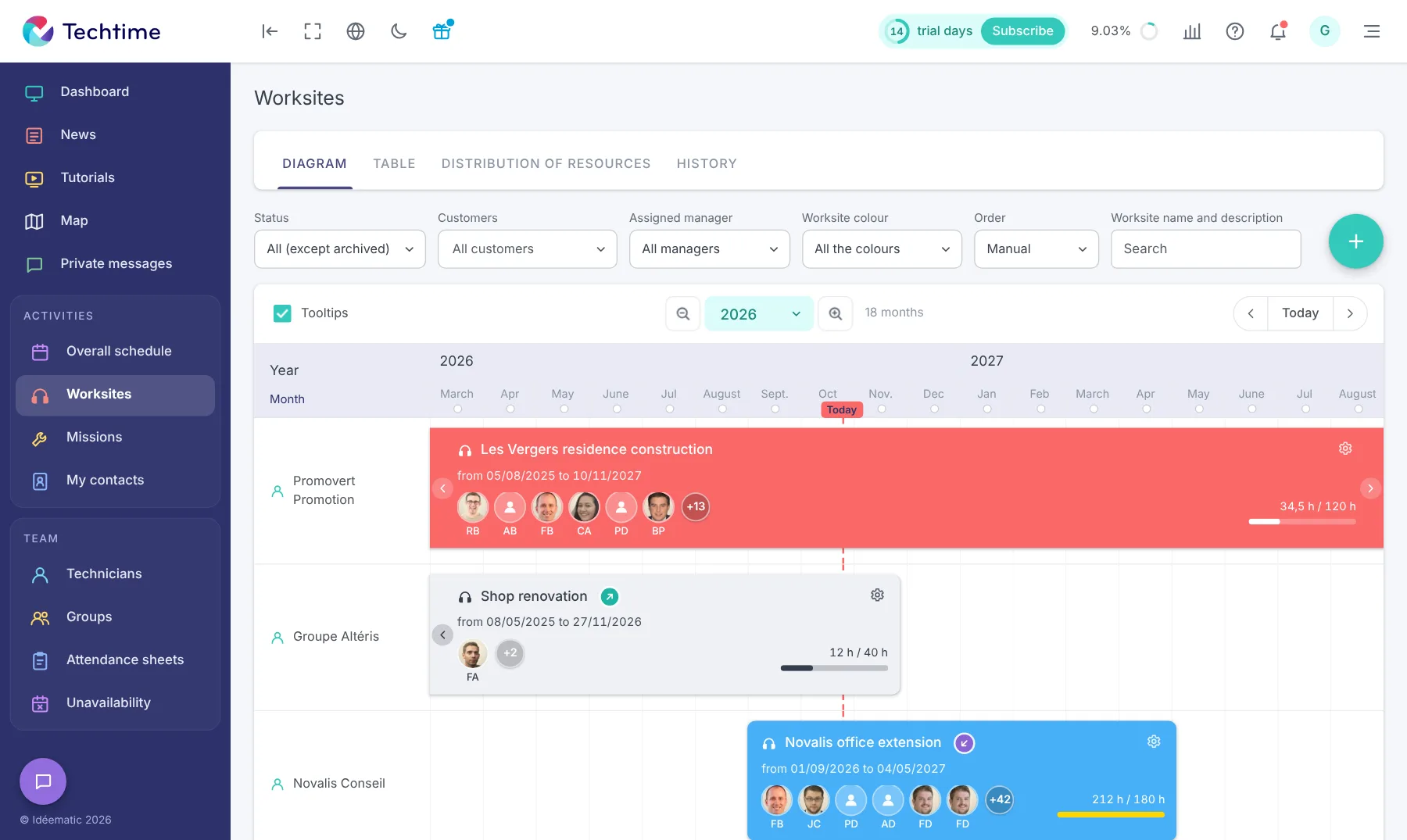
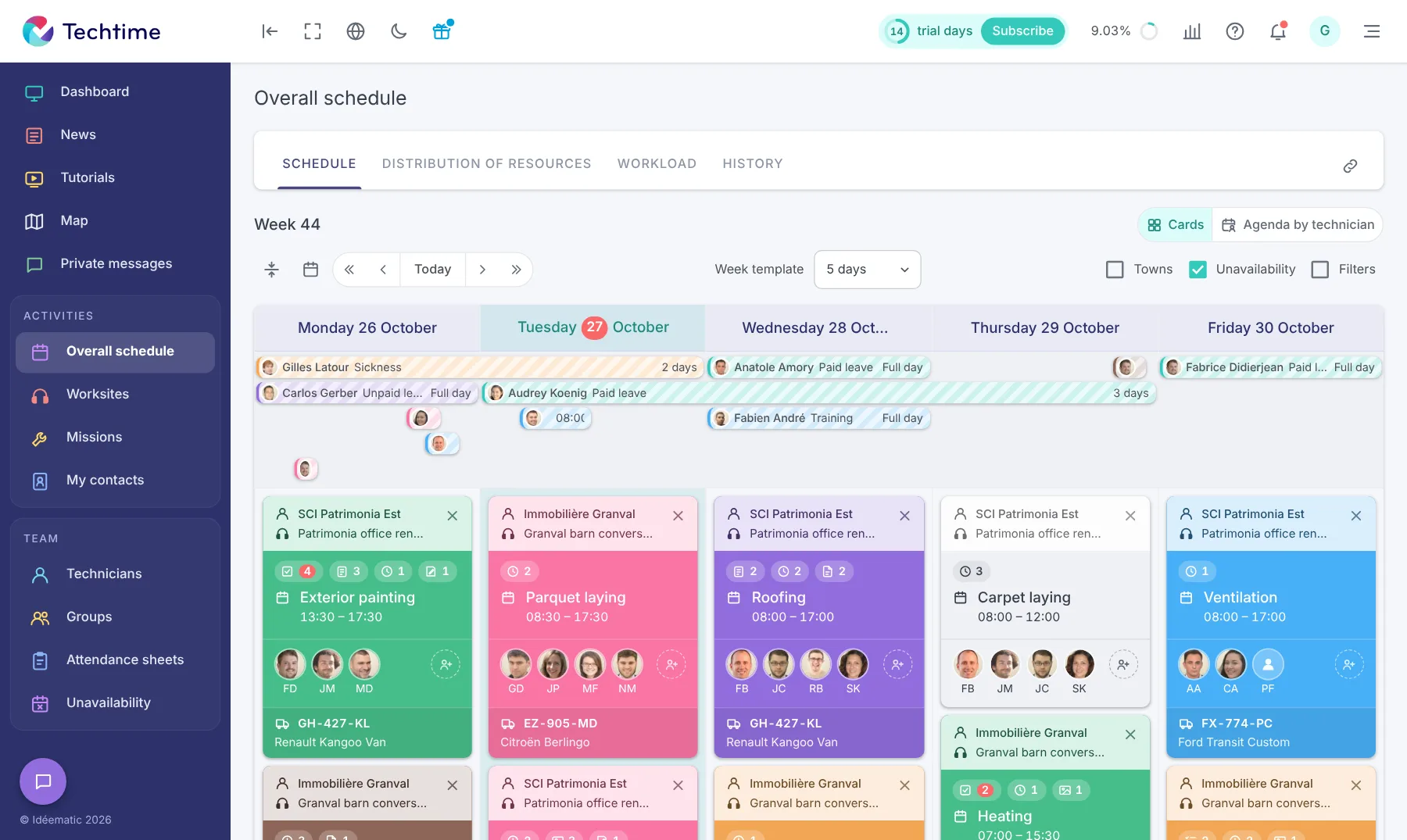
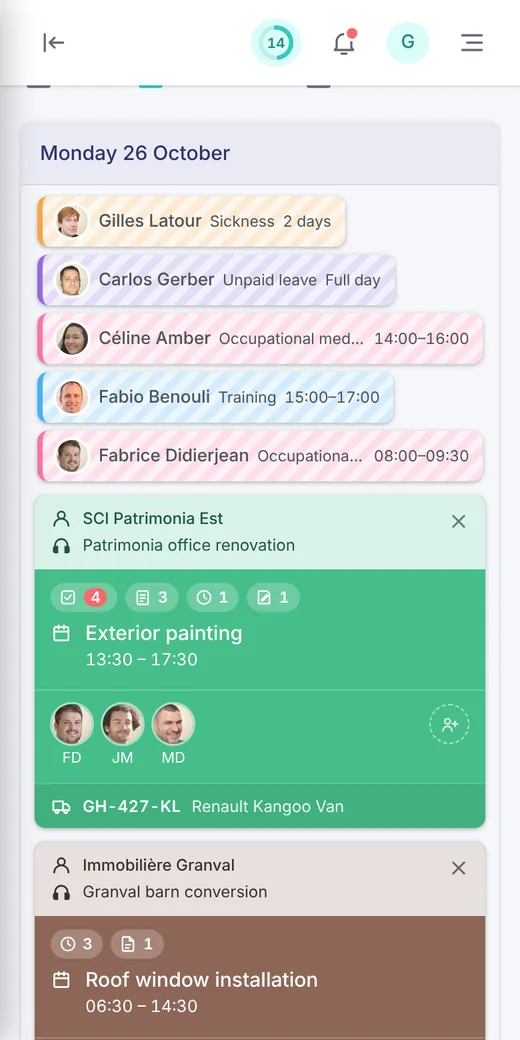
With Techtime, you get document centralisation (worksite EDM) to centralise important worksite documents. You save more time when you come to invoice your services.
When e-invoicing applies to your construction company depends on its size. Your transition will take place in 2027 at the latest. In the meantime, you can contact our business support experts to get up to date on the new invoicing rules.
Frequently asked questions
When does e-invoicing become mandatory in construction?
From 1 September 2026 for large and mid-sized companies, and from 1 September 2027 for SMEs and micro-entrepreneurs.
What new details must appear on an e-invoice?
In addition to the usual details: the company’s SIREN number, the type of transaction (supply of goods, services or mixed), the delivery address if it differs from the customer’s and, where applicable, the statement “option to pay VAT on a debit basis”.
What are the penalties for non-compliance?
A fine of €50 per invoice that does not meet the obligation, capped at €15,000 per calendar year, and a fine of €500 per transmission for failing to comply with e-reporting.