


Please note: this article refers to French regulations and standards.
The fires that broke out in France in summer 2026 showed that a construction company can have its business interrupted even if its premises are not directly hit by the flames. Batirama reports in particular halted worksites, facilities closed to access, supply difficulties and employees stood down. All these factors can be enough to disrupt the company’s business.
To limit the consequences, three priorities stand out: protecting employees, reporting the loss quickly and drawing on the cover and support schemes that actually apply.
As droughts and heatwaves become more frequent and intense, the risk of forest and vegetation fires is gradually spreading to new areas. What financial support after a fire can help a construction company? Insurance, short-time working and contribution deferrals exist, but their effectiveness depends on how well the company was prepared before the loss.
In brief: what support is available after a fire?
After a fire, a construction company can benefit from several support schemes, provided it acts quickly and documents the impact of the loss precisely. Before applying for this support, the employer must first protect employees and preserve essential documents. Next, it organises worksite continuity to limit business interruption losses.
| Solution | Contact | Key condition | Type |
|---|---|---|---|
| Fire cover | Insurer | Damage covered by the policy | Contractual |
| Business interruption | Insurer | Cover taken out and event covered | Contractual |
| Short-time working | Labour administration | Business stopped or impossible to maintain | Public |
| Payment deadlines | Urssaf / tax offices | Difficulties linked to the loss | Public |
| CPSTI aid | Urssaf | Eligible self-employed worker | Social |
| PRO BTP/CIBTP measures | Organisation concerned | Exceptional scheme open | Temporary |
1What support and cover can you draw on after a fire?
Insurance remains the first source of compensation
The first source of compensation remains the company’s insurance policy. According to France Assureurs, business interruption cover can compensate for part of the drop in revenue while the business is interrupted.
A commercial multi-risk policy can cover premises, equipment and stock, but it does not automatically cover all the company’s assets or uses. Vehicles, construction plant and business interruption losses require suitable cover, built into the policy or taken out separately as the case may be.
Good to know: when damage results from a wildfire and failure to meet legal brush clearance obligations is established, the insurer may apply, on top of the excesses in the policy, an additional excess of up to €5,000. This condition is set out in article L 122-8 of the French Insurance Code.
It is important to distinguish a wildfire from the natural disaster scheme. In most cases, it is the policy’s “fire” cover that applies. The “Cat Nat” scheme covers specific phenomena and requires the publication of an interministerial order (article L 125-1 of the French Insurance Code). Wildfires in principle fall under fire cover and not the Cat Nat scheme.
- Provided by the company’s insurance policy
- Additional excess of up to €5,000 if brush clearance obligations are not met (art. L 122-8)
- Covers specific phenomena
- Requires an interministerial order (art. L 125-1)
- Does not in principle apply to wildfires
Key point:
The exceptional measures announced after the summer 2026 fires are not automatic. They concern certain companies located in affected or evacuated areas and depend on the conditions set by each organisation.
What support can supplement compensation?
When the loss causes the business to stop or slow down, several schemes can supplement the insurance compensation. Depending on its situation, the company can in particular:
- apply for short-time working (activité partielle) from the labour administration when the loss, an evacuation or an administrative ban temporarily prevents the business from continuing. In exceptional circumstances, the application can be filed within thirty days of employees being placed on short-time working;
- request a deferral of social security contributions from URSSAF (Service Public Entreprendre);
- benefit from aid from the CPSTI (council for the social protection of self-employed workers), up to €2,000 (Batiweb).
Chambers of Commerce and Industry (CCI), professional organisations (FFB, CAPEB, FNTP), Chambers of Trades and Crafts and departmental advisers for businesses in difficulty can direct affected companies to the schemes applicable to their situation.
Better organise your worksite information
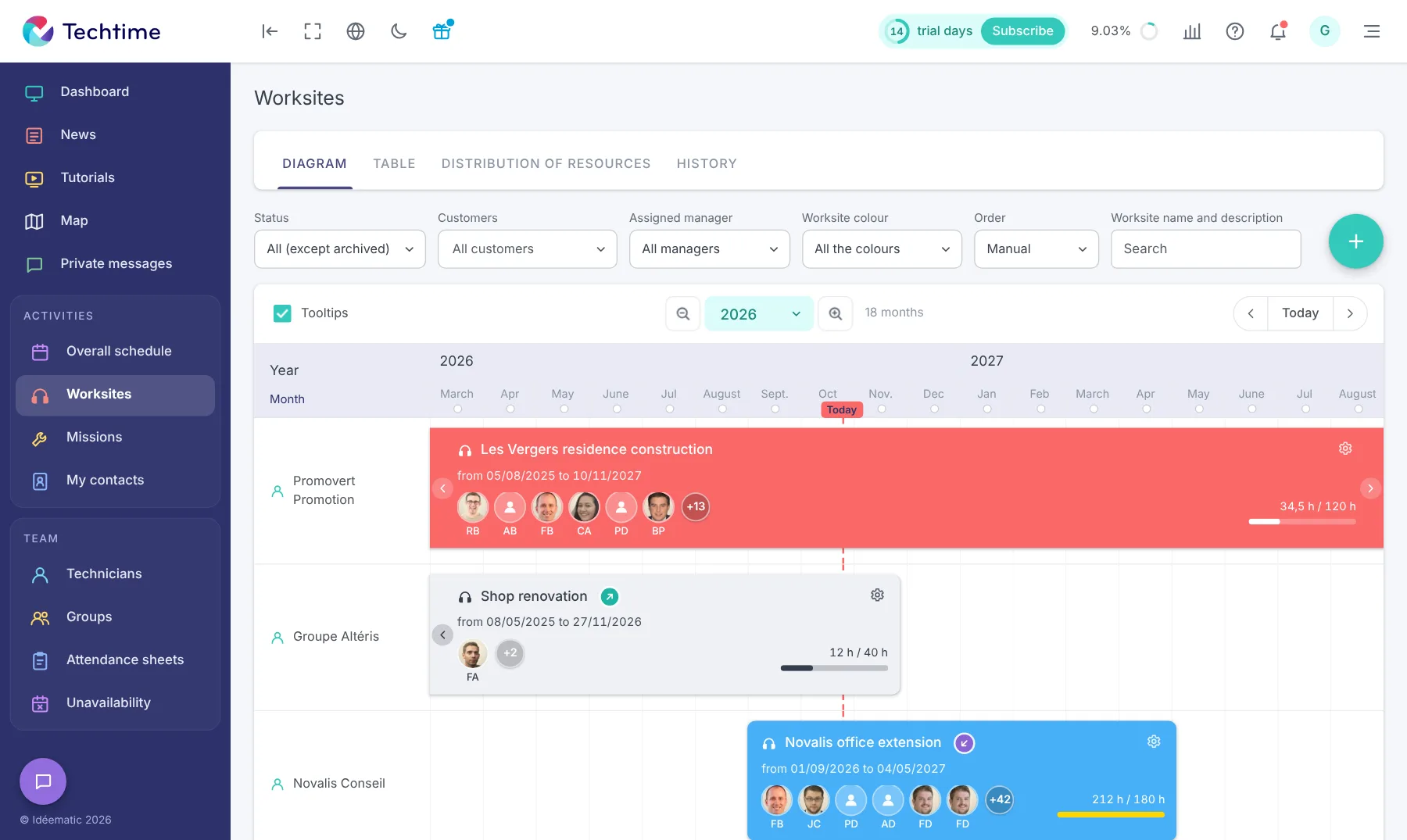
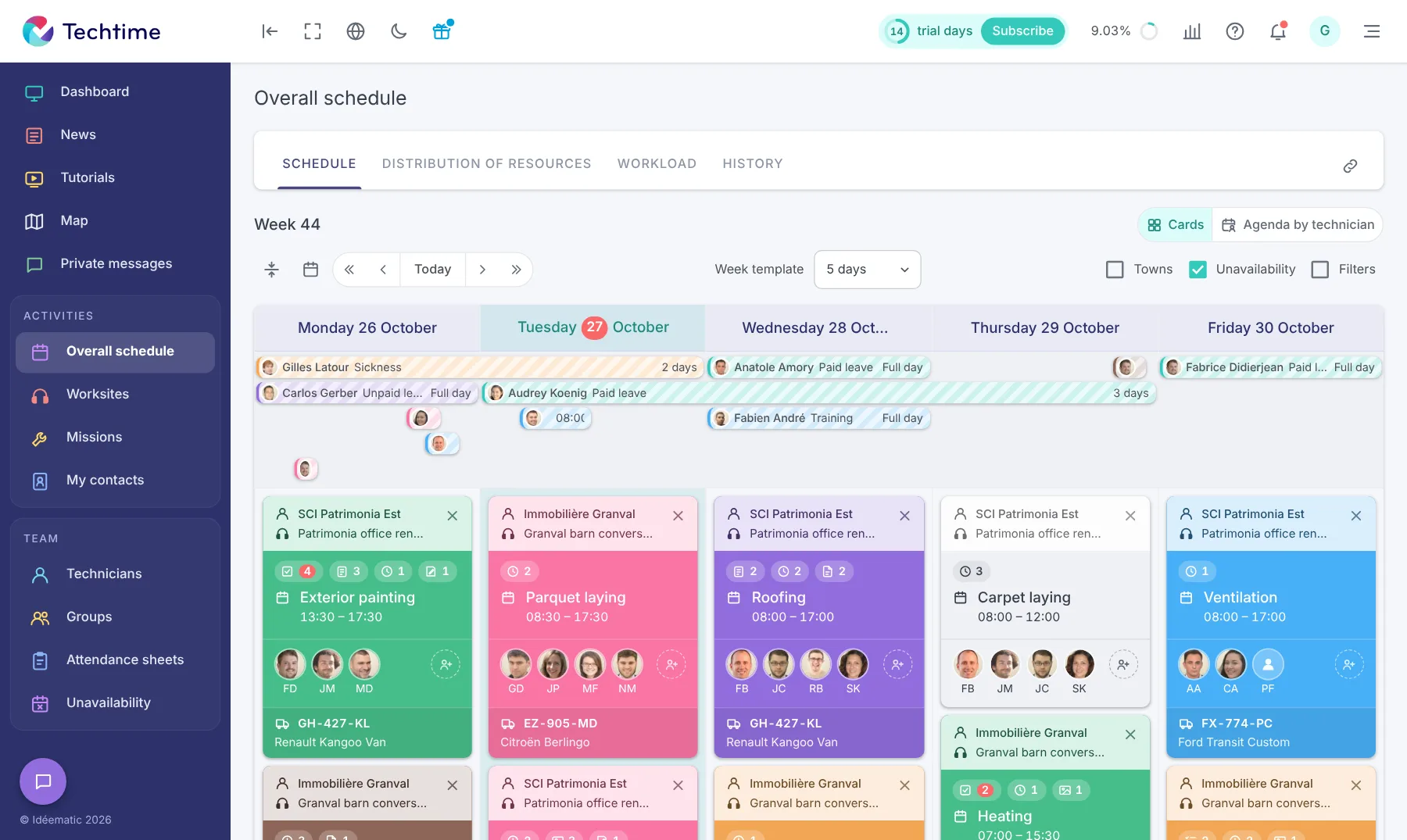
Find out how Techtime supports tradespeople and construction company managers.
What exceptional measures were announced after the 2026 fires?
After the summer 2026 fires, PRO BTP (the construction sector’s social protection group) announced exceptional measures for certain companies located in affected or evacuated areas. These include cancelling one month of contributions, waiving late-payment penalties and surcharges, and personalised support. The group also set up a €5 million emergency fund for affected or evacuated individuals. This fund is not direct cash-flow support for companies.
The CIBTP network (construction paid-leave and bad-weather funds) has also introduced, on an exceptional basis, a temporary scheme covering certain worksite stoppages under the bad-weather unemployment scheme. It applies in particular to companies whose worksite or head office is located in a department subject to evacuations, access bans or traffic restrictions linked to the fires. Eligibility must be checked with the relevant CIBTP fund.
Important:
Information checked as of 4 August 2026. Exceptional measures may be changed, extended or withdrawn; their availability must be confirmed with the organisation concerned.
How quickly this support is obtained depends largely on the quality of the file submitted. An inventory of damaged equipment, accounting records and an estimate of business interruption losses make it easier to process applications.
First lever · Fire cover · business interruption (if taken out)
In addition · Short-time working · deferral of Urssaf contributions · CPSTI aid up to €2,000
Not automatic · PRO BTP · CIBTP (exceptional bad-weather scheme) · depending on affected or evacuated area
To find your way · CCI · FFB · CAPEB · FNTP · Chambers of Trades · departmental advisers
2What steps should you take in the first few hours?
Once the teams are safe, the company must report the loss to its insurer promptly, within the deadlines set by the policy. In exceptional disasters, these deadlines may be extended by insurers or the authorities. It is nevertheless better to act without delay to make the loss adjuster’s work easier.
After taking the protective measures essential for safety, gather the evidence needed to assess the damage precisely: photos, videos, an inventory of damaged equipment, invoices, rental agreements and repair quotes. Where possible, keep the damaged items until the loss adjuster has visited and avoid starting non-urgent repairs before the insurer agrees. Also remember to document the impact on the business (halted worksite, inaccessible depot, business interruption losses) in Electronic Document Management (or EDM).
Quickly inform the client, the project manager, customers, subcontractors and the suppliers concerned. This communication makes it possible to reorganise worksites and limit delays. A fire, an evacuation or an administrative access ban may lead the company to request a suspension or extension of the completion deadline. This adjustment is not automatic: it depends on the circumstances, the contract clauses and compliance with the notification procedures in the contract.
Key points – the 7 reflexes after a fire:
- Get employees and third parties to safety.
- Alert the emergency services and respect access bans.
- Report the loss to the insurer immediately.
- Photograph the damage and preserve evidence.
- Inform the client, customers and partners concerned.
- List the damage and business losses.
- Contact Urssaf, CIBTP, PRO BTP and professional bodies as appropriate.
3How do you protect employees and restart worksites?
During a major fire, employees may be exposed to smoke, fine particles or a significant deterioration in air quality. The employer must then reassess the risks based on the instructions issued by local authorities and air quality indices.
Depending on the situation, the French Ministry of Labour and Solidarity recommends several measures. The employer must follow the instructions of local authorities, monitor air quality, limit travel and physical exertion outdoors and favour remote working for roles that allow it. The need for respiratory protection must be assessed according to the nature of the exposure and the recommendations of the competent services.
Beyond the effects of the fire itself, restarting work also requires vigilance about residual risks. Weakened trees, damaged networks, unstable ground or materials exposed to high temperatures can endanger workers’ safety. A prior inspection of the worksite remains essential before any work resumes.
4How do you prepare the company before a fire?
During a major fire, the flames are not always the main cause of the difficulties construction companies face. Access restrictions and evacuations can be enough to stop several worksites for several days or even weeks. Batiactu cites the example of the Tout Faire group, which had to close three Fabien Matériaux branches because they were within the exclusion zone. Network outages or supply disruptions can add to these constraints and make it harder to keep the business going.
Risk management is not just about preventing fires from starting. It also aims to limit their spread, protect employees and property, and then organise business continuity and recovery. The employer must therefore seek to reduce interruptions, limit business interruption losses and make it easier to resume work quickly.
Find out more about how to ensure safety on worksites.
Priority worksites, decision-makers, partners to call on, equipment location
Contracts, plans, certificates, agreements, minutes in a backed-up EDM
Hot work: 30% of fire origins, hot work permit
Evacuation instructions, reporting, emergency contacts
Prepare a business continuity plan suited to construction
The business continuity plan (BCP) should in particular specify the worksites to be maintained as a priority; the people authorised to take decisions; the contractors or partners who can be called on; and the location of essential vehicles, plant and equipment. The CAPEB-OPPBTP guide can serve as a framework for formalising this organisation.
This preparation avoids wasting precious time when every hour counts. It also makes communication with customers, partners and insurers easier during the recovery period.
Secure the documents essential for recovery
A company can replace a vehicle or hire a new piece of plant. However, losing its administrative and technical documents can delay the restart of worksites for a long time.
It is therefore advisable to keep a secure copy of the main documents:
- signed contracts and quotes;
- construction drawings;
- insurance certificates;
- subcontracting agreements;
- site meeting minutes;
- safety documents such as the PPSPS or the prevention plan.
Electronic Document Management (EDM) hosted on remote infrastructure with regular backups keeps documents accessible when offices or the depot become inaccessible. It also makes it easier to send documents quickly to customers, insurance loss adjusters and government bodies.
Reduce the risk of a fire starting on the worksite
According to INRS (the French national research and safety institute), hot work accounts for 30% of fire origins in companies. Welding, grinding, cutting, torch-on waterproofing or using a naked flame must be covered by suitable preventive measures and, where necessary, a hot work permit.
This permit checks several essential points:
- no combustible materials nearby;
- firefighting equipment available;
- monitoring organised after the work;
- each contractor’s responsibilities.
This approach remains relevant all year round, but it is particularly important during droughts or strong winds.
Train teams and plan for crisis management
Preparation also depends on the teams. Every employee must know the evacuation instructions, how to report a fire and who to contact in an emergency. Article R4227-38 of the French Labour Code specifies the information that must appear in the fire safety instructions.
Clear organisation limits hesitation in the first hours after the loss. It then makes administrative procedures and communication with partners easier. The company can then draw on financial support schemes and compensation procedures if it falls victim to a major fire.
5Conclusion
A major fire can bring a construction company to a halt in a few hours. While insurance and financial support can soften the economic consequences, their effectiveness depends on the company’s risk management. Centralising worksite documents, ensuring their traceability and having information accessible at all times make both compensation claims and the restart of work easier.
By centralising the documents and information for each worksite, Techtime helps building companies keep a clear organisation and find the information needed to restart their business and deal with the insurer or loss adjuster more quickly.
FAQ
Have questions? We answer the main ones…
Can a company restart its worksite immediately after a fire?
Not always. Before restarting, the company must make sure the worksite is accessible and safe. A prior inspection checks in particular the stability of structures, the condition of networks, the possible presence of hazardous materials or areas still exposed to fire risk.
Is business interruption cover automatically included in an insurance policy?
“Business interruption” cover is generally offered as an option in commercial multi-risk policies. It compensates for part of the drop in revenue caused by the interruption, but only if it was taken out before the loss. It is therefore advisable to check the extent of your cover regularly.
Can a company be compensated if its premises did not burn?
Not automatically. Standard business interruption cover usually applies following material damage covered by the policy. When the company’s premises are not damaged, compensation is only possible if the policy includes a suitable extension: for example, for denial of access, a loss nearby or a supplier’s failure.
Why keep worksite documents in an EDM?
Electronic Document Management (EDM) makes it possible to find quotes, contracts, plans, insurance certificates or site meeting minutes quickly, even if the offices become inaccessible. These benefits only apply if the EDM is hosted on remote infrastructure with regular backups. This centralisation makes communication with the insurer, loss adjusters and customers easier, while speeding up the process of restarting the business.
Do companies located near a forest have specific obligations?
Yes, in certain municipalities exposed to wildfire risk. The French Forestry Code then imposes legal brush clearance obligations (OLD) around buildings and installations. Failing to meet them can increase the risk of a fire spreading and, in some cases, affect the compensation provided by the insurance policy.