


Please note: this article refers to French regulations and standards.
Heatwaves in construction have become a major issue for companies in the sector. Episodes of extreme heat are becoming more frequent throughout France. These heatwaves have a direct impact on team organisation, safety on a worksite and meeting contractual deadlines.
Faced with growing risks of dehydration, heat exhaustion and heatstroke, French regulations changed significantly between 2024 and 2025. A heatwave is now recognised as a situation that can justify a worksite stoppage under the bad-weather scheme. At the same time, employers’ prevention obligations have been strengthened.
What are the risks? What measures should be put in place? When should a worksite be stopped? Here is what building and public works companies need to know.
In brief:
Since 2024, heatwaves have been included in the construction bad-weather unemployment scheme. Since 2 June 2025, employers must include the risks linked to intense heat in their prevention approach and implement suitable measures. The main ones are risk assessment, providing cool water, adjusting working hours, rest areas and adapting protective equipment.
Prevention obligations must be distinguished from the bad-weather unemployment scheme. Prevention applies as soon as an episode of intense heat is identified, in particular during a yellow, orange or red warning. The heatwave bad-weather scheme, on the other hand, is subject to specific conditions, generally linked to an orange or red warning or a prefectoral order suspending activity.
1Immediate response
In a heatwave, the employer must assess the risks, adapt the worksite organisation and protect exposed employees. When working conditions become dangerous despite these measures, a worksite stoppage can be declared under the construction heatwave bad-weather scheme, subject to certain conditions.
2Heatwaves in construction: what has changed since 2024
Managing hot weather on worksites has seen two major changes. The first is the official recognition of heatwaves as grounds for stoppage under the bad-weather unemployment scheme. Since the decree of 28 June 2024, companies can receive compensation when certain weather conditions make work dangerous.
Heatwaves are included in these conditions following the addition of article D. 5424-7-1 to section 2 of Chapter IV of title II of book IV of part five of the French Labour Code. This section contains other articles on seasonal stoppage periods and the payment of bad-weather leave in construction. For details of how to declare a worksite stoppage and claim reimbursement of allowances, refer to your CIBTP fund.
The second change results from decree no. 2025-482 of 27 May 2025 on protecting workers against heat-related risks, which came into force on 2 June 2025. It introduced into the Labour Code a chapter dedicated to preventing the risks linked to episodes of intense heat. When an assessment reveals a risk to workers’ health or safety, the employer must define and implement suitable preventive measures, in particular:
- maintaining a temperature suited to workers’ activity in an enclosed space;
- providing them with cool drinking water;
- implementing preventive measures to reduce the risks of heat exposure (adjusting working hours, providing suitable protective equipment, etc.).
For prevention purposes, an episode of intense heat begins with a yellow, orange or red warning. For the heatwave bad-weather scheme, the periods concerned correspond to orange or red warnings, subject to the scheme’s other conditions.
- From a yellow, orange or red warning
- Decree of 27 May 2025, in force since 2 June 2025
- DUERP, cool drinking water, adapted organisation
- Orange or red warning, or prefectoral order
- In principle from 1 June to 15 September
- Compensation by the CIBTP network funds
3What are the employer’s obligations in hot weather?
Protecting employees now relies on several complementary measures. The aim is to reduce heat exposure while keeping work going where possible. The following recommendations appear on the website of the French Building Federation (FFB).
Assess the heat risk and adapt the worksite organisation
The employer must first include the heat risk in their single occupational risk assessment document (DUERP). This analysis must take into account physical tasks, the wearing of PPE (personal protective equipment) and sun exposure. When the employer is informed of a vulnerable situation, they must also adapt the preventive measures in liaison with the occupational health and prevention service. Employers with a team of 50 or more employees must provide an annual programme for preventing occupational risks and improving working conditions (PAPRIPACT).
Work organisation must also be adapted. The most physical tasks should be carried out during the coolest hours where possible. Where local rules allow, the company can start earlier, reduce exposure during the hottest hours and increase breaks. Adjustments should be organised with the client or project manager where the worksite requires it. This means regularly updating your worksite schedule.
Ensure hydration and recovery areas
Water supply is another essential obligation. On worksites with no running water, the company must provide at least three litres of cool drinking water per employee per day. In addition, article R. 4463-4 of the Labour Code requires the employer to provide a way of keeping this water cool throughout the day and close to workstations.
Rest areas must allow teams to recover in good conditions. This can mean shaded areas, ventilated or air-conditioned site cabins or protection against solar radiation.
Provide PPE suited to hot weather
Personal protective equipment must remain compatible with weather conditions. Breathable clothing, UV protection, neck shades and cooling vests help limit heat exposure.
Working shirtless is incompatible with prevention and worksite safety requirements. Wearing shorts may also be unsuitable when the risks of the job require leg protection against splashes, cuts, burns and UV radiation.
Heat risk in the DUERP, physical tasks at the coolest times
At least 3 litres of cool drinking water per employee per day where there is no water point
Shaded areas, ventilated or air-conditioned site cabins
Breathable clothing, UV protection, neck shades, cooling vests
4How do you prevent heatstroke on a worksite?
Heatstroke is the most serious risk associated with heatwaves. When the body can no longer regulate its temperature, the consequences can be very rapid: feeling unwell, loss of consciousness, neurological damage or cardiac arrest. The French INRS points out that heatstroke is fatal in 15 to 25% of cases.
The first warning signs must never be ignored:
- headache;
- dizziness;
- unusual tiredness;
- nausea;
- confusion;
- fever of 40°C or more;
- muscle cramps;
- abnormal behaviour.
If heatstroke is suspected, stop work immediately and move the person to a cool place. Remove clothing and PPE that hinder cooling and call the emergency services on 15, 18 or 112. Do not give a drink to a person who is confused, drowsy or unconscious. Follow the instructions given by the emergency services.
Key point:
If heatstroke is suspected, stop work immediately, move the person to a cool or shaded place, cool them down and call the emergency services on 15, 18 or 112.
Only give a drink if the person is conscious, alert and able to swallow. Never leave them alone.
Prevention also relies on collective vigilance. On worksites exposed to high heat, it is best to avoid lone working so that signs of distress can be spotted quickly.
Site managers and team leaders play a key role in this daily monitoring. The company must also plan how to report someone feeling unwell and how the emergency services will intervene, particularly for isolated or remote employees. The team must be familiar with these instructions. Sole tradesperson or manager on site: the same principles apply. Plan for cool water, breaks, shade, limited exertion and how to raise the alarm if someone feels unwell.
5Heatwave bad-weather scheme: when should a worksite be stopped?
Stopping a worksite does not depend on a fixed temperature. The company assesses the situation according to actual weather conditions, the tasks carried out and the effectiveness of the preventive measures in place. Météo-France warning levels are now the main reference indicator. According to the order of 27 May 2025:
- A yellow warning leads the company to step up prevention and adapt work organisation.
- An orange warning corresponds to a confirmed heatwave. Protective measures then become particularly important. Depending on the situation, stopping certain activities may become necessary.
- A red warning indicates an extreme heatwave. The company must regularly reassess working conditions, adapt preventive measures as the situation develops and stop activities when safety can no longer be guaranteed.
It is in this context that the notions of heatwave bad weather and heat-related bad weather in construction take on their full meaning. As with frost or heavy rain, these weather conditions can make normal work impossible or even dangerous. The head of the company, or their representative on site, decides on the stoppage after assessing the risks and checking that the weather conditions genuinely make work impossible or dangerous. Before declaring a stoppage under the bad-weather scheme, the employer must consider whether they can offer employees alternative work. According to CiBTP, this work may not match their trade or qualifications. In that case, normal pay is maintained and the hours worked do not fall under the bad-weather scheme. If no alternative work can be offered, the weather conditions effectively make work impossible or dangerous and the other eligibility conditions are met, the stoppage can validly be declared.
CIBTP also points out two important rules:
- the stoppage can only be decided after consulting the social and economic committee (CSE), where the company has one;
- when work is carried out on behalf of a public authority, a local authority or a concession or subsidised service, the contractor must first inform the client’s representative, who may object to the stoppage.
At the request of public authorities, the employer may also make the stopped employees available to them to carry out work of general interest, under the conditions laid down by the regulations.
- Red warningExtreme heatwave
Reassess regularly, stop activities if safety can no longer be guaranteed
- Orange warningHeatwave confirmed
Stronger protective measures; stopping certain activities may become necessary
- Yellow warningHot spell
Step up prevention and adapt work organisation
6How does the heatwave bad-weather scheme work?
Including heatwaves in the bad-weather unemployment scheme is a major change for the sector. In principle, worksite stoppages for heatwaves are eligible between 1 June and 15 September. However, exceptional provisions may be announced by the CIBTP network, particularly in the event of an early or late hot spell.
For a stoppage to be eligible, the worksite must generally be located in a department placed on orange or red warning by Météo-France. The stoppage is also eligible, even without an orange or red warning, when a prefectoral order requires activity to be suspended because of the heatwave. The company must then attach a copy of this order to its declaration.
Once the stoppage is approved, employees are compensated under the rules of the bad-weather unemployment scheme managed by the funds of the CIBTP network. Declaring a stoppage under the construction heatwave bad-weather scheme can also be useful in supporting a request for an extension of the completion deadline. The consequences for contractual deadlines and any late-completion penalties depend, however, on the contract documents applicable to the worksite.
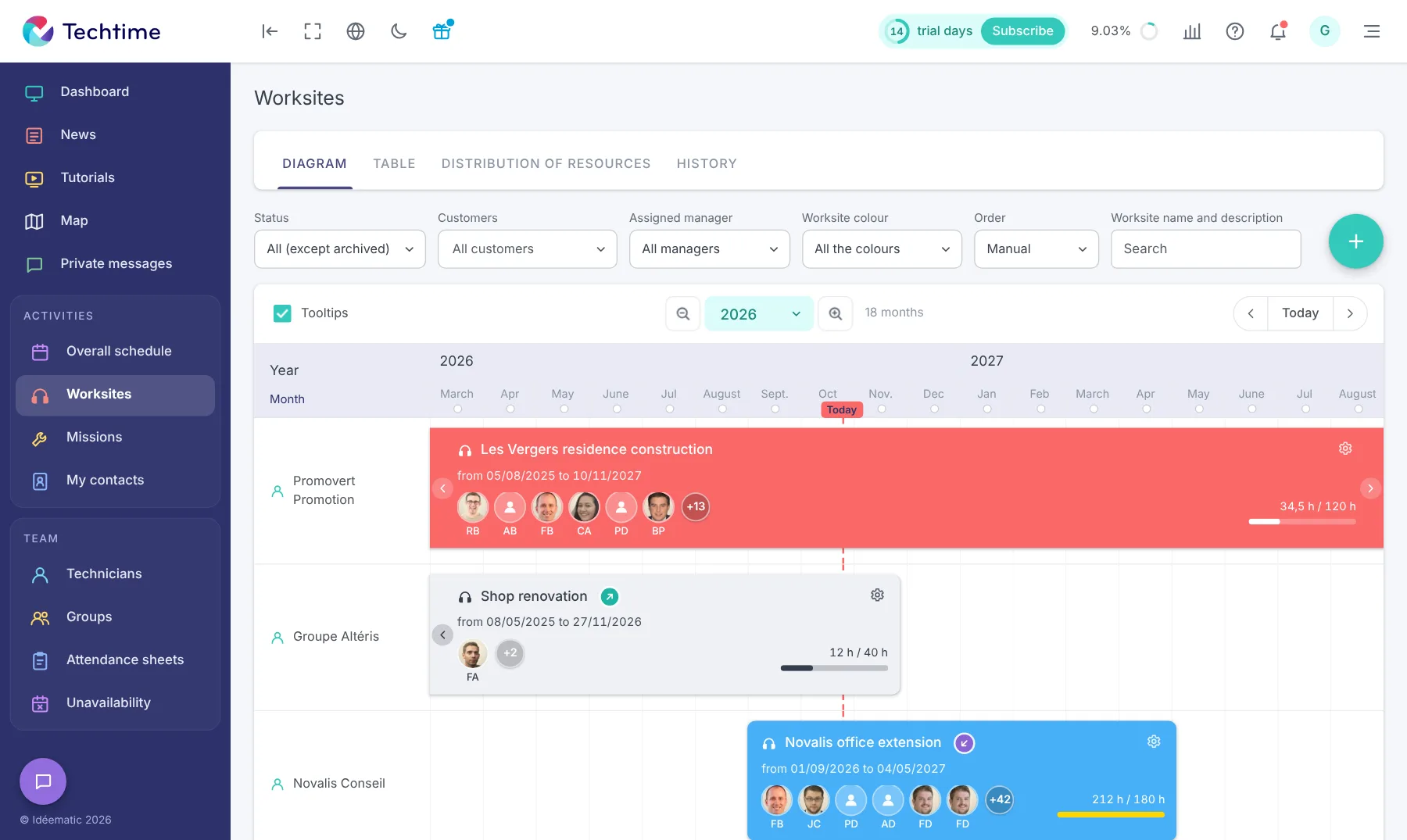
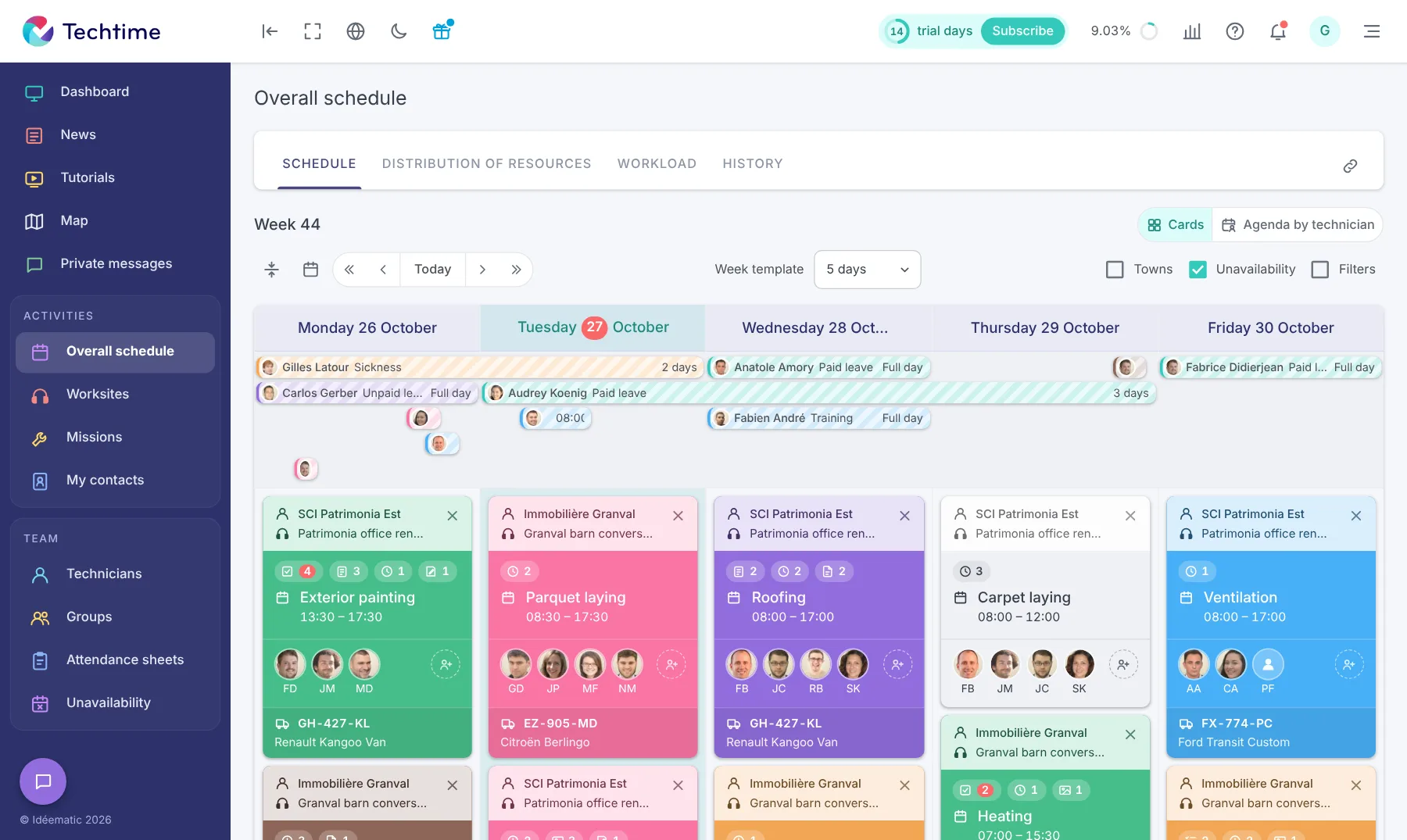
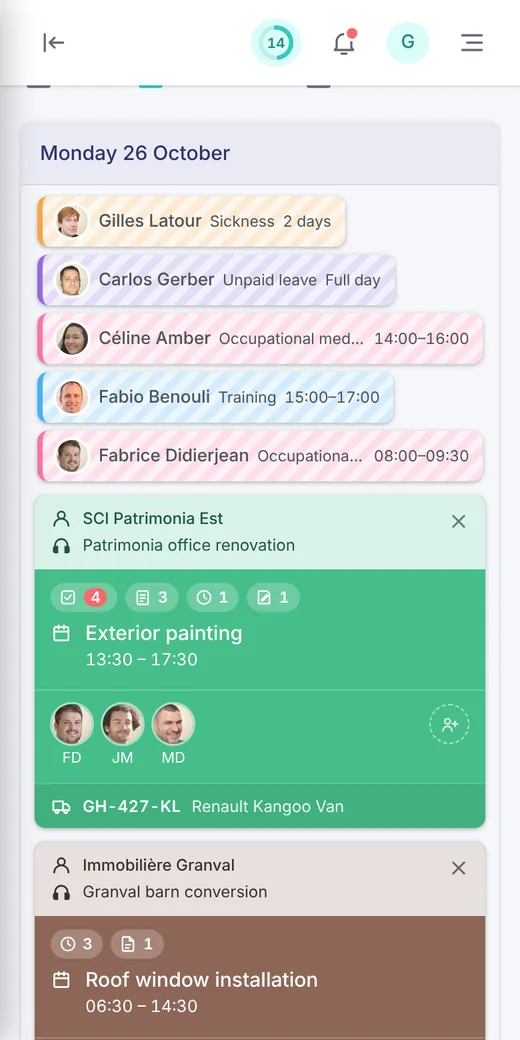
For site managers, the traceability of decisions taken during a hot spell is essential. An Electronic Document Management (EDM) solution, included in Techtime, centralises various key documents such as:
- warning bulletins;
- worksite reports;
- photos;
- exchanges with teams;
- evidence of stoppages.
7Can an employee exercise their right to withdraw?
Article L4131-1 of the Labour Code allows an employee to withdraw from a work situation when they believe it presents a serious and imminent danger to their life or health. A weather warning does not automatically trigger a right to withdraw. Each situation must be assessed according to the actual exposure conditions and the preventive measures in place on the worksite.
Some situations may, depending on the actual circumstances of the worksite, help establish a serious and imminent danger. This is particularly the case when there is no drinking water, no protection from the sun, no suitable breaks, or when exposure remains excessive despite the preventive measures in place.
In the event of disagreement about working conditions, having a record of preventive measures, photos of the worksite and minutes makes dialogue with teams easier. It helps justify the decisions taken.
8Mistakes to avoid during a heatwave
Not updating the DUERP
A missing or out-of-date risk assessment weakens the company’s position in the event of an accident and can lead to penalties. The French Labour Code requires the employer to record and update the results of the risk assessment in the DUERP, including those related to thermal conditions (article R. 4121-1).
Failure to record or update the DUERP is a fifth-class offence (article R. 4741-1 of the Labour Code), i.e. a maximum fine of €1,500 for an individual and €7,500 for a legal entity. For repeat offences, these ceilings can rise to €3,000 and €15,000 respectively.
Since 27 June 2026, the very absence of a DUERP can also lead, provided there is no criminal prosecution, to a warning or an administrative fine imposed by the competent authority (article L. 8115-1 of the Labour Code). This fine can reach €4,000 and be applied as many times as there are workers concerned; its ceiling is doubled for a new breach of the same kind within two years of notification of a previous fine (article L. 8115-3 of the Labour Code).
Underestimating water needs
Access to water must be simple, permanent and suited to the number of employees on the worksite. Where there is no water point, the employer must provide enough cool drinking water close to workstations. Poor planning increases the risk of dehydration, feeling unwell and non-compliance during an inspection.
Keeping usual working hours despite the heat
Keeping the same hours during a heatwave exposes teams to the highest temperatures of the day. Where possible, it is advisable to start work earlier, increase breaks and limit the most physical tasks. The aim is to reduce the risk of feeling unwell, accidents and reduced alertness.
Neglecting recovery breaks
Breaks allow employees to hydrate, recover in the shade and lower their body temperature. Shortening or cutting them to keep to the schedule increases the risk of fatigue, reduced alertness and accidents. It is better to adapt the pace of the worksite than to deal with the consequences of someone falling ill.
Letting an employee work alone
Lone working makes it harder to spot the first signs of dehydration or heatstroke quickly. During a heatwave, favour working in pairs or regular monitoring of teams. Rapid intervention can limit the severity of a medical emergency and make it easier for the emergency services to take over.
9Conclusion
Heatwaves are now an occupational risk to factor in when you prepare and organise a worksite. The main measures to prevent accidents are updating the DUERP, adapting the schedule, protecting teams and anticipating a possible stoppage.
For the business owner, the site manager or the tradesperson on the ground, the traceability of decisions taken during a hot spell is as important as the preventive measures themselves. By bringing together your regulatory documents, photos, minutes and daily worksite tracking in a single tool, Techtime helps you keep your work safe throughout periods of high heat.
FAQ
Have questions? We answer the main ones…
Is a heatwave officially classed as bad weather in construction?
Since 2024, heatwaves have been included in the construction bad-weather unemployment scheme. Companies can receive compensation when the regulatory conditions are met.
At what temperature should a worksite be stopped?
The regulations do not set a single temperature. The assessment is based mainly on Météo-France warning levels and the actual risks observed on the worksite.
Can an employee refuse to work during a heatwave?
If exposure conditions present a serious and imminent danger to their health, the employee can exercise their right to withdraw in accordance with the Labour Code.
Does an orange warning automatically require the worksite to stop?
No. The company must first assess the risks according to the work being done, exposure, breaks, available water and the scope for adapting the organisation. Stopping becomes necessary when safety can no longer be guaranteed despite the preventive measures.
How much water should be provided on a worksite in hot weather?
When it is impossible to provide running water, the employer must provide at least three litres of cool drinking water per worker per day. This water must be kept cool close to workstations.