


Please note: this article refers to French regulations and standards.
Faced with increasingly difficult recruitment, construction companies are encouraging their employees to work more and more overtime. In the fourth quarter of 2024, according to Dares data, a full-time worker in France, all sectors combined, worked 17.3 hours of overtime. This figure has been rising steadily since 2018. In construction specifically, overtime ranges from 25.6 to 28.6 hours per full-time employee.
However, overtime in construction represents a cost for the company and additional rights for employees. What are they? How do you calculate them without putting your cash flow and your workers’ health at risk?
In brief
In French construction, overtime is counted beyond 35 hours a week for a full-time employee. The annual quota is 145 hours if hours are annualised, 180 hours otherwise. The first eight hours carry a 25% premium, then 50% from the 44th hour, or are replaced by equivalent compensatory time off. Example: 7 hours of overtime at €13.18 an hour amount to €115.33 gross. These hours also benefit from tax and social security advantages.
1What counts as overtime in construction?
An overtime hour is counted beyond the statutory working time stated in the employment contract. For a full-time employee, this is 35 hours a week. But unlike other sectors, construction companies in France follow their own rules in line with the Labour Code and their collective agreement.
For example, overtime cannot be paid through exceptional bonuses or allowances (Éditions Tissot). Only a pay premium or compensatory time off is accepted to remunerate this extension of working time on worksites. However, no employee may go beyond the terms of their contract without the company’s agreement.
2Overtime quota in construction: what are the ceilings in 2025?
The annual quota is the maximum amount of overtime an employee can work in a calendar year. It applies to every employee except those on a days-based contract and is a default rule, meaning a company agreement can set its own ceiling (FFB). The building workers’ national collective agreement or the company agreement sets the working time ceilings not to be exceeded.
In the first case, Article 3-13 of the 1990 collective agreement still applies in 2025 to all construction companies. It sets the quota at 145 hours per employee if hours are annualised; otherwise, it is 180 hours. Any overrun is subject to the opinion of the works council or staff representatives.
Some overtime is not counted against the annual quota. Article L3121-30 of the Labour Code provides for this exception for urgent work expressly referred to in Article L3132-4: immediate interventions needed to organise rescue operations, prevent an imminent accident or repair the consequences of an accident affecting the establishment’s equipment, installations or buildings.
This exception concerns how the quota is counted, not the removal of the employee’s rights. The overtime concerned gives entitlement to premium pay or, where the applicable provisions allow, to equivalent compensatory time off. The urgency of a worksite is therefore not, in itself, a reason to work overtime without compensation.
Good to know: the amendment to the agreement of 6 November 1998, which would have raised the quotas to 265 and 300 hours, was annulled by the Paris Court of Appeal for lack of extension (SVP).
3How is overtime pay calculated in construction?
Overtime is calculated by counting actual working time. Travel time is not included, unless:
- The employee goes to the company’s head office before going to the worksite;
- They travel from one worksite to another during the same day.
Pay premiums
Premiums can be financial or replaced by compensatory time off. In the first case, Article L3121-36 of the French Labour Code sets the premium rate for the following bands:
- 25% for each of the first eight hours of overtime;
- 50% for each subsequent hour from the 44th hour.
For example, an electrician works 7 extra hours on a building under construction because sockets have to be moved or a home automation system integrated. If their gross monthly salary is €2,000, their hourly rate is €13.18 (as there are 151.67 hours in a working month). A 25% premium rate is equivalent to a coefficient of 1.25. So the calculation is as follows:
Gross overtime pay = number of overtime hours x hourly rate x premium coefficient = 7 x €13.18 x 1.25 = €115.33.
For 10 hours of overtime, you need to add the premium coefficient corresponding to the 50% rate for time beyond the eighth hour. So:
Gross overtime pay = 13.18 x [8 x 1.25 + 2 x 1.5] = €171.34
Good to know: the collective or company agreement may provide for premium rates different from those set by law. But whatever the percentages, they can never be lower than 10%.
- 1First 8 hoursat a 25% premium: 8 × 1.25
- 2Next 2 hoursat a 50% premium: 2 × 1.5
- 3Gross amount13,18 × [8 × 1,25 + 2 × 1,5] = 171,34 €
Compensatory time off in lieu (RCR)
Depending on the terms of the collective or company agreement, compensatory time off can replace the financial compensation. Article L3121-37 of the Labour Code requires the approval of the works council (CSE) to introduce this system. RCR time is also increased in the same way as overtime pay, at the same rates:
- 25% premium for the first eight hours of overtime, i.e. 1h15 off for 1 hour worked.
- 50% premium beyond that, i.e. 1h30 off for 1 hour worked.
A drywall installer who works 7 extra hours is entitled to 8 hours and 45 minutes of compensatory time off. If they work 10 hours of overtime, the 50% premium applies to the last two hours, i.e.:
Compensatory time off = 8 x 1.25 + 2 x 1.5 = 13 hours
The pay or time-off premium applies if the employee works at night (9 pm to 6 am) or on a public holiday. If night work is scheduled regularly and involves 10 or more employees, the hourly rate is increased by 25% over the gross salary. If it is exceptional or takes place on a Sunday or public holiday, the work is paid double (100% premium). These rates come from Article 3-17 of the national collective agreement for workers and cannot be combined. They apply to both workers and ETAM.
However, none of these premiums can be combined with each other. Imagine an employee works overtime, night work and a Sunday job in the same month. Only the highest premium rate is applied (Captain Contrat)
Good to know: if overtime exceeds the quota, compensatory time off must be 100% for workers and ETAM (clerical staff, technicians and supervisors). This applies to all construction companies regardless of size. For managers in a company with more than 20 employees under a collective agreement, compensation is only 50% if there is no specific agreement (Editions Tissot).
- €171.34 gross for 10 hours at €13.18
- €115.33 gross for 7 hours
- 13 hours off for 10 hours
- 8 hours 45 off for 7 hours
4What tax advantages can overtime bring?
Since 2019, overtime in public or private building work in France has benefited from a reduction in social security contributions at a rate of 11.31%. This percentage is calculated on overtime pay. As a result, it is not subject to withholding tax if the exemption does not exceed €7,500 a year (Habitat Presto).
For employers, those with fewer than 20 employees benefit from a flat-rate deduction of €1.50 from their URSSAF employer contributions for each overtime hour declared (excluding compensatory time off). Between 20 and 249 employees inclusive, this deduction is reduced to €0.50 per hour. Companies with 250 or more employees can no longer benefit from it (Legisocial).
Overtime and the associated premiums are taken into account in calculating paid leave in construction. Both are included in the reference gross salary (general scheme) or the working time calculated over the accrual period (construction scheme).
5Conclusion
Calculating overtime in construction is an essential accounting task to keep your worksites profitable. Protecting your teams’ health is also essential to your company’s well-being. The specific rules, between quota ceilings and premium rates, call for constant vigilance.
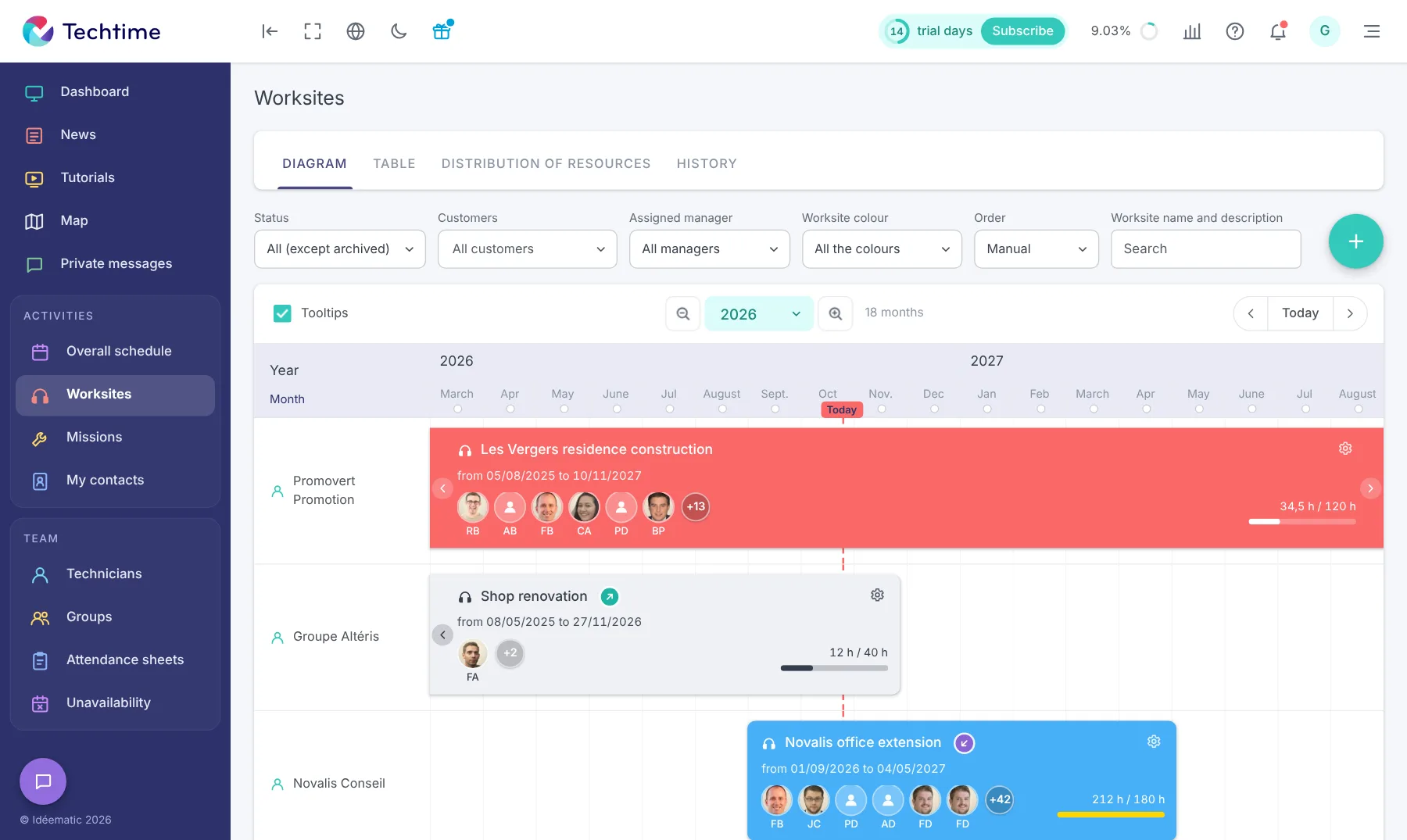
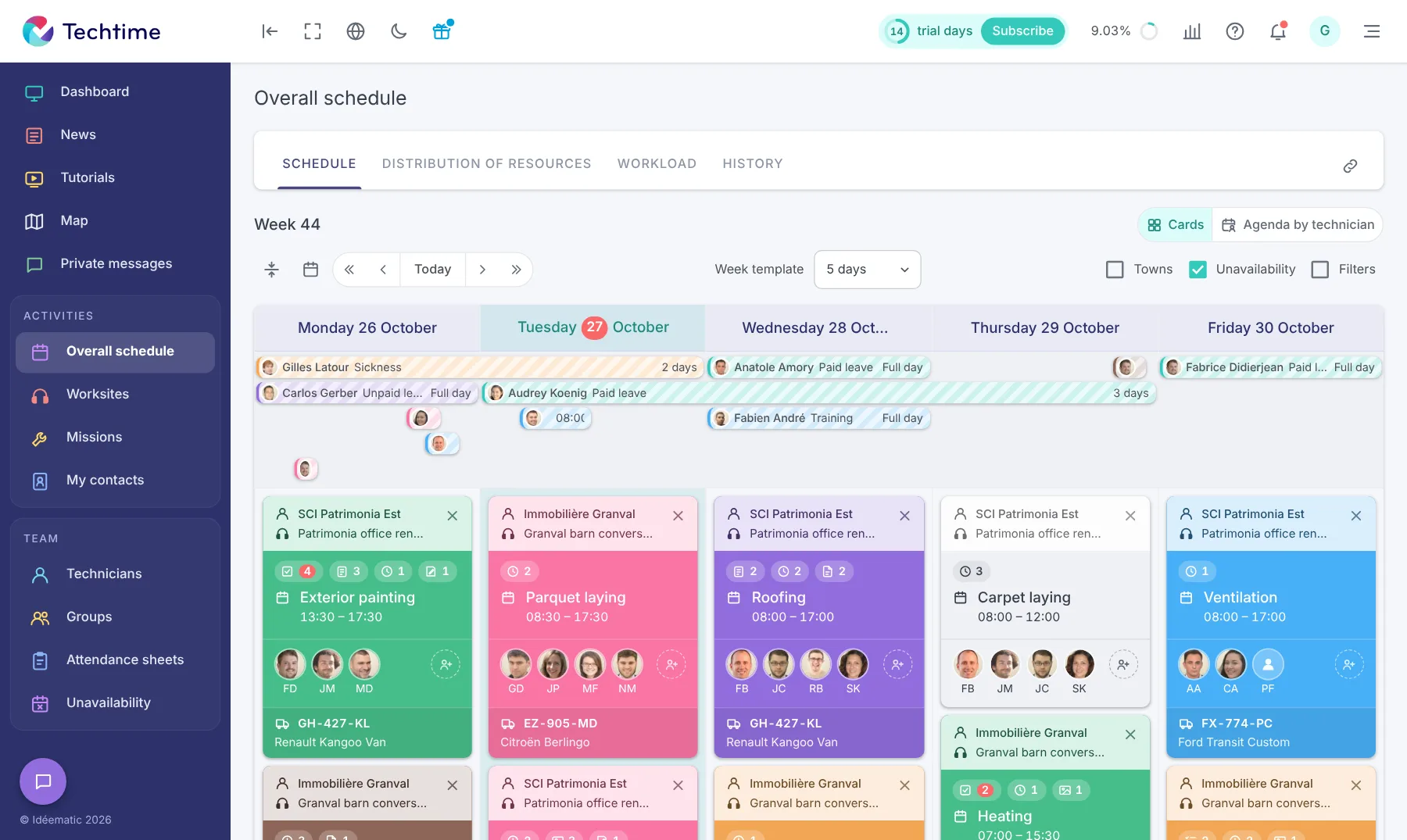
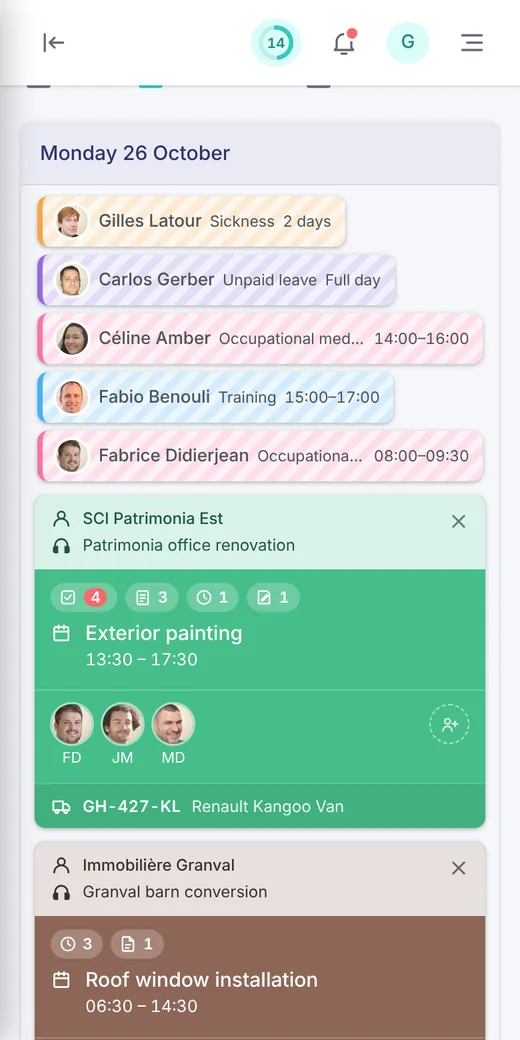
With Techtime, your technicians fill in their construction timesheets from the mobile app. The time declared is linked to the activities concerned and centralised in the web application. At the office, you can see the hours spent on each worksite without having to collect paper sheets from every team.
These records provide a basis for checking the time declared by your staff and preparing what is needed for payroll. You keep the details of the activities the hours relate to, rather than a simple total with no indication of the work involved.
Frequently asked questions
What is the overtime quota in construction?
Under Article 3-13 of the 1990 collective agreement, still applicable in 2025, it is 145 hours per employee per year if hours are annualised, and 180 hours otherwise.
How do you calculate the overtime premium?
Multiply the number of hours by the hourly rate and the premium coefficient: 1.25 for the first eight hours, 1.5 beyond. For 10 hours at €13.18: 13.18 × (8 × 1.25 + 2 × 1.5) = €171.34 gross.
Can overtime be replaced by time off?
Yes, if the collective or company agreement provides for it: 1 h 15 off per hour for the first eight hours, 1 h 30 beyond. For 10 hours of overtime, that is 13 hours off.