


Please note: this article refers to French regulations and standards.
When the sunny days return, construction employees can’t wait to take their paid leave. Some need it to recharge after strenuous work such as carrying heavy loads or working in awkward positions, a situation that gets worse when the company is facing a labour shortage. Others want to escape the summer heat, particularly public works operatives. To help them make the most of their rest period, support is available, such as the construction holiday bonus. Is it mandatory? What are the conditions for receiving it?
In brief
Paid leave is granted to all construction employees in France: 150 hours of actual work entitle them to one month of leave, managed by the leave funds (CIBTP). The holiday bonus is a top-up of 30% of the paid leave allowance, provided for by collective agreements and paid subject to conditions: 1,675 hours of work for building workers, 1,200 hours for public works operatives and 6 months’ attendance for ETAM and managers. It is paid at the same time as the leave allowance.
1Construction holiday bonus vs paid leave: the legal framework
The construction holiday bonus is additional pay that tops up paid leave. Unlike paid leave, it is not made mandatory by the French Labour Code. It depends on the conditions set out in a collective agreement, a company agreement or simply the employment contract. It must be granted in a general, consistent and fixed way. If the employer does not follow the rules of these agreements, the employee is entitled to go to the employment tribunal to claim what is owed (Legalstart).
Paid leave in construction is governed by article D3141-30 of the Labour Code. Under the law, 150 hours of actual work give the right to one month of leave, plus a flat amount representing the previous year’s leave (CIBTP). These provisions apply both to companies established in France and to those based abroad that employ workers on French soil. The same applies to posted workers (articles L1262-1 and L1262-2 of the Labour Code).
- Granted to all construction employees
- 150 hours of actual work = one month of leave
- Managed by the leave funds (CIBTP)
- 30% of the paid leave allowance
- Subject to hours or attendance conditions
- Paid at the same time as the leave allowance
2Eligibility: all employees versus collective agreements
Paid leave is granted to all construction employees, whatever their type of contract and working hours. The construction holiday bonus, on the other hand, is paid under certain conditions. These depend on the employee’s category and their number of hours actually worked.
Building workers (specialising in construction or renovation) must work at least 1,675 hours. The period runs from 1 April of year N to 31 March of year N+1. This threshold is reduced to 1,503 hours for a 35-hour employment contract (L’Expert Comptable). They can accumulate this working time with one or more construction companies.
Public works operatives (public or private infrastructure) must show at least 1,200 hours of work over the same period. For managers and ETAM (clerical, technical and supervisory staff), the minimum attendance is set at 6 months.
Whatever the workers’ status, the holiday bonus is included in all the national collective agreements (CCN) for construction. Some may grant members other benefits (extra days of leave or allowances), particularly according to length of service:
- 2 days for workers after 20 years’ service in the company. This bonus rises to 4 days after 25 years, then 6 days after 30 years.
- 2 days for managers and ETAM after 5 years’ service or 10 years in the profession. This rises to 3 days for 10 years’ service or 20 years in the profession.
Apprentices on apprenticeship or professionalisation contracts can also receive it, as can employees on fixed-term contracts. In this case, it is calculated pro rata to their working time.
3Calculation methods: percentage of salary or of leave
Paid leave and the holiday bonus are managed in a specific way through dedicated funds (CIBTP, etc.). The particularities of construction lead to calculations that differ from the general scheme, depending on employees’ categories.
The building sector’s paid leave fund calculates the amount of the construction holiday bonus. It is based on 2 working days per month (24 days over a full year) and 30% of the paid leave allowance. Days can be added to this base according to the employee’s length of service and split-leave days.
Administrators determine the gross paid leave allowance using two calculation methods (MMA):
- If the employee is under the general scheme, the allowance is their gross salary divided by 10. Pay is calculated over the reference period, from 1 April of year N to 31 March of year N+1 (article L3141-22, Labour Code).
- If they are under the construction scheme, their last monthly salary is taken into account. The hourly rate for their last month worked is multiplied by the number of hours worked, and this result is also divided by 10 (article D 3141-32, -33, Labour Code).
The fund makes sure the result is the most favourable for the employee. Once the allowance has been calculated, it is divided by the number of statutory leave days to obtain a daily value. Young parents under 21 do not receive any increase for the extra days granted for their dependent children.
4Who pays the bonus or the leave?
The bodies that pay paid leave or the holiday bonus differ depending on the company’s sector. If its activities fall under building or public works, it must belong to a paid leave fund. It pays a contribution based on the gross salaries it declares (Culture RH).
If the company employs construction staff but belongs to another sector, the employer can pay the holiday bonus directly. Payment is made within the 10 days before the employee goes on leave. The employer has two options:
- Either pay it each time paid leave is taken.
- Or pay it annually when the paid leave balance is settled or at the end of the period.
Whatever the choice, it is best to avoid paying the bonus in advance. As it is linked to the paid leave allowance, early payment may lead to adjustments during the year.
5Payment dates for the holiday bonus and leave
The construction holiday bonus is paid at the same time as the paid leave allowance, when the employee takes the leave. Leave entitlement is earned during the reference period, from 1 April of year N to 31 March of year N+1. It is then taken from 1 May of year N+1 to 30 April of year N+2 (CIBTP Grand Ouest).
Statutory leave is generally split into two parts:
- The main leave, from the 1st to the 24th working day.
- The fifth week of paid leave, from the 25th to the 30th working day.
Beyond that, extra leave is granted for split leave or length of service. Other leave is possible for personal reasons, such as family events (marriage, bereavement, etc.), paternity or maternity leave or for dependent children. The same applies to unforeseen reasons, such as bad-weather leave. None of these periods count towards the holiday bonus.
The bonus is subject to income tax and social security contributions, so it must appear on the tax return as soon as it is paid. If the employee leaves the company before using up their balance, they cannot claim payment in lieu for leave not taken. However, they keep their rights from one company to the next. To do so, they present their construction paid leave balance statement to their next employer or to their leave fund.
6Conclusion
The construction holiday bonus and paid leave are two separate but complementary schemes. Combined, they allow construction and public works employees to receive fair pay during their time off. Paid leave applies to all workers, but the bonus is subject to the conditions of collective or company agreements.
For employers, respecting these schemes is essential to comply with the regulations in force and retain talent in the building sector. For employees, understanding their rights helps them optimise their pay and plan their time off better.
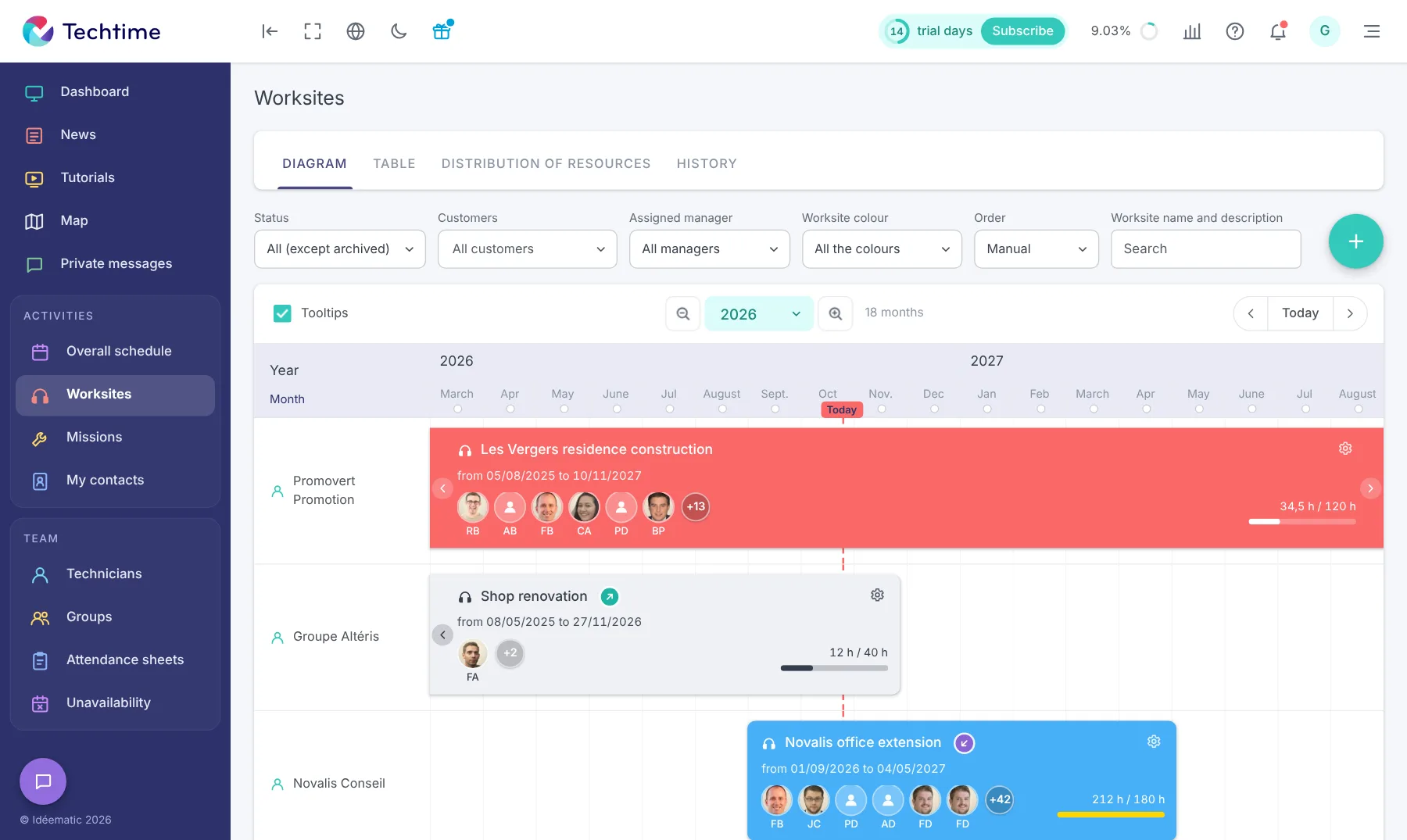
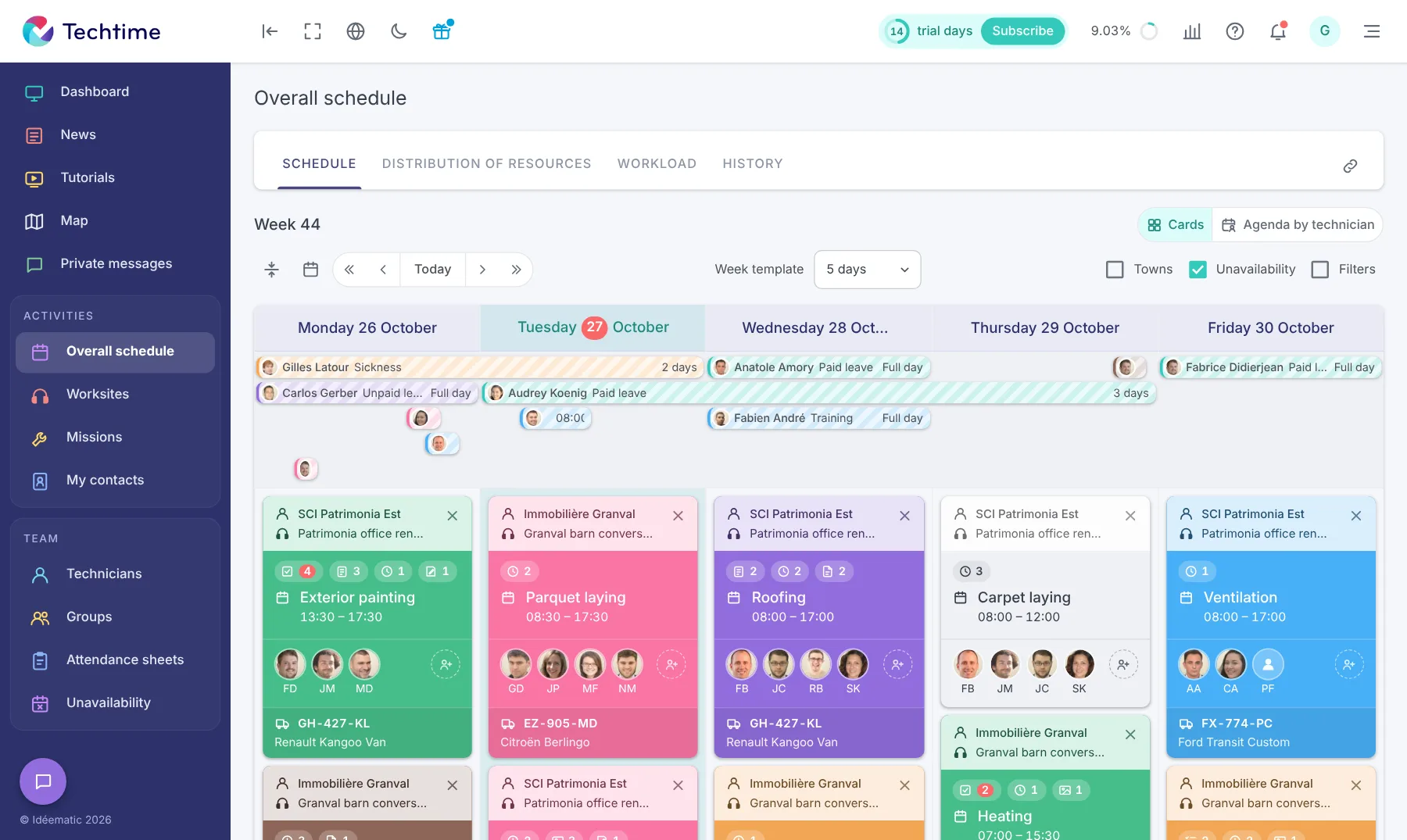
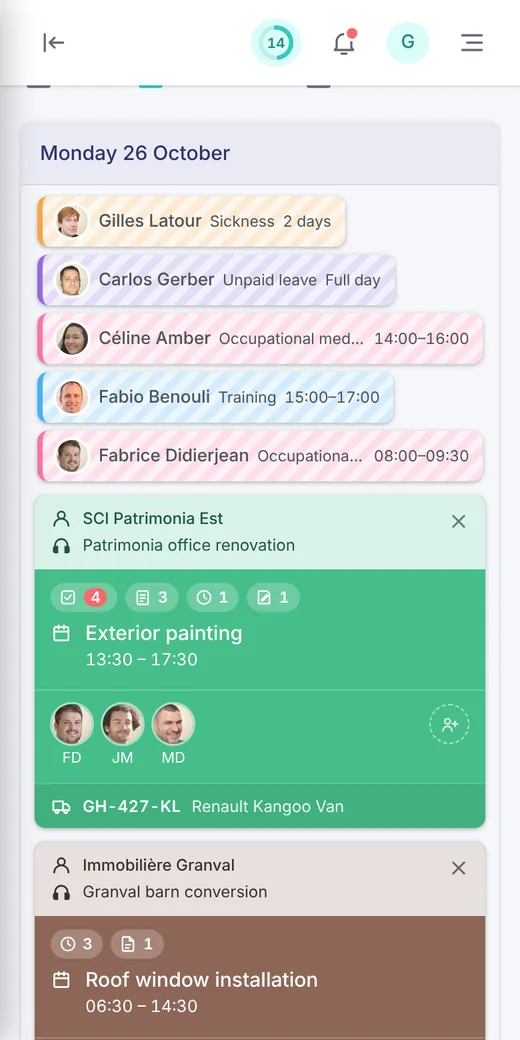
But to ensure continuity of service, it is vital to coordinate well during the leave period. Anticipate your team members’ absences and organise your worksite schedule accordingly with the Techtime web app. With Techtime, you manage your schedules in real time, taking into account each tradesperson’s absences and unavailability. As soon as a team member is marked as absent, the app automatically alerts you to all the projects or worksites they were working on. You become more responsive and can easily reorganise your teams, even when the unexpected happens, ensuring your worksites keep running.
Frequently asked questions
What is the difference between the construction holiday bonus and paid leave?
Paid leave is a right under the Labour Code for all employees. The holiday bonus is additional pay of 30% of the paid leave allowance, provided for by construction collective agreements and subject to conditions.
Who is entitled to the construction holiday bonus?
Building workers who have worked at least 1,675 hours, public works operatives with at least 1,200 hours, and ETAM and managers with 6 months’ attendance. Apprentices and employees on fixed-term contracts can also receive it.
When is the holiday bonus paid?
At the same time as the paid leave allowance, when the employee takes their leave.