


Please note: this article refers to French regulations and standards.
The French electrical engineering market recorded revenue of €50 billion in 2023 (source). There are plenty of challenges and prospects, from the energy transition to smart grids and charging points for electric vehicles. In towns and in the countryside, opportunities abound. Here is everything you need to know to succeed in your career change and become an electrician.
In brief
The electrician installs, repairs and upgrades the electrical networks of buildings. In new build, they define the cable routes and the location of sockets and the consumer unit, install equipment in coordination with the other trades and check compliance before the OPR (pre-handover inspections). In renovation, they replace equipment, rewire circuits and add home automation, solar PV or connected sensors. In France, the trade is learned through a CAP, vocational baccalaureate, BTS or master craftsman’s certificate; without qualifications, three years of experience are required to set up in business.
1What does an electrician do in construction?
Whether employed or self-employed, the electrician carries out a wide range of tasks. They handle both the installation and the repair of electrical networks. In France, their NAF code depends on their activity:
- 43.21A for electrical installations in all premises.
- 43.21B for electrical installations on public roads.
- 45.3A for self-employed electricians.
Their work is not limited to their time on the worksite. In fact, it starts well before the project is carried out.
The electrician’s role in constructing a building
Along with other construction trades, the electrician takes part in site meetings, under the responsibility of the site foreman. They contribute to the building plans by adding information specific to their work (source):
- Defining the cable routes in the walls.
- Indicating the location of sockets and switches.
- Deciding the position of the consumer unit and its various meters.
Once on site, they install the electrical equipment while ensuring coordination with the other trades. Working on the electrical network is dangerous (short circuits, electrocution) if the safety standards in force are not met. For new build and renovation in France, this is the NF C 15-100 standard. It sets, for example, the minimum number of electrical sockets in each room and the various lighting points (source).
To comply with these safety rules, the electrician’s work takes place at specific points in the worksite schedule. Normally, they start their finishing work after the masonry and roofing, once the building is watertight. They can easily work at the same time as the plumbing or insulation work (source).
Before the pre-handover inspections (OPR), they check that the electrical installations comply and use their measuring instruments to detect any faults. In the event of remedial work, they repair the faulty equipment (source).
The electrician’s role in renovating a building
The electrician doesn’t just install cables or electrical appliances. They also repair them and apply solutions for energy renovation:
- Replacing the consumer unit, sockets and switches with next-generation equipment.
- Rewiring electrical circuits with surface mounting (along the walls) or concealed installation (in the walls).
- Making sure every supply point has an earth connection (source).
With the spread of home automation systems in households, the electrician’s job is becoming increasingly complex. Only a specialised, versatile installer can equip an entire smart home with electronics (source).
Beyond this service, the tradesperson offers clients innovative solutions to save energy. These may be solar PV installations or connected sensors controlled by artificial intelligence. These sensors process real-time data to detect overvoltage areas or distribute electricity better (source).
- Cable routes, sockets, switches, consumer unit
- Installation coordinated with the other trades
- Compliance check before the OPR
- Replacing the consumer unit, sockets and switches
- Rewiring circuits, surface-mounted or concealed
- Home automation, solar PV, connected sensors
2What are the pros and cons of being an electrician?
The advantages of the electrician’s trade
Despite current difficulties, with 349 electrical business failures in France in 2024 (source), electricians enjoy good employability. In 2024, the French Federation of Electrical Integrators had 7,500 member companies, representing 130,000 employees (source). This group is only part of the existing network. In general, apprentices don’t need long studies to become professionals in this field.
Their know-how guarantees safety and savings when the work involves eco-construction. And time is pressing: according to the French Promotelec association, 83% of the 31 million homes built before 2008 have at least one electrical defect (source).
Between home automation and installing charging points, demand is changing and diversifying. By developing their skills to keep up with this trend, a self-employed electrician has every opportunity to add value to their work.
The disadvantages of the electrician’s trade
There are so many jobs and emergencies that days can be long. The electrician has to work on several worksites, or for several private clients. This requires good physical fitness, especially as they have to put up with uncomfortable positions (crouching, kneeling, standing). Overtime is frequent and not always fairly paid.
Despite the mandatory PPE (personal protective equipment), the work remains dangerous. The risks of burns or electrocution are very real when handling badly installed wiring or poorly insulated equipment.
3What skills do you need to be a good electrician?
An electrician is above all a rigorous, methodical professional who masters the laws of electricity and the standards in force. They can read wiring diagrams, find their way around and contribute to the plans of a building or worksite. A liking for DIY is a fundamental quality for making connections between equipment.
More than just carrying out electrical work, they are also curious and versatile. As soon as they work with several construction trades on a project, they show knowledge of masonry, joinery, painting, etc.
Finally, their people skills are an undeniable asset for their clients. Their analytical mind helps them solve problems in an organised way. They are autonomous and vigilant and know how to take the initiative. Team spirit and good communication skills are essential to completing the worksite successfully. And they remain available to clients to advise them and improve the comfort of their home.
4Retraining to become an electrician: what training do you need?
In France, there are many training routes to become an electrician. Most initial courses last two or three years:
- Brevet de Maîtrise (BM, master craftsman’s certificate) in equipment electrics.
- Technological baccalaureate in electrical trades.
- Vocational baccalaureate specialising in electrical engineering, electrical power or industrial electricity.
- CAP specialising in electrical equipment maintenance, communications installation or electrical works preparation and execution.
- BEP in electrical engineering.
- BTS specialising in electrical engineering or industrial mechanics and automation.
- DUT (university technology diploma) in electrical engineering and industrial computing.
Can you become an electrician without qualifications?
It is possible to become a self-employed electrician without any qualifications. However, you must prove at least three years of experience, including as an employee (source). That said, French decree no. 2017-767 of 4 May 2017 makes a professional qualification mandatory for working as a self-employed electrician. This requirement now applies to the trade itself, and no longer to the group of activities (source).
What are the possible career prospects in electrical work?
As they gain experience, a seasoned electrician can apply for team leader, site foreman or site manager positions. A position in a design office is also possible, in which case they prepare installation plans (source). They are free to go self-employed after a few years as an employee of an electrical company.
5What does an electrician earn?
An electrician’s salary depends on their skills, speciality and location. On average, a beginner employee in France starts on €20,000 gross a year, i.e. the minimum wage (SMIC). This pay rises after 3 years of experience and can reach €27,000 gross a year after more than 10 years (source).
On top of this gross annual salary, some companies cover work expenses such as the meal allowance, which is not subject to social security contributions. The monthly deduction rate is 4.5% for an employee who lives alone and does not have executive status.
While an employee earns at most €1,800 gross a month, an electrician team leader’s salary ranges from €1,800 to €2,300. If they set up with a well-established client base and fairly priced services, a self-employed electrician can reach €4,000 gross a month (source).
6Conclusion
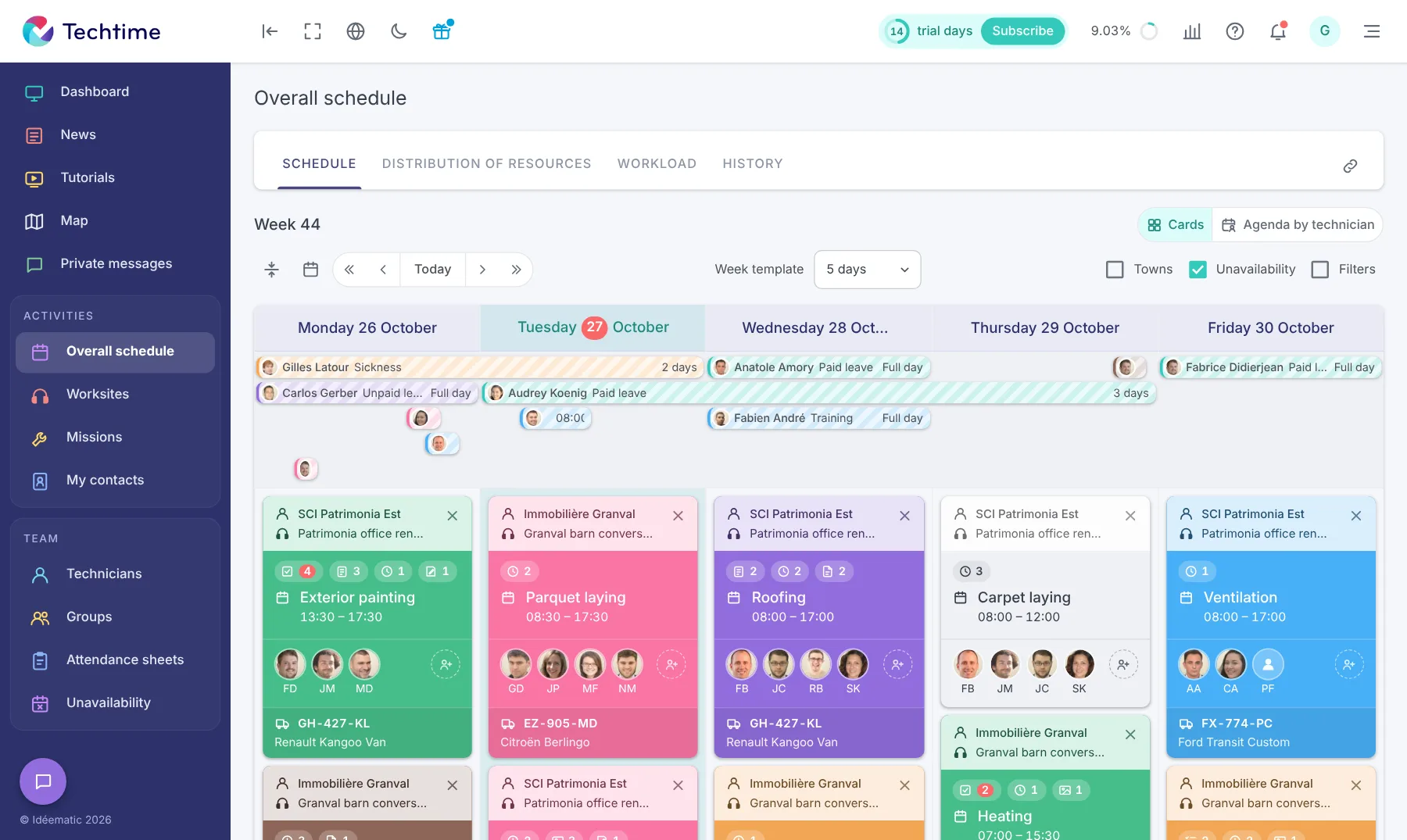
The electrician’s trade is a profession undergoing great change that continues to offer job opportunities, in line with demand for home automation and renewable energy. Training remains short for reasonable salaries. Whether self-employed or employed, communication with other construction professionals is essential for a successful worksite. To optimise your jobs and help you manage your electrical business, our Techtime management software is here to help!
Frequently asked questions
What does an electrician do on a construction site?
They take part in site meetings, define the cable routes and the location of sockets, switches and the consumer unit, install the equipment in coordination with the other trades, then check that the installations comply before the pre-handover inspections.
What training do you need to become an electrician?
In France, most courses last two or three years: CAP, BEP in electrical engineering, vocational or technological baccalaureate, master craftsman’s certificate in equipment electrics or BTS in electrical engineering.
Can you become an electrician without qualifications?
Yes, to set up as a self-employed electrician, provided you can prove at least three years of professional experience.