


Please note: this article refers to French regulations and standards.
According to France Travail estimates, construction employers posted 35,370 drywall installer job offers in France between January 2024 and February 2025. Most of these jobs were permanent contracts (27%) or temporary and apprenticeship contracts (67%). The lack of qualified candidates and the trade’s low appeal make it the second most understaffed profession in construction (Batirama). As renovation work overtakes new construction, how can you succeed in your career change and become a drywall installer?
In brief
The drywall installer fits out the interior of buildings: they install partitions, linings and suspended ceilings, insulate walls and tape the joints between boards. The trade is recruiting: 35,370 job offers were posted between January 2024 and February 2025, according to France Travail. In France, it is accessed through a CAP (French vocational certificate) in plaster and insulation, an additional qualification as a drywall installer, a vocational baccalaureate or a BTS. A beginner earns the French minimum wage, around €1,300 net, and a team leader up to €45,000 gross a year.
1What does a drywall installer do?
The drywall installer creates interior spaces in new builds and renovations. Using walls and partitions, they divide the building into several functional rooms for personal or professional use. That is why they usually step in after the structural work, like the plumber or the painter and decorator.
Installing boards and linings for interior architecture
The boards they install are all prefabricated and fixed to metal frames. Plasterboard (or drywall) is the most common. It is versatile, easy to handle and inexpensive, and its surface is smooth enough for finishing (Atelier Paul). However, to optimise insulation or fire resistance, the drywall installer can work with other materials such as (Parachevement Shop):
- gypsum fibreboard;
- fire-resistant boards;
- glass fibre reinforced cement;
- cement;
- glass fibre;
As for wood, it is more durable and very strong. Wooden panels are made using several different methods: chipboard, melamine, OSB, plywood, laminate, etc. (Dispano).
Insulating walls and taping joints inside the building
The drywall installer does not just install partitions to create new rooms. They also install suspended ceilings and linings to improve the thermal and acoustic insulation of walls and ceilings. The panels bonded to the plasterboard are generally made of mineral wool or synthetic materials (expanded polystyrene, polyurethane) (Placo).
Next, they tape the joints to connect the plasterboards. These take the form of joint tapes (paper or glass fibre) or plaster- or carbonate-based fillers. Fillers smooth the surfaces beforehand, while tapes protect them for finishing (paint or wallpaper).
Finally, they round off their work by installing the door frames, casings and studs for interior joinery (Manpower). They may also fit a few decorative elements, such as skirting boards, fireplace surrounds or plaster ornaments (mouldings, ceiling roses).
2What are the pros and cons of being a drywall installer?
The advantages of the drywall installer’s trade
As they work inside the building, the drywall installer is not affected by bad weather on the worksite. Job offers are plentiful: more than 3,000 in March 2025 according to the latest estimates on Hellowork. Their contribution to insulating walls and ceilings is a key step in the energy renovation of buildings. With solid enough experience, a candidate can negotiate a salary and working conditions that match their expectations.
The disadvantages of the drywall installer’s trade
Depending on how the worksite schedule is managed, the drywall installer may work overtime according to worksite constraints. The work is very physical, as they stand all day and may carry several loads. As well as plasterboard, they carry bags of plaster and put up scaffolding to prepare their work.
Depending on the tools they use, they are particularly exposed to the dangers of worksite dust. As a mineral dust, plaster can cause allergic and asthmatic reactions, or even serious respiratory diseases without adequate protection. That is why wearing personal protective equipment (PPE) follows a strict protocol to ensure safety on the worksite.
- Indoor work, sheltered from bad weather
- Plenty of job offers
- A direct contribution to building insulation
- Overtime depending on worksite constraints
- Standing and carrying loads
- Exposure to plaster dust
3What skills do you need to be a good drywall installer?
Installing boards or partitions requires great precision. After reading the plans, the drywall installer handles their tools (square, drill, spirit level) with rigour and safety. Finishing with filler requires care and speed, because fast-setting plaster fillers dry quickly. That doesn’t stop them from showing creativity to personalise the interior layout to the client’s wishes.
The working conditions described above require good stamina and good health. Even though they come in after the structural work, they have every interest in collaborating with other construction tradespeople to avoid remedial work. As well as their knowledge of insulation, nothing stops them from having skills in other areas, for example masonry, to lay plaster bricks (Isolation Combles).
4Retraining to become a drywall installer: what training do you need?
Training to become a drywall installer is the same as for becoming a plasterer. Although the two trades do not have the same tasks, they tend to merge to offer a complete service. In France, depending on the number of years of study after lower secondary school, the courses are as follows (CIDJ):
- CAP in plaster and insulation or BEP in finishing, plaster and prefabricated elements.
- Additional qualification (MC) drywall installer.
- Vocational baccalaureate in building fitting-out and finishing.
- BTS Fitting-out and finishing
- 1CAP or BEPplaster and insulation, finishing
- 2MC drywall installeradditional qualification
- 3Vocational baccalaureatebuilding fitting-out and finishing
- 4BTSfitting-out and finishing
Can you become a drywall installer without qualifications?
The drywall installer’s trade is regulated in France, as these tradespeople must meet precise technical standards that guarantee their own protection and that of consumers. Opening a drywall business requires a certificate of recognition of professional qualification, obtained from your Chamber of Trades and Crafts. You can also establish your qualification with your CAP/BEP or by proving 3 years of experience (Legal Place).
What are the possible career prospects?
The drywall installer keeps on training to adapt to new materials and installation techniques. After several years of experience, they can take several paths (Samsic Emploi):
- Become a fibrous plasterer and ornamentalist to create decorations in fibrous plaster or stucco.
- Become a site foreman in the construction company that employs them.
- Become a self-employed construction tradesperson.
5What does a drywall installer earn?
A drywall installer starting out in France earns the minimum wage (SMIC), around €1,300 net (Batiactu). This salary then rises with years of experience and depending on the region where the professional works. A drywall installer in the Paris region earns an average gross salary of between €25,000 and €28,000 a year (Hellowork).
When they change status, their pay increases. A drywall team leader earns up to €45,000 gross a year. A self-employed tradesperson can earn €60,000 gross a year, provided they have a good client base (Hellowork). As a sole trader, their communication skills are also important for keeping their business going. With that in mind, working with construction influencers proves a good long-term strategy.
6Conclusion
The drywall installer’s trade offers many job opportunities thanks to growing demand for energy renovation work. It requires great precision, rigour and good physical fitness. But after short training, career prospects are varied and lead to attractive pay.
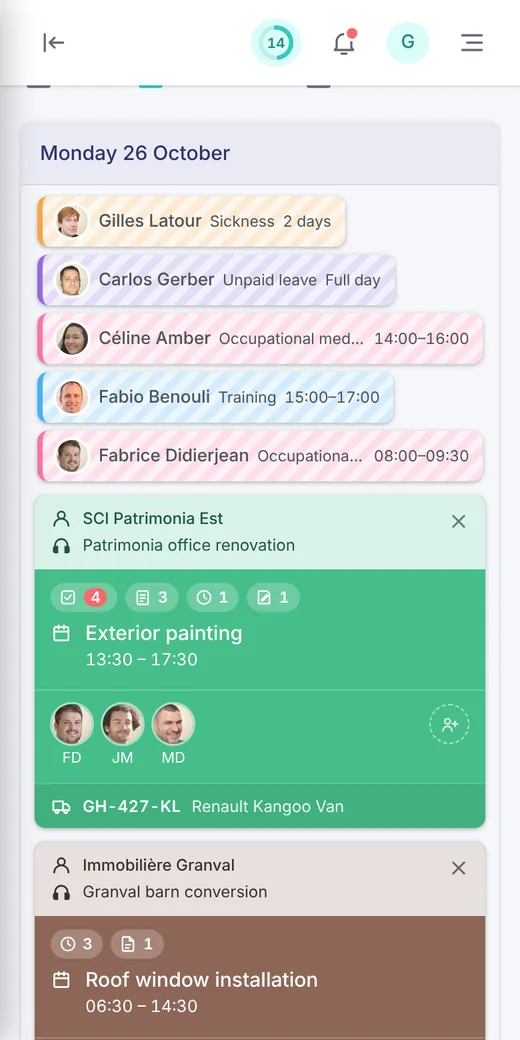
For employed or self-employed drywall installers, Techtime software lets them optimise their worksite schedule. Manage your stock of tools, equipment, materials or vehicle fleet in real time. Book your video demo now.
Frequently asked questions
What does a drywall installer do?
They create interior spaces by installing partitions, linings and suspended ceilings, improve wall insulation, tape the joints between boards and install door frames and casings for interior joinery.
What training do you need to become a drywall installer?
In France, a CAP in plaster and insulation or a BEP in finishing, plaster and prefabricated elements, then possibly an additional qualification as a drywall installer, a vocational baccalaureate in building fitting-out and finishing or a BTS in fitting-out and finishing.
How much does a drywall installer earn?
A beginner drywall installer in France earns the minimum wage, around €1,300 net. In the Paris region, the average salary is between €25,000 and €28,000 gross a year. A team leader can earn up to €45,000 gross a year and a self-employed tradesperson around €60,000.