


Please note: this article refers to French regulations and standards.
The BTP card is a professional identity card for building professionals in France. It was created to tackle illegal work and unfair social competition in the construction sector. These illegal practices disrupt the construction market, threatening companies’ survival, building quality and the safety of customers and workers.
Thanks to the BTP card, employers, site foremen and site managers know exactly who is working on their site. This means clients avoid incurring liability if subcontracting involves irregular labour (Travail Emploi). According to data from CIBTP Île-de-France, 5 million BTP cards have been produced since 2017. This figure relates to the 230,000 company accounts recorded by the building trade body. How do you obtain the BTP card? Which trades must have one?
In brief
The BTP card is a professional identity card that has been mandatory since 2017 for employees carrying out building or public works in France, including temporary and posted workers. It helps fight illegal work and social dumping. The employer orders it on cartebtp.fr on hiring, for a fee of €9.80 per card; a temporary certificate valid for 72 hours covers the wait. Architects, quantity surveyors, land surveyors, building inspectors, SPS coordinators and micro-entrepreneurs are exempt.
1BTP card: what is it for?
The BTP card has existed since 2017 under decree no. 2016-175 of 22 February 2016. It identifies all employees working on building or public works, including temporary and posted workers. Its main aim is to fight illegal work and unfair social competition, which take several forms:
- Undeclared work and unregistered employment. This is a particular problem in construction, more than in other sectors. In Martinique, the director of the Deets (the regional economy, employment, labour and solidarity directorate) estimates the rate of illegal work at 8%.
- Abusive use of subcontractors. Chains of subcontracting lead some businesses into illegal practices, such as not paying VAT or illegal labour supply (Contrats Publics report).
- Anti-competitive agreements between construction companies that collude to fix prices or share out contracts unfairly. In 2024, the French Competition Authority fined 11 precast concrete companies for cartels lasting 7 to 10 years. They had to pay fines totalling €76 million (La Tribune).
- Social dumping. This involves using low-cost foreign or posted workers in precarious conditions. The aim is to cut labour costs at the expense of health and safety. This worsens the statistics for workplace accidents in construction, which are much higher than in other sectors. French Health Insurance recorded 56 accidents per 1,000 employees in 2018, or one accident every two minutes.
2For which professionals is the BTP card mandatory?
Under article R. 8291-1 of the decree mentioned above, the employer must declare all employees carrying out building or public works. These tasks are as follows:
- Ground preparation (excavation, earthworks).
- Drainage (plumber, roofer).
- Assembly and dismantling of prefabricated elements.
- Interior and exterior fit-out (landscaper, tiler, electrician, locksmith, etc.).
- Rehabilitation, renovation, stripping out, demolition or conversion.
- Maintenance or repair of structures.
- Painting and cleaning (painter and decorator).
- Site management and supervision (site foreman, site manager).
Construction companies may be French or foreign, permanent or temporary, as long as their employees work in France. The employer is responsible for declaring workers and issuing them a BTP card. We set out these steps in more detail below.
Construction employees exempt from the card
Some trades, although linked to building, are exempt from the BTP card, even when they are present on site (Entreprendre Service Public):
- architects;
- property inspectors;
- quantity surveyors;
- health and safety coordinators;
- drivers and/or delivery staff;
- land surveyors or chartered surveyors;
- office roles (payroll, risk or IT management).
This exemption also applies to managers who do not work directly on site, even if they attend site meetings. As for interns, their situation is their tutor’s responsibility in the event of an inspection.
- Earthworks, drainage, fit-out
- Renovation, demolition, maintenance
- Painting, cleaning, site supervision
- Temporary and posted workers
- Architects, quantity surveyors, land surveyors
- Building inspectors, SPS coordinators
- Drivers, delivery staff, office roles
- Micro-entrepreneurs (SIREN number)
Do micro-entrepreneurs need to show a BTP card?
The BTP card does not apply to micro-entrepreneurs either. They only need to show their SIREN number to justify their presence on site during an inspection. If their work takes place at private homes, no identification card is required (Pro Bâtiment).
3The 2024 reforms on the BTP card’s validity
Decree no. 2024-112 of 15 February 2024 amends certain articles of decree no. 2016-175. It formally appoints the CIBTP France association to handle the administrative, technical and financial management of the BTP card.
Among the new measures, the validity of the BTP card has been extended for posted workers, whether temporary or not. Instead of being ordered for each posting, it is now valid for 5 years and allows an unlimited number of postings. However, their location can no longer be viewed on the SIPSI platform. The BTP card for temporary workers shows the SIREN or SIRET number and company name of the user company (CIBTP France).
4How do you get a BTP card?
To order a BTP card, the employer must go to the CIBTP France website and then the Cartebtp.fr portal. The ordering deadline depends on where the company is based (CIBTP France):
- If the company is based in France, the employer orders the card as soon as the new employee is hired.
- If the company employs temporary workers, whether established in France or elsewhere, the order must be confirmed before the first assignment starts, unless the temporary worker already has a valid BTP card.
- If the company is based outside France, the order is placed after the employer has declared the posting of its employees. They must have their card no later than the first day of their posting.
- 1Orderon cartebtp.fr, on hiring
- 2Fee€9.80 per card
- 3Temporary certificatevalid for 72 hours
- 4BTP cardto be shown during inspections
Mandatory information for a BTP card application
Under decree no. 2016-175, certain identity information is required for all employees:
- surname, first name, sex, date and place of birth;
- nationality;
- type of employment contract;
- digital ID photo;
- work permit or residence permit number, if the employee is a foreign national.
If the employee is a temporary worker, their BTP card must also show the SIREN or SIRET number and company name of the user company. The employer also enters the company’s legal status, logo, legal representative and registered office details on the portal.
These steps must be carried out with the utmost care. Any false declaration is punishable by two years’ imprisonment and a €30,000 fine (article 441-6, French Criminal Code). Failure to declare is covered by article L.8291-2 of the Labour Code: a fine of up to €4,000 per employee.
How much does the BTP card cost?
Ordering a BTP card is not free for the employer, who pays a flat fee of €9.80 per card. It can be paid by bank card, transfer or prepaid balance. However, the Union of CIBTP funds portal does not accept cheques.
What should you do if the BTP card is lost, stolen or damaged?
Before receiving their BTP card, the employee carries a temporary certificate proving their status (article R. 8294-2 of decree no. 2016-175). It is only valid for 72 hours from the date the card is sent to the employer or their representative. It must be shown during an inspection by the client or another principal present on site.
If the card is lost, stolen or damaged, the employee has 24 hours to inform their employer, who passes this information on to the CIBTP association to order a new one (article R.8294-3). The cost is borne by the employer.
5Conclusion
Since its introduction, the BTP card has become an essential tool in the fight against illegal work in construction. It improves the traceability of most building professionals and also protects law-abiding companies against unfair competition. The latest 2024 reforms simplify procedures for posted workers, notably by extending the card’s validity to a maximum of 5 years.
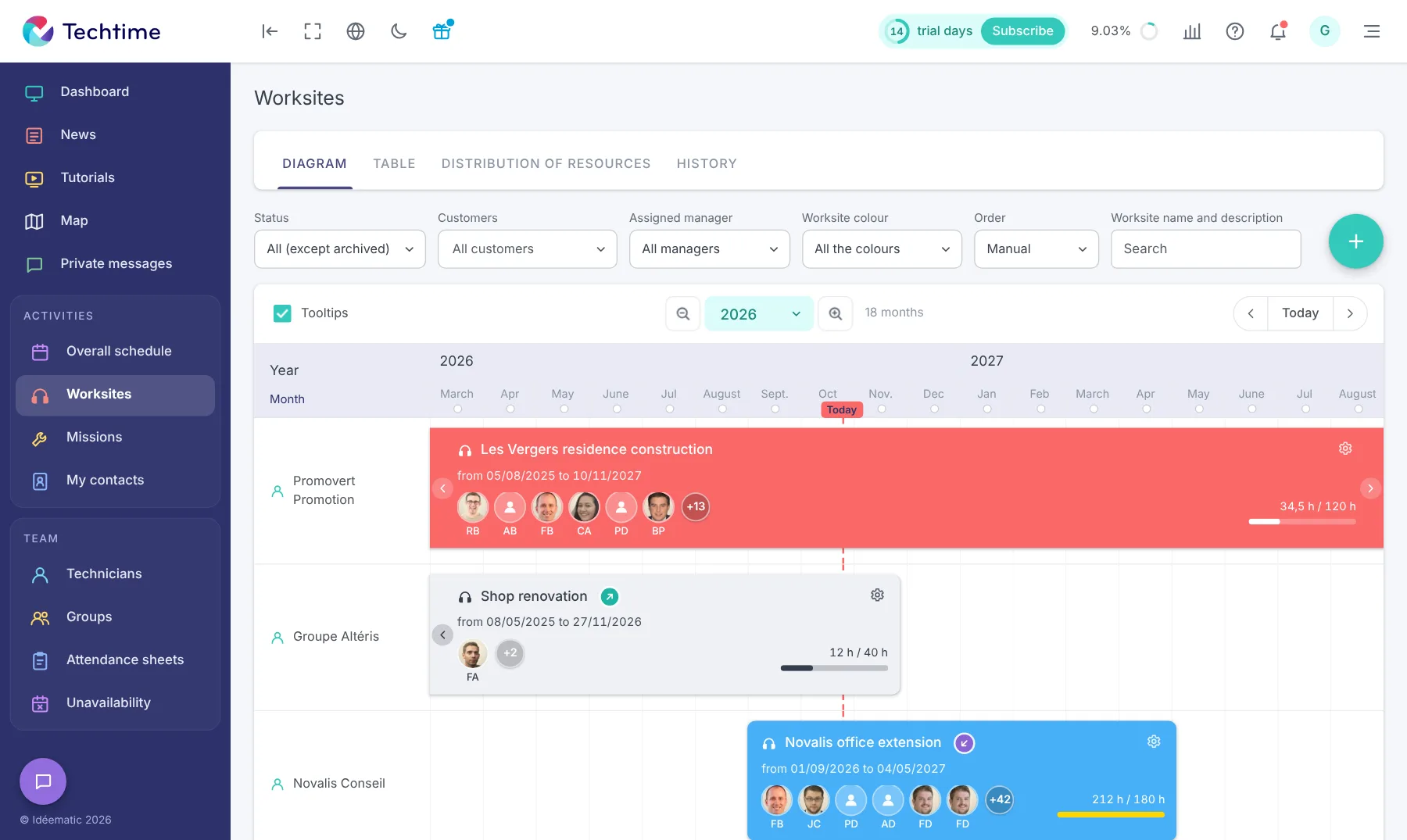
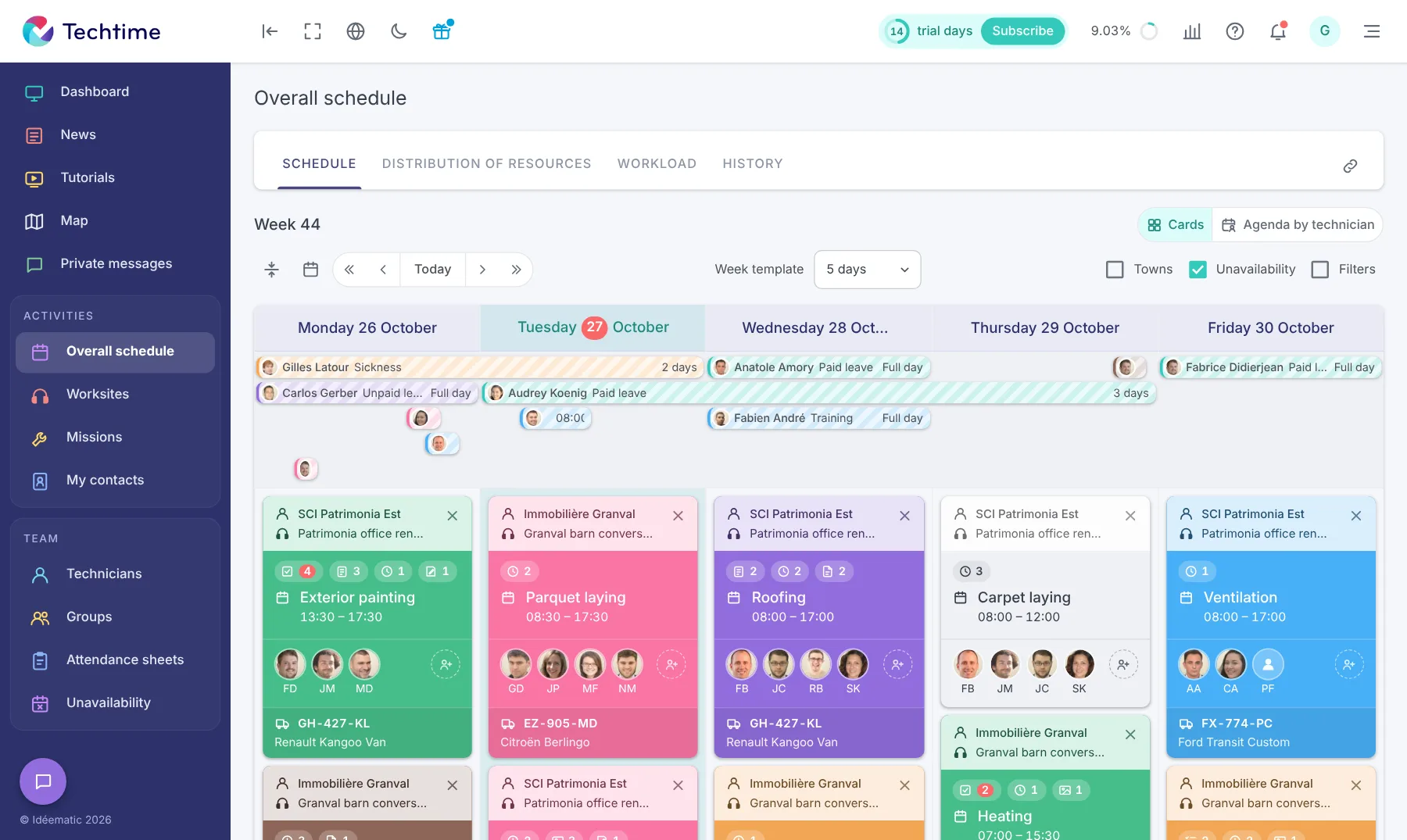
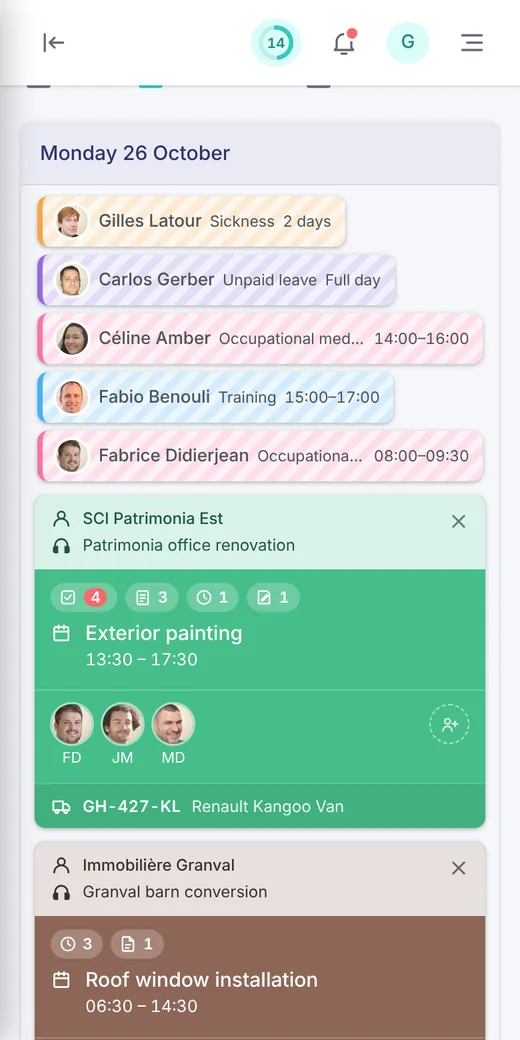
Have all your employees been declared on the BTP card platform? Then move on to the next step: coordinating them on the various worksites where they are posted or employed. For that, there is nothing like tailor-made worksite management software such as Techtime to manage their schedules.
Frequently asked questions
Who needs a BTP card?
All employees carrying out building or public works in France: earthworks, drainage, assembly, fit-out, renovation, demolition, maintenance… This applies to French and foreign companies, temporary workers and posted workers.
How much does the BTP card cost?
The employer pays a flat fee of €9.80 per card.
What should you do if the BTP card is lost or stolen?
The employee informs their employer within 24 hours. The employer informs the CIBTP association and orders a new card at its own expense.