


Please note: this article refers to French regulations and standards.
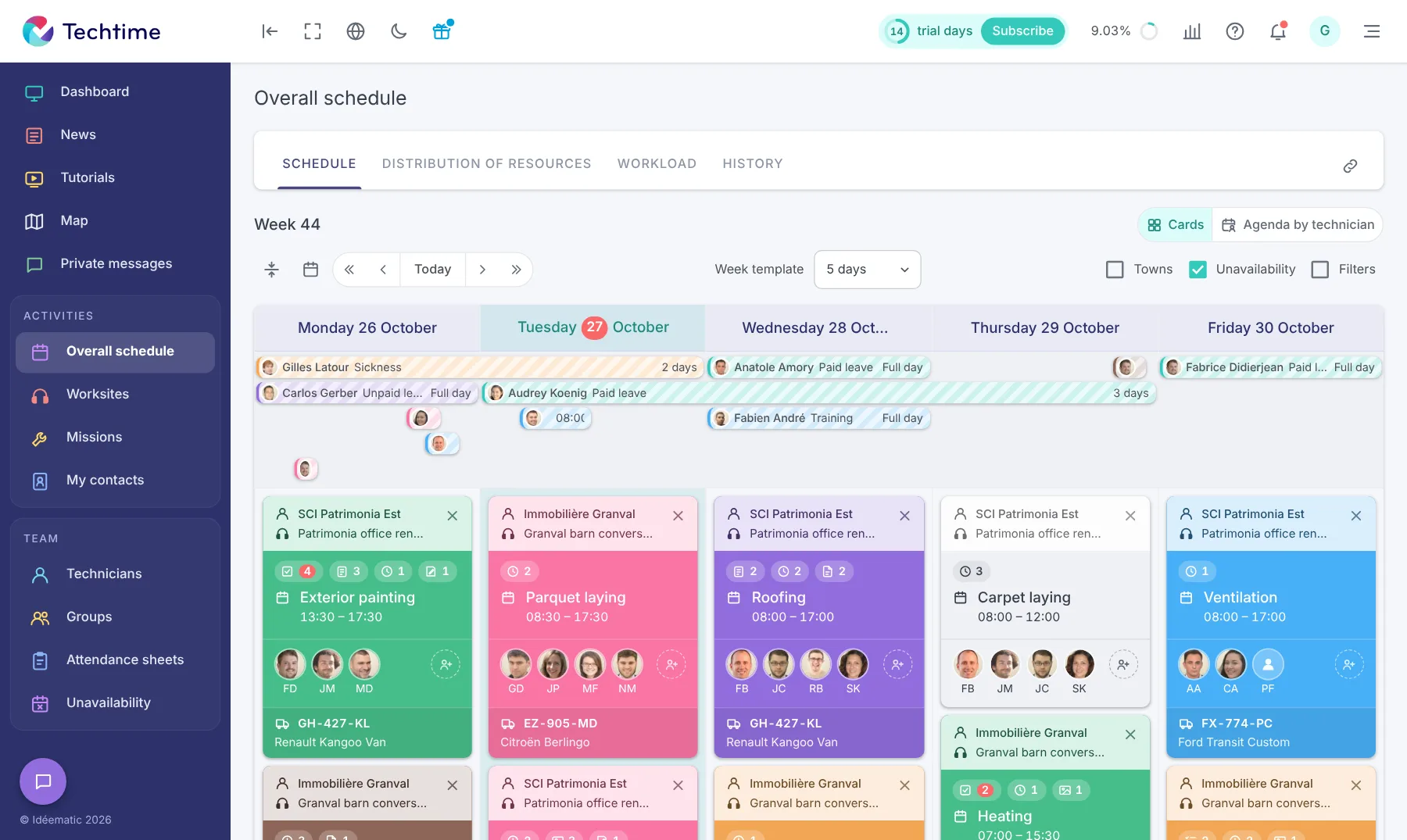
Despite concerns at the start of the year (Le Figaro article), landscaping companies are one of the few growing sectors in French construction. Their national union (Unep) recorded average growth of 2% across its markets in the first half of 2024, along with a 13% rise in hiring over the same period (source). For lovers of nature in urban settings, here is what you need to know to retrain successfully and become a landscaper.
In brief
The landscaper designs and creates green spaces, public or private: they prepare the project in their design office (sketches, drawings, administrative file), then prepare the soil, plant and maintain gardens. Unlike a gardener, who focuses on maintenance, they manage the whole project. In France, the trade can be learned from the BEPA (vocational agricultural certificate) up to the state landscape architecture diploma (5 years of higher education), and can be practised without a qualification. In 2024, an employed landscaper earned between €2,000 and €3,800 gross a month.
1What does a landscaper do?
Landscaping is not considered a construction trade in the strict sense. Landscapers do not take part in building or renovating infrastructure. Instead, they add an aesthetic dimension and do everything possible to integrate buildings or civil engineering works into the environment.
They work in an agency or a landscaping company, or as freelancers. Their customers range from private clients to public ones (municipalities, local authorities, etc.).
A landscape architect working in their office
The landscaper’s project starts in their design office. Analysing the client’s brief, they produce a preliminary project file containing the following documents (source):
- Sketches or 3D drawings of the outdoor development project, much like Building Information Modelling (BIM) for buildings under construction.
- Technical drawings for the professionals working with the landscape designer (architects, urban planners, engineers, landscape workers, horticulturists, etc.). These documents cover earthworks, irrigation, infrastructure and planting.
- Administrative documents setting the legal and financial framework of the project (special clauses, deed of commitment, tender rules, etc.).
The information needed to prepare this file comes from topographical surveys and prior exploration of the site. The landscaping contractor makes sure environmental constraints such as climate, wildlife, vegetation, soil and water management are respected (source).
A construction professional working on a variety of sites
The landscaper’s work is very varied. The spaces they create are found in public gardens, residential areas, parks, shopping centres, riverbanks, etc. They also maintain roadside verges along motorways or high-speed rail lines.
Their aim is to bring beauty to developments that would otherwise look rather dull without their plants and decorative touches. When wearing their landscape architect hat on site, they play the same role with their workers or subcontractors as a site manager. These are mainly gardeners, horticulturists or nursery workers.
Their main activities are:
- Preparing the soil with various tools (shovels, pickaxes, rakes, diggers, etc.). They check that all the materials are available, such as plants, trees, flowers, gravel, soil or timber.
- Creating green spaces by planting or transplanting cuttings and seedlings. They add garden sheds, timber decking, ponds, etc. Besides gardeners, this work calls for other construction professionals such as bricklayers, plumbers (for irrigation) or electricians (for lighting).
- Maintaining gardens with manual or powered gardening tools for pruning, mowing, weeding, clearing undergrowth, etc. They avoid chemicals as far as possible to keep the environment healthy.
- Advising customers on landscaping (source).
What is the difference between a landscaper and a gardener?
A landscaper (in the sense of landscape architect) focuses mainly on managing the green space project. A gardener only looks after maintaining the garden or park. As a result, the two trades do not require the same training (in France, a BTS in landscape design versus a BEPA or CAPA, vocational agricultural certificates). However, beyond their special relationship with plants, both landscape professionals also need to look after their customer relationships (source).
- Designing green spaces in the design office
- Drawings, sketches and administrative file
- Coordinating contractors on site
- Maintaining the garden or park
- Mowing, pruning, weeding
2What are the pros and cons of being a landscaper?
The advantages of the landscaper trade
If you love nature, you can give free rein to your creativity and poetic sense, as long as the customer likes it. The landscape architect’s job is varied enough to avoid falling into a routine, even though it mostly takes place outdoors.
It is rewarding to create a green space that brings escape and serenity to your customers. You can also watch plants and trees develop over time while you maintain them. Learning new techniques and skills broadens your expertise for wonderful results.
The drawbacks of the landscaper trade
The calm of the garden does not prevent the physical demands of the job, in terms of posture or tools. Weather conditions make the job harder when they are too gloomy or too dry. That is why you need to be ready to work outside normal hours depending on these contingencies.
Landscapers generally work as freelancers or as employees of small agencies. Freelancers face irregular income that depends on their customer base. Employees earn fairly low salaries compared with their level of education (see below) (source).
3What skills do you need to be a good landscaper?
Landscapers first and foremost master botany and plant physiology. They know what plants need and the techniques for looking after them. They know the safety rules for the tools and machinery needed for green space maintenance. Their autonomy and versatility require some basic knowledge of other disciplines: masonry, electrics, plumbing, civil engineering, etc.
A truly creative mind, the landscaper is nonetheless a conscientious professional who respects budget and environmental constraints. Their art does not rule out computer skills, as their drawings are done by hand or with CAD software (computer-aided design). Good physical fitness is needed for outdoor work, which may be done in a team with engineers, architects or urban planners.
4Retraining as a landscaper: which training should you follow?
Several training routes lead to becoming a landscaper in France. After lower secondary school, you can take a BEPA (vocational agricultural studies certificate) in land development or a CAPA (vocational agricultural aptitude certificate) in landscaping work. You then continue with a vocational baccalaureate in landscaping before moving on to a BTSA (advanced agricultural technician certificate) in landscape design or horticultural production. CACES certificates are needed to operate motorised machinery such as tractors or cranes.
If you want to manage development projects, we recommend continuing your studies at specialist schools. The qualifications and their levels after the baccalaureate are as follows (source):
- Professional bachelor’s degree in landscape design (3 years of higher education);
- Landscape assistant bachelor (3 years of higher education);
- State landscape architecture diploma (DEP) at the national schools of landscape architecture (ENSP) (5 years);
- Landscape engineering degree at the Institut supérieur d’agriculture (5 years);
- European master’s in landscape gardening at the École supérieure d’architecture des jardins (ESAJ) (5 years).
Can you become a landscaper without a qualification?
Despite the training routes above, it is possible to set up as a landscaper without a qualification. However, in the absence of regulation, you have no protection. Only the title of landscape designer is regulated, by the French Landscape Federation (FFP) (source).
What career prospects are there in landscaping?
After several years’ experience, a landscape gardener can aim for a position as team leader, engineer or site manager in their field. This leads them to use digital tools to manage the worksite of their green space properly. Besides private agencies and sole traders, the civil service and the councils for architecture, urban planning and the environment (CAUE) are possible career paths.
5How much does a landscaper earn?
In 2024, the average salary of a landscaper in France ranged from €2,000 to €3,800 gross a month (source). Pay depends on many factors such as seniority, region and self-employed or employed status. In any case, a beginner landscaper earns the French minimum wage (SMIC, €1,426 net) before rising to €1,892 after 10 years’ experience. In the French civil service, the landscape gardener belongs to category B, while the engineer is in category A.
Unlike an employee, a business owner sets their own hourly rates. Their monthly income can exceed €6,000 gross, but it is less predictable. It all depends on their network and how the business is managed, particularly if the number of orders falls.
Conclusion
The landscaper is a nature professional who wears several hats to create public or private green spaces and gardens. They are both an engineer who develops and manages the project and a technician who maintains it on site. The trade requires no qualification to get started, but training remains necessary for good career prospects and proper protection. If you are a landscaper or retraining as one, subscribe to Techtime to optimise your worksites and make your daily work easier.
Frequently asked questions
What is the difference between a landscaper and a gardener?
The landscaper designs the green space in the design office (drawings, sketches, administrative file) and coordinates contractors on site. The gardener only handles maintenance: mowing, pruning, weeding.
What studies do you need to become a landscaper?
In France, after lower secondary school, a BEPA, then studies up to a professional bachelor’s in landscape design or a landscape assistant bachelor (3 years of higher education), or even the state landscape architecture diploma or a landscape engineering degree (5 years).
How much does a landscaper earn?
In 2024, between €2,000 and €3,800 gross a month depending on experience and region. A business owner sets their own rates and can exceed €6,000 gross a month, with less regular income.