


Please note: this article refers to French regulations and standards.
Defects are the main fear of French people planning to build. According to a survey by the consumer association CLCV, they account for almost half (45%) of worksite disputes (source). Yet worksite quality control is essential to spot construction defects throughout the construction phase. This monitoring, and communication between the parties, come into their own when the building has to be handed over to the client. To avoid last-minute repairs before handover to the client, how should you manage your pre-handover inspections properly?
In brief
Pre-handover inspections (OPR) check, before handover, that the works comply with the drawings, standards and contract: work carried out, tests, services not performed, equipment, defects and removal of site facilities. They take place in four steps: request for handover, notice to the parties, report, then final handover, with or without snags. Handover triggers the statutory guarantees, including the two-year and ten-year guarantees.
1What are pre-handover inspections (OPR)?
Pre-handover inspections are used to assess whether the works have been carried out properly in line with the drawings, standards and the customer’s expectations. In theory, these tasks are not mandatory unless they are specified from the outset in the works quote (source). This applies to both public contracts and private ones.
Nevertheless, OPR enable final handover of the building while reducing the need for snag lists. They are the responsibility of the site project manager (MOE) or the architect supervising the works.
For French public contracts, the checks cover several points under Article 41 of the CCAG (general administrative clauses):
- Inspection of the work carried out: checking compliance with drawings and specifications.
- The tests provided for in the contract: ensuring installations comply and work properly.
- Recording any services not performed.
- Checking that equipment is properly installed.
- Detecting and correcting defects and imperfections before final handover.
- Removal of site facilities, such as scaffolding, and restoring the site by dealing with worksite waste.
- Confirming completion of the works in line with contractual requirements.
Several tests can be carried out (performance, strength, watertightness) to check the quality of materials and the rigour of construction tradespeople (source). The inspection report is recorded on form EXE4, while the handover report is drawn up on form EXE8. The project manager fills in both documents, but the handover report has a legal value that the inspection report does not. (source).
For private contracts, other contractual frameworks may apply. Under Article 1102 of the French Civil Code, negotiations on contract clauses enjoy greater freedom, provided private law is respected (source). The documents relating to OPR are either the special administrative clauses (CCAP) or the special technical clauses (CCTP).
2The link between pre-handover inspections and statutory guarantees
Under Article 1792-6 of the French Civil Code (source), pre-handover inspections trigger the statutory guarantees that protect the client against non-compliance. These include the completion guarantee, which is mandatory. The contractor “is bound for a period of one year from handover […] to repair all defects reported by the client”. The client can record snags on the handover report during the site visit, or through notifications sent after handover.
Against the risk of discovering hidden defects while the building is in use, the customer also benefits from the following mandatory protections (source):
- the proper functioning guarantee (or two-year guarantee);
- the ten-year guarantee.
The first requires the company responsible for the works to repair or replace any equipment that does not work properly. This item must be separable from the structure of the building, such as an electric water heater or part of the plumbing (source). It is valid for at least two years from the date of handover (Article 1792-3, French Civil Code).
The second is an obligation for all professional builders and for individuals who build their own home with their own resources. This insurance covers the repair of hidden defects not detected during the OPR. It concerns elements inseparable from the building, such as the roof structure, drainage, pipework, etc. The certificate given to the client is valid for 10 years from the date of handover (source).
Structural damage insurance (DO) is normally mandatory, but it is not always taken out in private contracts. Yet it allows repairs linked to hidden defects covered by the ten-year guarantee to be handled quickly. Optional guarantees also include a commercial warranty, to extend the statutory guarantees, or a contractual performance guarantee.
3The 4 main steps of a pre-handover inspection
Whether in a public or private contract, preparing and carrying out pre-handover inspections always follows the same steps. Here is how they work.
- 1Request for handoverand list of inspections
- 2Notice to attendclient and companies
- 3Reportsnags and signatures
- 4Final handoverof the work
Submitting the request for handover of the works
The builder or tradesperson responsible for the works informs the client that the worksite is about to finish. These two parties meet with the project manager to draw up the list of inspections to be carried out. They set the handover schedule, the list of areas to inspect and the list of people to be invited.
For interior painting work, the inspection list might be:
- Check that the colour and texture match the project specifications.
- Test the paint’s adhesion to the surface.
- Assess the paint’s resistance to knocks and scratches.
Inviting the client and contractors to the worksite
The project manager sets the date of the inspections and, on the day, convenes the contractors who took part in the project and the client. Suppliers, subcontractors and other parties are not invited (source). The company responsible for the works must bring certain administrative documents, which will be handed to the client (source):
- The as-built file (DOE).
- The as-built survey drawings.
- The operating manuals.
The final technical inspection report (RFCT).
Drawing up the handover report
After the visit, the project manager or the independent expert in charge of the inspections draws up the worksite report. It is the only document that can be used legally in the event of a worksite dispute. It must contain the following information:
- The reference of the construction company and the contract.
- The date of the site visit and of the handover report.
- The address of the work.
- The people present, represented or absent despite being invited.
- The list of inspections carried out.
- Information on services performed or not.
- Information on clearing the site and removing worksite facilities (removal of temporary installations; cleaning).
- The list of snags or visible defects, recording defects and imperfections in as much detail as possible. Compliance with equipment installation conditions is also taken into account in order to enforce the guarantees.
- The signatures of the companies present at this stage, to record completion of the works.
Issuing final handover of the work
The client has several ways of recording the handover:
- Handover without snags. All the work inspected complies with the contract with the construction company, with no defects. The client waives any claim for repairs, as defects found later will be covered by the completion guarantee. The worksite is officially handed over.
- Handover with snags. The report is signed even though some work does not comply. The company therefore undertakes to carry out the necessary repairs within a set deadline.
- Refusal of handover. The client refuses to sign because the works are not finished or the building cannot be used as it is. Under Article 41 of the CCAG, the project manager’s silence counts as tacit handover. Either way, handover is postponed to a later date. However, if the client does not set a date, handover of the works is deemed to have taken place after 30 days (Article 41.1.3 of the CCAG).
- Judicial handover occurs when the parties cannot agree on the handover date or the nature of the snags.
Compliant work, no defects
Report signed, repairs within a set deadline
Unfinished work or unusable building
Disagreement on the date or the snags
Good to know: what is the difference between a defect in workmanship and a construction defect?
A defect in workmanship is work carried out in a way that does not comply with the contract or good practice. It may or may not be visible, but it is usually found during the works or the OPR. It does not endanger the building, as it is generally a finishing defect. It is covered by the mandatory guarantees (source).
A construction defect is a more or less serious flaw that can jeopardise the use of the building. It may be cracks or a structural defect. It is apparent when the client or their representative can see it with the naked eye during handover (Article 1642, French Civil Code). It must be corrected under the completion guarantee. But if it is not recorded in the handover report, no claim can be made one month after the keys are handed over (source).
If the defect cannot be detected at handover and is discovered afterwards, it is called a hidden defect. It makes the work unfit for its purpose. Only the ten-year guarantee can remedy it, up to 10 years after the keys are handed over.
4Use worksite tracking software to validate your pre-handover inspections
Worksite tracking software such as Techtime can help you prepare your inspections in advance. Even though these inspections take place at the end of the worksite, checks can be carried out as the works progress.
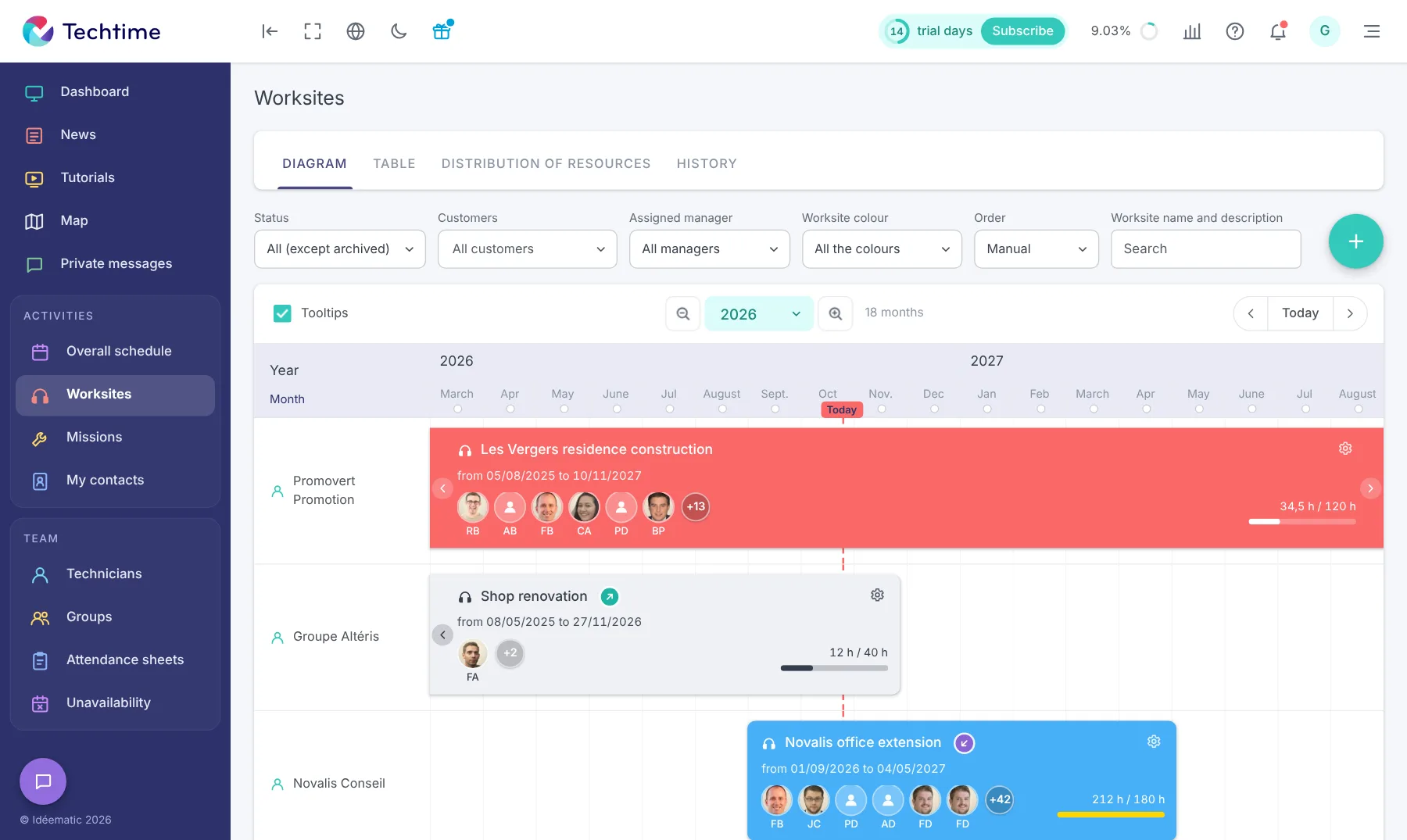
Based on the special technical clauses (CCTP), the project manager centralises in the app all the documents and photos used to check the work of employees or subcontractors. If defects are found and geolocated, repairs can be carried out on time and in an organised way, as this data is shared with everyone working on the construction project.
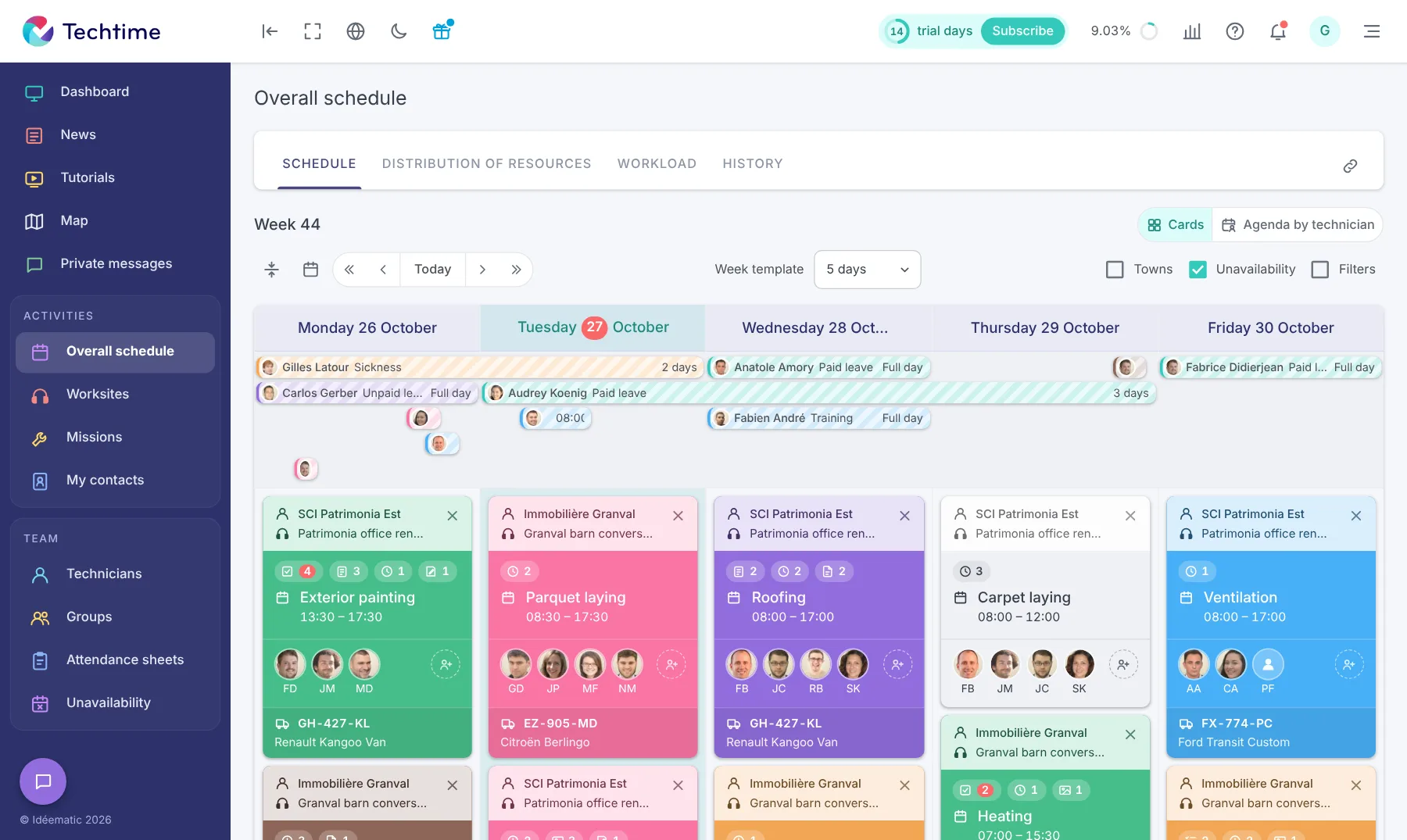
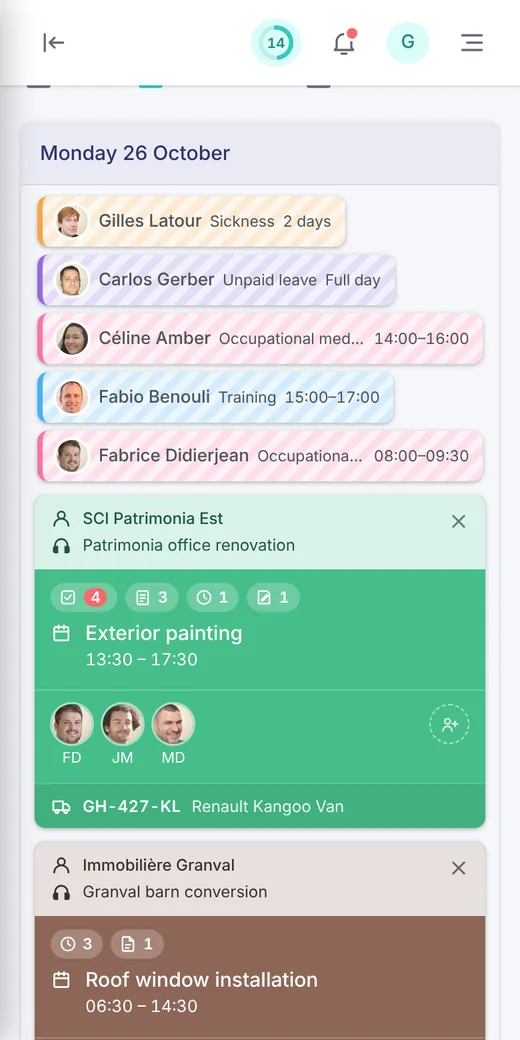
With the worksite schedule, select the right person to fix the construction defect. Then, as the inspection date approaches, your project manager can see at a glance whether your team members will be available. Planning ahead helps limit absences and gather all the signatures needed to validate the handover report.
At the last visit before handover, no more worrying about forgetting a single document to give the client. They are all stored in the electronic document management (EDM) feature. There you will find all reports, quotes, invoices and any other document linked to the project.
To make your pre-handover inspections a success, don’t neglect the quality of materials and of your team’s work. Fix defects as the worksite progresses. Centralise all project documents and check in advance the availability of the people who must attend the inspections. Finally, optimise communication with the client, the project manager and site teams to make sure the works comply. For all these reasons, a worksite tracking app like Techtime is the tool you need! Discover it now!
Frequently asked questions
What are pre-handover inspections (OPR) in construction?
Pre-handover inspections check that the works have been carried out properly in line with the drawings, standards and the client’s expectations, so as to limit snags at handover.
How do pre-handover inspections work?
In four steps: the request for handover with the list of inspections, the notice to the client and companies, drawing up the report with any snags, then final handover of the work.
What is the difference between a defect in workmanship and a construction defect?
A defect in workmanship is work that does not comply with the contract or good practice. A construction defect is a more or less serious flaw that can compromise the use of the building; if discovered after handover, it is called a hidden defect.