


Please note: this article refers to French regulations and standards.
A France Travail survey reveals that France has 27,000 roofers. It adds a very interesting fact: these professionals seem to be getting younger, with an average age of 34. Why does laying tiles on the roofs of detached houses or historic buildings seem to be so popular? What new skills are expected in this trade? Here is all the information you need to succeed in your career change and become a roofer.
In brief
The roofer builds, repairs and maintains roofs: they prepare laying plans, insulate the roof, lay the roofing (clay tiles, synthetic slate, EPDM) and ensure it is watertight. France has 27,000 roofers. In France, the trade is learned through a CAP (French vocational certificate) in roofing or waterproofing in 2 years, up to BTS level; without qualifications, a professional title can be obtained in 7 months on average. A beginner roofer earns around €19,822 gross a year, €26,780 after about ten years, and €3,000 gross a month as a site manager.
1What does a roofer do?
The roofer builds or repairs the roof of an apartment building or a detached house. They are responsible not only for its watertightness but also for its thermal insulation. Unlike other construction trades, you might think their role is confined to the end of the worksite. In reality, their work begins as early as the preparation and organisation of the project.
Preparing plans and scaffolding before the worksite
First, the roofer draws up the laying plans for the roof. They work out the number of tiles needed for the project and how they will be cut. In consultation with the client, they choose the roofing material from the following list: clay, concrete, slate, aluminium, zinc or glass. The material used for the tiles must suit the building and its surroundings (Jobijoba).
On site, the roofer works with other building trades at specific stages of construction. They put up their scaffolding, with or without a scaffolder, to ensure their safety when working at height (Pro Matériel Bâtiment). They coordinate with the timber framer to fix the battens, wooden laths that will support the future roofing.
Roofing at the end of the worksite
The roofer first works on the roof’s thermal insulation and sound insulation. This task, like installing solar panels or designing green roofs, is increasingly part of their daily work (Groupe Actual). It is all about meeting the challenges of sustainable development.
Once the roof is prepared, they can lay the tiles and adjust them to the millimetre to ensure watertightness. Three particularly resistant materials stand out (Protoumat):
- Clay is the most popular material thanks to its longevity and its resistance to strong winds and heavy rain. With a special treatment, it is even frost-resistant.
- Synthetic slate stands out for its lightness and ease of cutting. It needs less maintenance than natural slate.
- EPDM (ethylene propylene diene monomer) resists UV, ozone and extreme temperatures. This synthetic rubber roofing is recommended for flat roofs or roofs with a low pitch.
Long-lasting, resistant to strong winds and heavy rain
Light, easy to cut, less maintenance
Resists UV and extreme temperatures, for flat roofs
Of course, the roofer takes care to leave spaces for fitting a roof window or a chimney. As a finishing touch, they put on their roofer and zinc worker hat to install gutters or other drainage systems (such as valley gutters). The main material for these installations is zinc, but other solutions are possible depending on the building, such as galvanised steel or impact-resistant PVC.
Maintaining the roof after the worksite
The roofer carries out the following repairs on a storm-damaged roof:
- Replacing tiles broken by hail or torn off by the wind.
- Reinforcing the roof structure.
- Cleaning and repairing leaks in the drainage system.
They also take on energy renovation work and the restoration of historic buildings. In the latter case, they make sure their work does not spoil the look of the property. They therefore favour natural slate or old clay tiles.
2What are the pros and cons of being a roofer?
The advantages of the roofer’s trade
The profession is versatile and offers plenty of job opportunities. It suits professionals who want to work outdoors on varied projects, whether traditional or modern.
What’s more, the trade is increasingly open to new technologies, such as using drones to inspect a damaged roof or CAD software. These computer-aided design programs create 3D models of roofs, like Building Information Modelling, to plan repairs effortlessly. For their part, clients can visualise the state of their roof after the work and are more satisfied as a result. CAD software optimises the use of materials, reducing waste and making worksite waste easier to manage.
The disadvantages of the roofer’s trade
The work involves uncomfortable positions in all weathers. Despite the harness and non-slip safety footwear, roofs in poor condition make for dizzying working conditions. According to a study by the IRSST, a roofer’s risk of serious accidents, or even fatal ones, is six times that of the average worker (Protection directe).
Apart from the basic equipment for their safety on the worksite, the roofer is also exposed to noise from their tools. Circular saws, insulation blowers and metal shears enable quality work, but they are extremely noisy. Wearing a mask and safety glasses is mandatory to protect against worksite dust.
3What skills do you need to be a good roofer?
A good roofer is meticulous and careful. Knowledge of geometry is needed to draw up the roof plans and work out the number of tiles to lay. They master the properties of roofing materials and know how they relate to different types of buildings and regional traditions. On site, they are skilful, have stamina and have no fear of heights.
They enjoy teamwork, especially when it means collaborating with other building trades. Nothing stops them from acquiring basic skills in other areas, such as plumbing, masonry or fitting cladding (Indeed). Like the landscaper, they pay attention to the look of the building through their choice of materials and the shape of the tiles.
4Retraining to become a roofer: what training do you need?
In France, after lower secondary school, you can apply for the CAP in roofing or the CAP in building and civil engineering waterproofing. These courses last 2 years, followed by a year of specialisation to master zinc work. The CAP leads to a brevet professionnel in the same specialities or a vocational baccalaureate in work on built heritage, “roofing” option (Onisep).
The highest qualifications are at BTS level, for positions with greater responsibility. You can choose from the following specialities:
- BTS SCBH: timber systems and housing;
- BTS building envelope: design and construction;
- BTS building envelope: façade and waterproofing;
- BTS building;
- BTS timber frame and roofing.
- 1CAProofer or waterproofer, 2 years
- 2Zinc workone year of specialisation
- 3Brevet professionnelto go further
- 4BTStimber frame and roofing, building envelope…
Can you become a roofer without qualifications?
It is possible to become a roofer without qualifications, provided you obtain a professional title and comply with strict safety conditions. As an employee, you can start your career as a roofer’s mate. You then take a training course lasting 7 months on average at a vocational training organisation such as GRETA or AFPA to obtain your title. To set up a business in France, you must prove 3 years of experience as an employee and hold a ten-year liability insurance (Toiture pro).
What are the possible career prospects in roofing?
Job opportunities become more attractive when the roofer specialises in working with a particular material. They can then choose between modern buildings and historic properties with more responsibility. They can move into more specific trades, such as zinc worker, roof waterproofer or solar panel installer. Their years of experience will lead them to become head roofer across several worksites, a position equivalent to site manager (CIDJ)
5What does a roofer earn?
A roofer’s salary varies according to experience and region. According to the latest data from Batiactu, a beginner roofer in France earns an average gross annual salary of €19,822, equivalent to the minimum wage (SMIC). It exceeds €20,000 gross a year after 3 years of experience, reaching €26,780 after about ten years. These salaries are supplemented by a €9 meal allowance for distant worksites, subject to the employer’s approval.
When the roofer becomes a site manager, their gross monthly salary reaches €3,000. If they go freelance, the recommended hourly rate is between €30 and €50 excluding VAT. This rate varies according to their costs and reputation (Ici formation).
6Conclusion
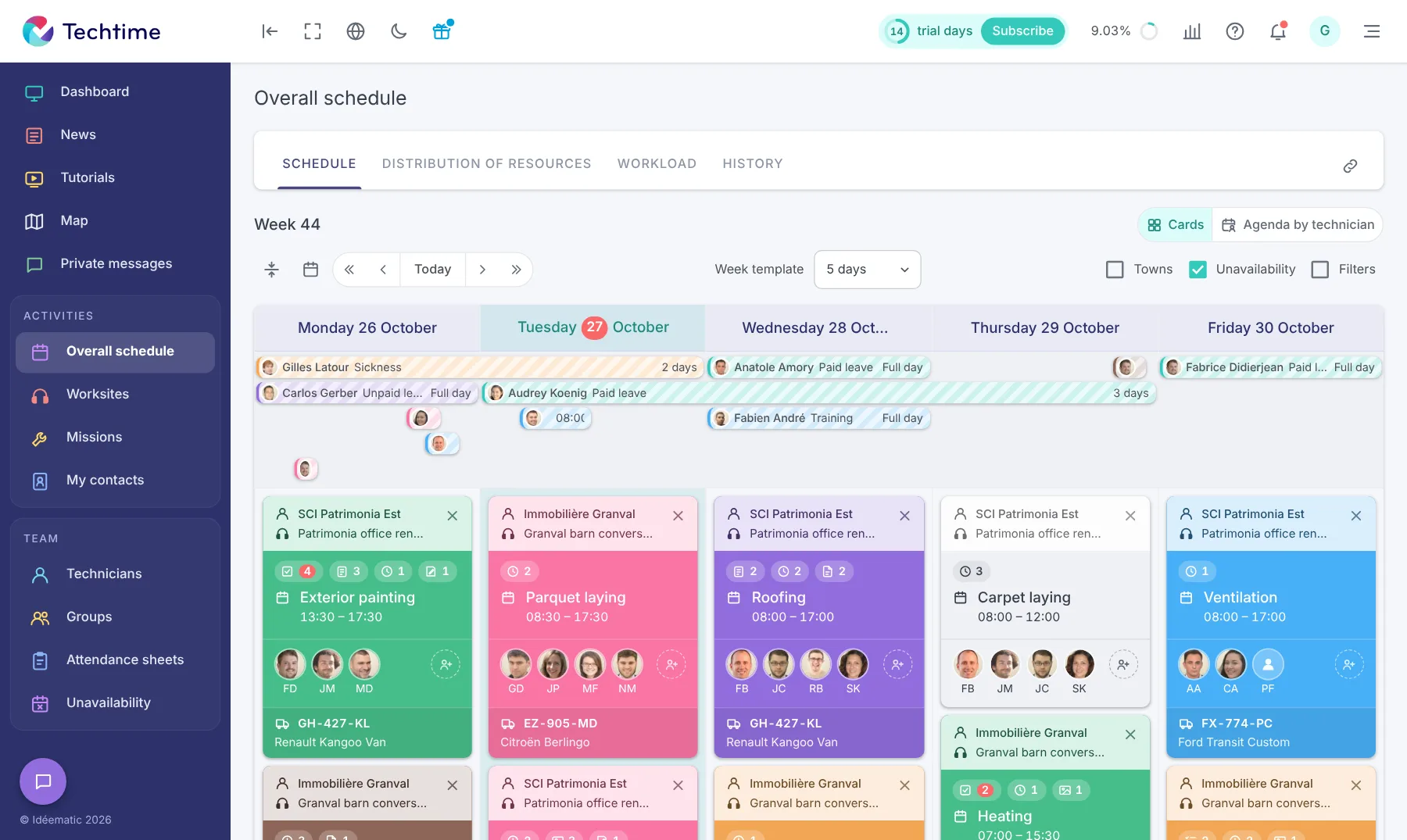
The roofer’s trade is essential for the comfort of a home. It ensures its watertightness and its thermal and sound insulation. The trade is moving with the times, adopting new technologies that improve how roof repairs are handled. But if you want your career change to be a complete success, you need the right tools to manage your worksite schedule. Techtime is the solution you need.
Frequently asked questions
What does a roofer do?
They draw up laying plans, put up scaffolding, insulate the roof, lay and adjust the tiles to ensure watertightness, then maintain and repair damaged roofs (broken tiles, roof structure, drainage).
Can you become a roofer without qualifications?
Yes, by starting as a roofer’s mate and then taking a training course of about 7 months (GRETA, AFPA) to obtain a professional title. To set up a business in France, you must prove 3 years of experience as an employee and hold ten-year liability insurance.
How much does a roofer earn?
In France, around €19,822 gross a year at the start of their career, more than €20,000 after 3 years and €26,780 after about ten years. As a site manager, they reach €3,000 gross a month; self-employed, the recommended hourly rate is €30 to €50 excluding VAT.