

Please note: this article refers to French regulations and standards.
In the construction or renovation of buildings, tilers hold a prime position. Their coverings on indoor and outdoor floors combine aesthetics, protection and thermal and sound insulation. On 1 January 2025, there were more than 1,600 job offers for this construction trade on the France Travail website (source). Training, tasks and salary: discover everything you need to know to start your career change and become a tiler.
In brief
The tiler lays coverings on floors and walls, indoors and outdoors: they prepare the substrate, mark out the setting-out plan, lay the tiles in adhesive with spacers, then grout the joints. The mosaic artist, for their part, creates works from fragments of glass, stone or ceramic. In France, the trade is learned with a CAP (French vocational certificate) in tiling and mosaics; without qualifications, a VAE (accreditation of prior experience) lets you have your experience recognised. Net pay reaches €1,400 after three years of experience and €1,500 after ten years.
1What does a tiler do?
The tiler is a skilled worker specialising in laying coverings on various indoor and outdoor surfaces. Tiles in all their forms (mosaic, earthenware wall tiles, etc.) are found mainly in kitchens, hallways, living rooms and bathrooms. They also clad swimming pools, balconies and terraces, making them resistant to the weather and the passage of time.
- 1Preparationanalysing and levelling the substrate
- 2Setting outlaying plan marked on the floor
- 3Layingadhesive and spacers
- 4Groutingafter drying
The steps of laying tiles
Laying tiles requires a particular technique. First, the tiler prepares the covering after analysing the surface. If it is not perfectly flat and smooth, levelling is needed to obtain an even screed.
Next comes the setting out. The tradesperson marks out the tile laying plan on the floor according to several factors (room dimensions, tile shape, etc.). Depending on the look the client wants, they select the most suitable materials. Marble, ceramic, terracotta, natural stone, slate and cement are the main components of floor coverings. Earthenware tiles, on the other hand, are reserved for walls because of their fragility.
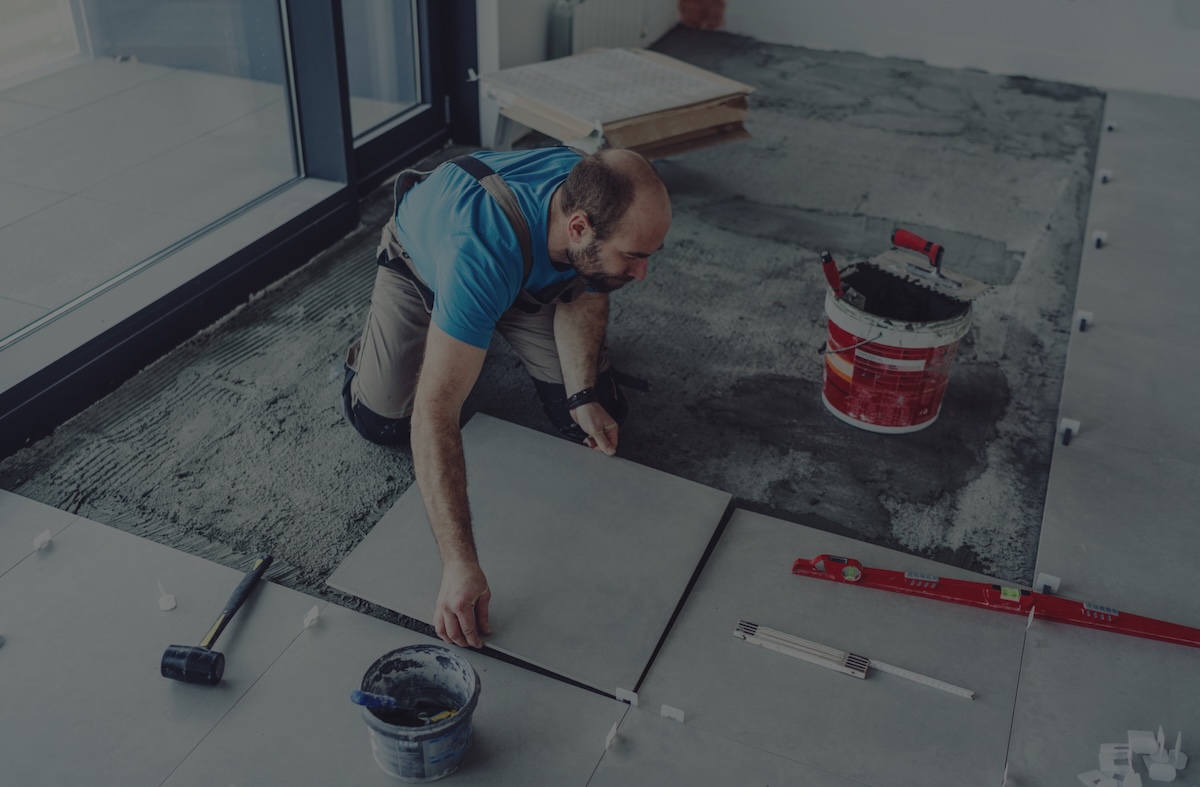
Finally, the tiler spreads adhesive on the cement screed before placing the tiles one after the other. Between them, they insert spacers to check the tiles are aligned. After drying, they remove them and fill the joints with grout, before cleaning the whole surface (source).
Collaborating with other construction trades
The tiler is an independent professional, but can take part in large construction or renovation projects alongside other construction trades. Besides detached houses and apartment buildings, they may work in public buildings, such as hospitals, offices, industrial laboratories, etc.
In that case, they work with several building professionals, such as the electrician, the painter and decorator or the plumbing and heating engineer. They have to coordinate their work with their colleagues’ tasks according to the worksite schedule (source).
Good to know: what is the difference between a tiler and a mosaic artist?
Although the two trades are not incompatible, they differ in materials and techniques. The tiler, in the general sense of the term, lays large ceramic or porcelain stoneware tiles for both functional and aesthetic purposes.
The mosaic artist (or tiler and mosaic artist) expresses their artistic side by creating complex works from fragments of glass, stone or ceramic. The trade is gradually opening up to a variety of profiles, including women in construction, who bring their artistic and aesthetic touch. They work as freelancers (source) or as construction influencers (source). The artistic composition of the work suits the format of the short videos posted on Instagram or TikTok.
- Large ceramic or porcelain stoneware tiles
- Floors and walls, indoors and outdoors
- Fragments of glass, stone or ceramic
- Complex compositions and works
2What are the pros and cons of being a tiler?
The advantages of the tiler’s trade
Tiling jobs are plentiful. In France in 2024, of 213,850 construction projects, 72% required finishing trades workers, including tilers (source). As an employee, you enjoy good, steady income. For business owners, demand is so high that they can easily increase their revenue by working on their visibility.
The disadvantages of the tiler’s trade
The trade requires good physical fitness, as the positions are often awkward and tiring. If the covering is outdoors, the tiler depends on the weather on the worksite, like the landscaper.
They must also protect themselves from chemicals, noise and worksite dust when cutting tiles. The risk of injury is not negligible, with an accident frequency rate of 50 per 1,000 employees. Mishandling tools and slips and trips on the level are the most likely causes of workplace accidents for a tiler (source).
3What skills do you need to be a good tiler?
A tiler, whether a mosaic artist or not, is a creative mind with an eye for the look of their work. They know the properties of the materials used to make tiles, including their sound and thermal insulation standards. They are not afraid of working outdoors in often uncomfortable positions. Patience and care are essential for creating the most attractive mosaic or wall tiling.
But they are also a rigorous mathematician who calculates dimensions to draw up plans when setting out. Although they know tile laying techniques, they keep up to date with the standards and safety rules to be followed.
As they may work on several worksites, they are available and ready to switch projects at any time. A truly versatile professional, they have some knowledge of masonry. They can work alongside a painter and decorator, a drywall installer or a plumbing and heating engineer (source).
4Retraining to become a tiler: what training do you need?
In France, the first course you apply for after lower secondary school is the CAP in tiling and mosaics. Once you have it, you can go on to the BP in tiling and mosaics (2 years) or the vocational baccalaureate in building fitting-out and finishing (3 years). The only post-baccalaureate course available is the BTS in building finishing and fitting-out.
Can you become a tiler without qualifications?
If you want to retrain as a tiler without qualifications, we recommend going through a VAE to have your experience recognised. The skills validated are at least at the level of the CAP in tiling and mosaics. With at least three years of professional experience, the Chamber of Trades and Crafts issues a certificate of recognition of professional qualification (source). Whatever you decide, make sure you first master the French DTU (unified technical document) on laying floor and wall tiles.
What are the possible career prospects in tiling?
After several years of experience, an employee can become a head tiler or a site manager. The latter position requires a BTS in fitting-out and finishing. If you are more interested in working with clients, become a renovation or decoration adviser. With a good specialisation, you can take part in more ambitious public projects, such as the restoration of historic buildings.
5What does a tiler earn?
As in other construction trades, a tiler’s salary depends on several factors: seniority, area, qualifications, etc. That said, a beginner with a CAP starts their career on the French minimum wage (SMIC). This salary varies by region, local demand and type of contract. Self-employed tilers in France can benefit from the following schemes (source):
- the return-to-work allowance (ARE) if registered with France Travail;
- the business takeover or start-up grant (ARCE);
- the business founders’ and buyers’ scheme (ACRE);
- the activity bonus, paid by the family allowance fund;
- support from AGEFIPH, the association managing the fund for the employment of people with disabilities.
After three years of experience, net monthly pay rises to €1,400, reaching €1,500 net after 10 years of experience. Despite irregular income, a self-employed tiler can expect to earn between €2,500 and €4,000 a month (source). These good figures come from the strength of their professional network and client recommendations.
Conclusion
The tiler lays coverings to insulate floors. These can be large tiles in a variety of materials, or have a more decorative look with mosaics or earthenware tiles. This professional has some knowledge of other construction trades, especially when working on a complex worksite. That is why at Techtime we offer tailor-made worksite management software for tilers to optimise your various jobs.
Frequently asked questions
What are the steps in laying tiles?
Preparing and analysing the substrate, setting out (the laying plan marked on the floor), laying the tiles in adhesive with spacers, then grouting the joints after drying.
What is the difference between a tiler and a mosaic artist?
The tiler mainly lays large ceramic or porcelain stoneware tiles on floors and walls. The mosaic artist creates more complex works from fragments of glass, stone or ceramic.
How do you become a tiler?
In France, after lower secondary school, with a CAP in tiling and mosaics, which can be supplemented by other qualifications. Without qualifications, the accreditation of prior experience (VAE) lets you have your experience recognised.