


Beyond theory, the BTS Bâtiment (a French two-year higher diploma in building) has a strong practical focus. It aims to prepare students to handle the unexpected on the ground, coordinate teams and meet deadlines. That is why integrating digital tools, such as a worksite tracking app, is a decisive asset for a successful start to working life.
With Techtime, it is possible to simulate and follow every stage of a construction project. Discover 5 practical exercises for the BTS Bâtiment to develop your students’ autonomy and operational skills.
In brief
The BTS Bâtiment prepares students to handle the unexpected, coordinate teams and supervise a worksite. With a worksite tracking app like Techtime, five practical exercises let them practise: building a schedule and reacting to an unexpected event, writing and sharing meeting minutes, recording snags and tracking remedial work, managing a materials order in the face of a stock shortage, and organising a role play between the office and the site. Each exercise comes with assessment criteria.
Build the schedule, then react to an unexpected event
Write and share the meeting minutes
Record snags, track remedial work
Order and handle a stock shortage
Role play between office and site
1Managing a worksite schedule in real time
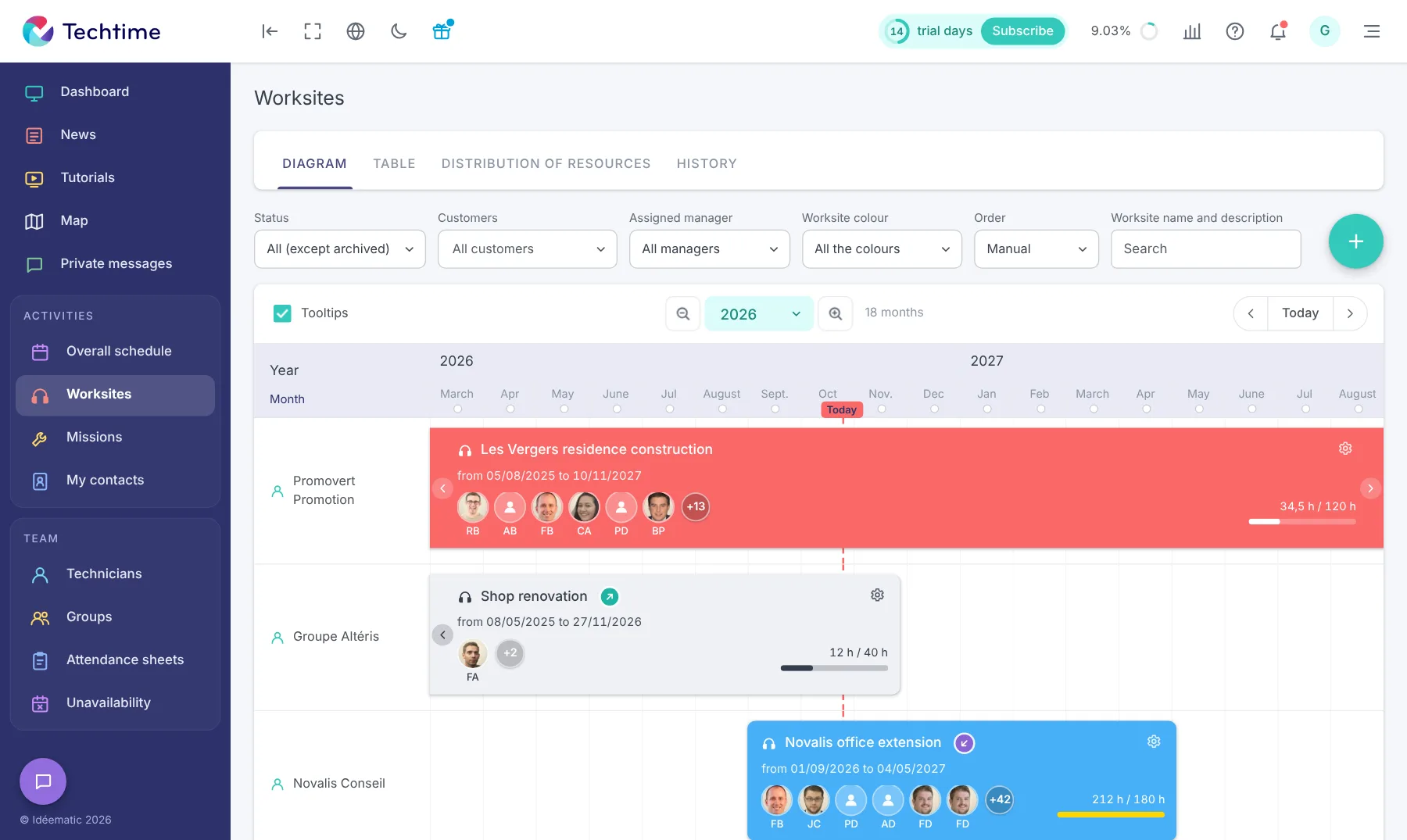
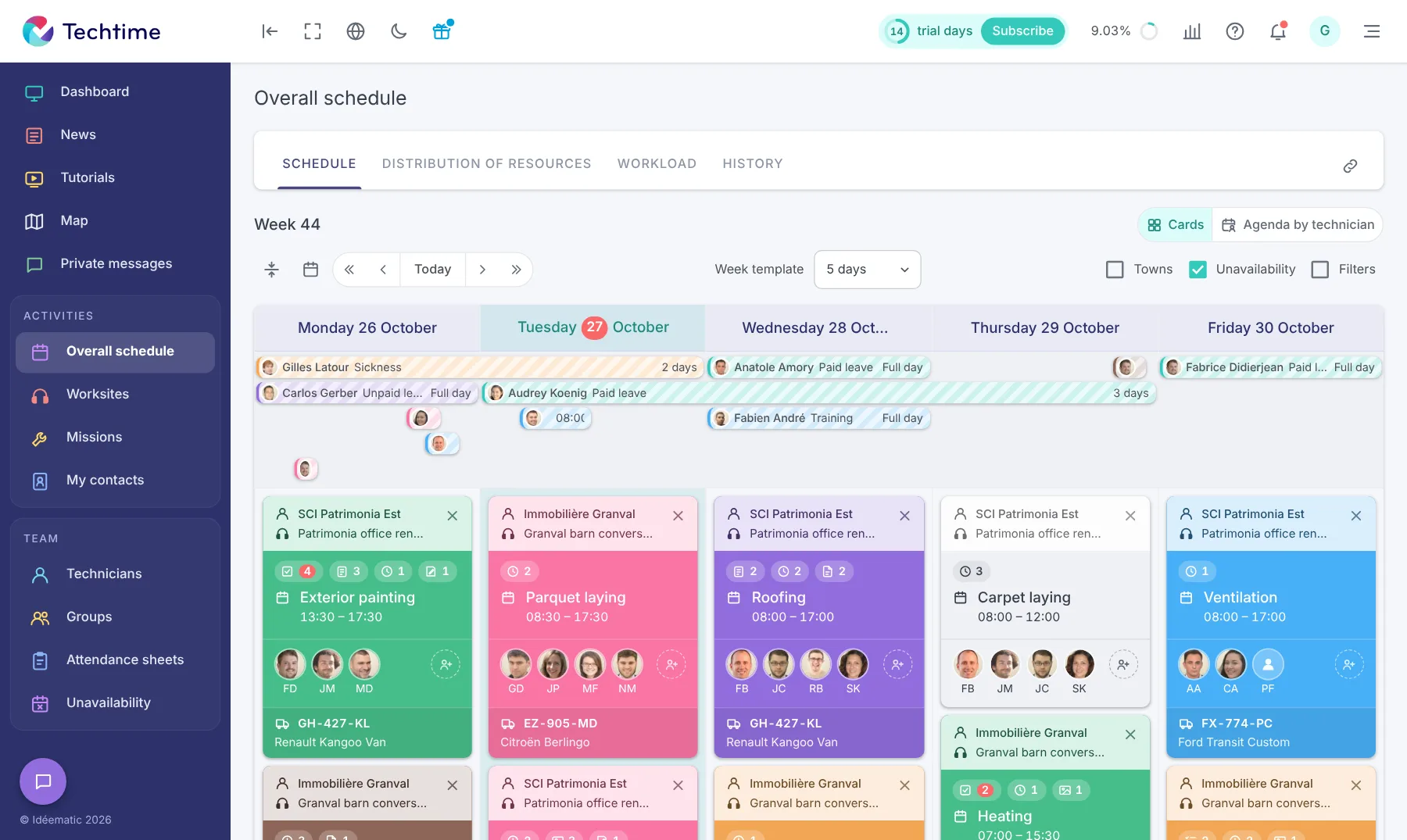
For the site manager, as for all the other construction trades, the worksite schedule is the foundation of the project. Linked to Electronic Document Management (EDM), it centralises all the information essential to running the worksite smoothly:
- Objectives;
- Tasks to be carried out;
- Professionals present or absent;
- Resources available or to be allocated.
As a BTS Bâtiment teacher, you involve your students in a mock worksite building a house. They split into several groups and each team member is given a role, including that of site manager. Creating and updating the schedule is their responsibility throughout the exercise.
Preparatory steps for creating a worksite schedule
Before creating their tracking document in the Techtime app, students review the various project data in the exercise brief. Their analysis helps them answer the following questions:
- What are the project objectives? What type of building is to be built? What is its purpose (housing, offices, etc.)? What are the estimated cost and duration?
- What are the project constraints? Which factors could hinder construction, such as regulations, budget, availability of resources, etc.?
- What is the risk assessment for the works? Which factor is likely to cause the most problems: late deliveries or budget overruns? What remedies could be put in place if this risk materialises?
- What tasks need to be carried out for this building? In what chronological order? What is the estimated duration of each? Which are considered priorities? Which tasks depend on the completion of earlier ones before they can start?
- How should resources (people, plant and materials) be allocated to each task, keeping them balanced and available? Which workers belong to the company and which tradespeople act as subcontractors? How should the different trades be managed and coordinated between structural work and finishing work? To answer this question, you ask your students to get to know the “Equipment” and “Vehicles” features built into Techtime.
With all this information, the project lead and their classmates can structure their worksite schedule in their digital tool. This exercise is similar to creating a Gantt chart (Habitat Presto).
Managing an unexpected event that disrupts the schedule in real time
To assess their adaptability and responsiveness, feel free to give them an unexpected event during the first review of the schedule. This could be a late delivery of a raw material (concrete, roof tiles, tiles, etc.), the absence of a subcontractor or a change order from the client.
The site manager must assess the consequences of this hazard and update the schedule in real time. Of course, they will make sure to inform their team on the ground, via instant messaging, that certain tasks have been reassigned.
In the end, the assessment criteria for this worksite scheduling exercise are:
- the relevance of the schedule entered;
- the ability to react quickly to the unexpected and to update the schedule in real time;
- the clarity of the messages sent via instant messaging to inform the team on the ground of the updates made to the schedule.
2Writing and sharing a worksite report
During a project, several site meetings are needed to check task progress and report any problems. Site meeting minutes summarise the discussions and observations made during the meeting. The rigour of this document is crucial, as it commits the company on its discussions, its progress and the anomalies observed. Well written and approved by all parties, site meeting minutes can have legal value in the event of a dispute and may be relied on in court. They can therefore be a way to protect yourself from worksite disputes.
With your students, you set up a weekly site meeting to review the progress of their project for the year. Each plays the role they have been given: site foreman, architect, subcontractor, etc. The teacher acts as the client, in other words the worksite’s customer.
After the meeting, the students write the corresponding minutes, including:
- progress by work package;
- the anomalies identified (cracks, defects);
- timestamped photos of the worksite;
- the decisions taken to resolve the problems.
To structure their minutes, they can rely on the data stored in the EDM or shared via the app’s instant messaging. The teacher focuses on making digital traceability second nature to the students, to avoid any complications during or at the end of the project.
The assessment criteria for the worksite report exercise are:
- the relevance and rigour of the technical comments;
- correct use of photos and annotations;
- compliance with the expected format, and command of the language.
3Snag management and quality control
When the students’ year-long project comes to an end, the teacher organises a quality check of their worksite. To help them, the teacher can hand out a checklist of the most sensitive checkpoints. These concern in particular safety, compliance with applicable standards and requirements, and the building’s finishes.
Standards to comply with include:
- the NF DTU (French unified technical documents);
- the Eurocodes (European standards for buildings and civil engineering);
- thermal regulations;
- etc.
The aim of the study project’s stakeholders is to avoid remedial work, which can harm the quality of their building. To do this, they draw up snag lists in advance, listing the construction defects to be corrected. Clear photos and rigorous documents shared via instant messaging or the app’s EDM are of paramount importance.
Based on the feedback received, the site manager updates the worksite schedule to assign corrective tasks to those concerned. Despite ever-tighter deadlines, they must never lose sight of the priority given to the quality of the works.
Once the corrections have been made, the students ask their teacher for a snag clearance visit. This visit checks that the remedial work meets the client’s expectations. If the client lifts the snags, this is recorded in a report signed by all parties.
The assessment criteria for quality control are:
- how complete the snag list is;
- the quality of photos and annotations;
- the site manager’s responsiveness and correct assignment of corrective tasks;
- follow-up of remedial work through to project close-out.
4Ordering and tracking worksite materials
The “Equipment” feature in Techtime gives access to the catalogue of materials available in real time in the company’s inventory. The teacher invites students to get to grips with supply traceability and develop their budget management when ordering raw materials.
The aim of the exercise is to assess the students’ responsiveness if their company faces a shortage of an essential material. The steps are as follows:
- record the initial order;
- report the partial delivery;
- update the stock in the app;
- simulate restocking;
- adjust the related budget.
- 1Orderrecord the initial order
- 2Partial deliveryreport it
- 3Stockupdate it in the app
- 4Restockingsimulate it
- 5Budgetadjust the related budget
This last point is very important, as students learn how ordering and materials availability affect cash flow. The site manager’s skill lies in their ability to maintain the worksite’s profitability.
The assessment criteria for supply and materials tracking in the app are:
- accuracy of entries (quantities, dates, suppliers);
- speed and relevance of the response to the stock shortage;
- updating the budget in the app;
- clarity of the information passed on to the team.
5Communication between worksite stakeholders
In every process of the construction project, communication between worksite stakeholders is key to its smooth running. Techtime’s instant messaging lets you pass important information to tradespeople on the ground. This could be a late delivery or an urgent job to be done on a given worksite. Messages can be exchanged with one professional or a group of tradespeople as needed.
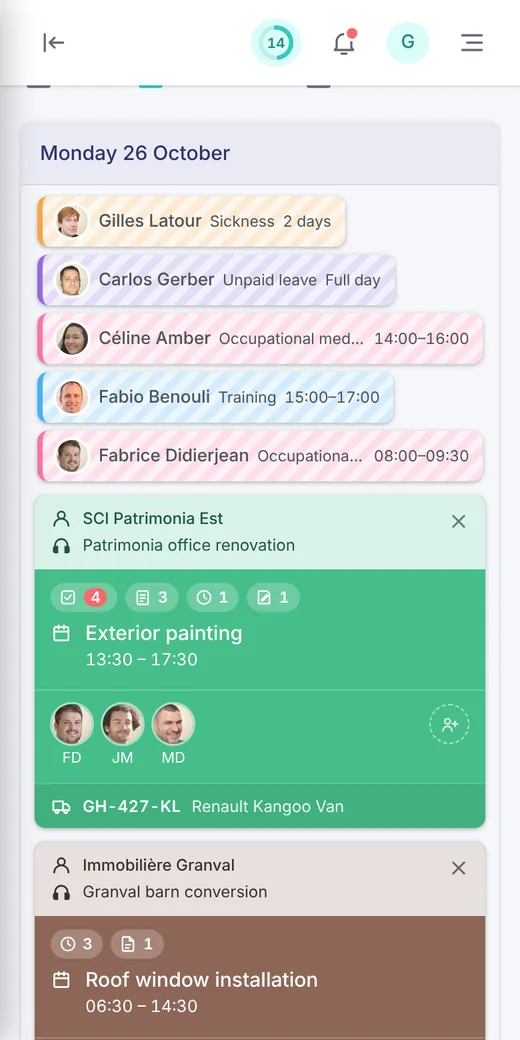
As responsiveness is an important professional skill, you can set up an alert notification on the mobile version of the app. That way, despite noise on the worksite, a simple vibration in your trouser pocket or work jacket may be enough to alert you.
As part of the BTS Bâtiment exercise, a role play can be organised between the students. They share out the following roles:
- site manager (at the office);
- site foreman (on site);
- subcontractors and suppliers (on site).
A problem arises, such as a late delivery, an urgent request from the client or an accident on the worksite. The students on site must send clear, precise messages, backed up by shared photos or documents. The site manager’s (who is not on the worksite) ability to react effectively will depend on how clearly they communicate.
Throughout the exercise, the teacher will keep reminding students of one essential point: message traceability. All written communication must be kept to ensure transparency and good faith in the event of a dispute with the client.
The assessment criteria for site/office communication are:
- the relevance and concision of messages;
- responsiveness in exchanges;
- the ability to keep a clear, usable record of communication;
- collective approval of a decision recorded in the app.
6Other BTS Bâtiment practical exercises compatible with the worksite tracking app
The 5 practical exercises described above mainly focus on a single disruptive event. To make the problem harder, feel free to combine several unexpected events at the same time to assess your students’ crisis management. Despite the critical situation, they must keep a cool head without ever losing sight of either their colleagues’ safety or the quality of the works.
7Conclusion
The 5 BTS Bâtiment practical exercises presented here are not mere academic exercises. They immerse students in real worksite management conditions. Late deliveries, budget tracking, snag clearance or communication between stakeholders: all situations that tradespeople and site managers face every day.
Using a worksite tracking app like Techtime not only helps structure these simulations better, but also prepares future professionals for the digital reality of the sector. At a time when companies are looking for operational profiles who can react quickly and optimise their worksites, mastering these tools becomes a real competitive advantage.
Training students in these practices gives them the keys to a successful construction placement, and above all to fit quickly and effectively into construction teams from their first job.
These exercises do not just train students: they also give construction companies young people who are already used to digital tools and ready to be effective as soon as they arrive on site.
Frequently asked questions
What practical exercises can you set on the BTS Bâtiment?
Managing a worksite schedule in real time with an unexpected event, writing and sharing meeting minutes, snag management and quality control, ordering and tracking materials, and communication between office and site in the form of a role play.
How do you assess a worksite scheduling exercise?
On the relevance of the schedule entered, the ability to react quickly to the unexpected by updating the schedule in real time, and the clarity of the messages sent to the team via instant messaging.
What should the worksite minutes written by the students contain?
Progress by work package, the anomalies identified (cracks, defects), timestamped photos of the worksite and the decisions taken to resolve the problems.