


Please note: this article refers to French regulations and standards.
The 2026 fuel allowance aims to support construction companies facing the rising cost of off-road diesel (GNR, gazole non routier). With geopolitical tensions and volatile energy markets, fuel has become a particularly sensitive expense for tradespeople, SMEs and public works companies.
In response, decree no. 2026-356 of 8 May 2026 introduces exceptional aid for French companies with no more than 20 employees. These companies must use off-road diesel (GNR) in their business. The measure provides temporary support for their cash flow, but how it works deserves close attention, notably because of a repayment clause linked to EBE (gross operating surplus).
In brief
The 2026 fuel allowance (decree no. 2026-356 of 8 May 2026) helps construction companies with no more than 20 employees that use off-road diesel (GNR) and carry out one of the 16 eligible activities. It is worth €0.20 per litre of GNR invoiced between 1 and 31 May 2026, up to €4,000 per company. Applications are made on impots.gouv.fr from 8 June to 3 July 2026. Above €600, the aid may have to be repaid if 2026 EBE is positive and at least 98% of 2025 EBE.
1Why did the government create the GNR aid?
2026 has been marked by strong volatility in energy markets. Geopolitical tensions in the Middle East and rising oil prices have led to a rapid increase in the price of off-road diesel (GNR), which is essential for running construction plant.
For construction companies, this situation weighs directly on margins. Many contracts were signed before costs rose, with no immediate way of passing the fuel increase on to the prices invoiced.
The activities most dependent on plant, such as earthworks, roadworks and civil engineering, are particularly exposed. According to data from Ecolow, a mini-excavator uses between 3 and 6 litres of fuel per hour for an engine of around 25 kW. Even idling for 2 hours a day on a 6-month worksite adds up to several hundred litres consumed… without producing anything!
In response, decree no. 2026-356 of 8 May 2026 introduces exceptional aid to temporarily support the cash flow of the hardest-hit SMEs. The aim is to limit the financial difficulties caused by the rise in GNR prices, while targeting companies whose profitability has genuinely been affected.
2Who can actually benefit from the 2026 GNR fuel allowance?
The decree reserves the scheme for construction companies whose workforce does not exceed 20 employees. When several companies belong to the same group, this threshold is assessed at the level of the single undertaking within the meaning of EU rules.
Your business must also meet at least one of the following two financial criteria set out in paragraph 6 of article 1:
- Revenue below €50 million;
- Balance sheet total of no more than €43 million.
These thresholds correspond to the standard thresholds defining an SME (small and medium-sized enterprise), as stated in the French Official Public Finance Bulletin. They are assessed at group level when the company controls or is controlled by other entities.
The latest INSEE study, in 2023, counted 587,898 construction companies in France, of which 95.5% were micro-enterprises and 4.4% SMEs. These include tradespeople, structural work SMEs, earthworks contractors, network companies and specialist subcontractors.
Is your business one of the 16 eligible sub-sectors?
The main activity carried out on 31 March 2026 must belong to one of the sectors listed in the decree. The activities listed in the decree’s annex include:
- Construction of roads and motorways;
- Construction of surface and underground railways;
- Construction of bridges and other engineering structures;
- Construction and maintenance of tunnels;
- Construction of utility networks for fluids;
- Construction of maritime and river works;
- Construction of other civil engineering works;
- Demolition work;
- Standard earthworks and site preparation;
- Specialist or bulk earthworks;
- Drilling and boring;
- Other specialised construction work;
- Equipment hire with operator;
- General masonry and structural work;
- Roofing;
- Timber framing work.
These trades use plant that consumes a lot of GNR every day, such as mini-excavators, bulldozers, loaders and graders. A company that uses a lot of fuel but does not belong to one of the sectors concerned cannot benefit from the scheme.
Before applying, check 5 points:
- Your company has 20 employees at most.
- Your main activity is listed in the decree’s annex.
- You have GNR invoices issued between 1 and 31 May 2026.
- You have your business bank details and the information needed for the sworn statement.
- You know the amount of de minimis aid you have already received.
Good to know: to avoid your application being rejected, check your latest annual accounts before applying.
How do you prove your administrative and tax compliance?
Under paragraph 3 of article 1, the company must be registered in the national business register by 31 March 2026 at the latest. The text also requires that there be no safeguard, receivership or liquidation proceedings (paragraph 4). Finally, under paragraph 10, the company must be up to date with its tax and social security filing obligations. Tax or social security debts are tolerated if they are below €1,500 or are covered by a payment plan that is in progress and being respected (FFB Bâtiment).
This requirement echoes the documentary rigour already needed on worksites, such as the PPSPS or prevention plan to make your worksites safe. A company able to centralise its administrative, tax and regulatory documents generally has an advantage during inspections: it can provide supporting documents quickly, limit the risk of errors or omissions and speed up its administrative procedures. This organisation reduces the risk of rejection due to missing or inconsistent documents.
Summary of eligibility conditions
| Criterion | Condition |
|---|---|
| Workforce | Maximum workforce: 20 employees |
| Revenue (for the company alone or the group it belongs to) | < €50M |
| Balance sheet total (for the company alone or the group it belongs to) | ≤ €43M |
| Activity | 16 construction sub-sectors defined by the decree |
| Legal situation | No insolvency proceedings |
| Tax and social security situation | Debt below €1,500 or plan respected |
3How is the amount of your GNR subsidy calculated?
The amount of aid depends directly on the volume of GNR invoiced between 1 and 31 May 2026 inclusive.
What is the calculation formula and the cap per company?
The calculation is set out in article 2 of the decree and is simple:
Aid amount = Number of litres of GNR invoiced between 1 and 31 May 2026 × €0.20
Only GNR invoiced between 1 and 31 May 2026 inclusive is taken into account. Note: the aid is calculated on the GNR volumes shown on eligible invoices. It is based neither on an estimate of actual worksite consumption nor on the litres left in the tank at the end of the month.
The amount is capped at €4,000 per company and counts towards the EU de minimis aid ceiling. This ceiling is set at €300,000 over three rolling financial years (Chamber of Commerce and Industry).
Worked examples of the GNR subsidy
First, an 8-employee SME specialising in earthworks is invoiced for 18,500 litres of GNR between 1 and 31 May 2026. Its aid amounts to €3,700:
18,500 × €0.20 = €3,700
This sum can cover a significant part of the month’s fuel bill, a plant finance repayment or part of the month’s fixed costs. It provides immediate support for cash flow, without fully offsetting the rise in energy costs.
The €3,700 of aid remains well below the de minimis ceiling. The company must nevertheless check the total public aid already received before applying. Controlling the cost price, a key parameter in calculating the markup rate, remains essential to preserving profitability.
Good to know: according to Service Public, the de minimis ceiling is assessed by adding up all the relevant aid received over the last three financial years. A company that has already received €250,000 in aid remains eligible for GNR aid of €3,700. Conversely, a company that has already received €298,000 will need to check its situation before applying.
As a second, more modest example, take a masonry company with 6 employees buying 3,200 litres of GNR in May 2026. Its aid is calculated as follows:
Theoretical aid: 3,200 × €0.20 = €640
As the aid exceeds €600, it will need to keep an eye on the EBE criterion at the end of the financial year (see below).
Why might the aid have to be repaid?
This is probably the least-known aspect of the scheme. At first sight, the GNR aid looks like a standard subsidy paid to offset rising fuel costs. Yet article 4 of the decree provides for repayment in certain cases.
The logic is simple: the State pays the aid immediately to ease companies’ cash flow. It then analyses their accounts. If the company’s profitability has not in fact deteriorated despite the rise in GNR prices, the aid may have to be repaid. This is measured using gross operating surplus (EBE) for the 2026 financial year.
Repayment applies when all three of the following conditions are met:
- aid received above €600;
- 2026 EBE positive;
- 2026 EBE at least 98% of 2025 EBE.
If any one of these conditions is not met, no repayment is required.
Note: to assess this condition, EBE is calculated after deducting the amount of aid received.
Our earthworks SME limits the impact of the rise in fuel prices on its results. By optimising its worksite schedule, it uses its plant more efficiently and reduces downtime. Its EBE goes from €100,000 in 2025 to €99,500 in 2026, i.e. 99.5% of the previous year’s.
It received €3,700 in GNR aid. At the end of the financial year, as the authorities find that it meets all three conditions above, they consider that the company has not suffered a significant deterioration in profitability. It will have to send the DGFiP (French tax authority), by 30 October 2027 at the latest, the documents needed to assess its EBE. If the repayment conditions are met, the authorities may recover the aid received.
Good to know: if your aid exceeds €600, treat it as a potentially repayable cash advance. Before including this sum in your financing plan or using it to cover long-term expenses, ask your accountant for a forecast of your EBE. You can then estimate the risk of repayment right away.
4What are the steps to submit your application without errors?
What is the official application timetable?
Applications are made exclusively in the professional area of the impots.gouv.fr website. The portal is open from 8 June 2026 to 3 July 2026 inclusive. Careful preparation is essential, as a missed deadline can have significant financial consequences.
Which supporting documents do you need to prepare?
You need to prepare the following documents:
- sworn statement;
- business bank details;
- summary of de minimis aid;
- GNR purchase invoices for May 2026;
- official invoice summary table provided by the authorities.
The decree requires GNR purchase invoices. Delivery notes may be useful internally, but they do not replace the invoices required for the application. To prevent fraud, the DGFiP may request any additional information needed to process the application and, in the event of irregularities, start proceedings to recover sums unduly received.
It is vital to check your online application before submitting it to avoid any risk of rejection that could put your company in difficulty.
- 1May 2026 invoicesGNR invoiced from 1 to 31 May
- 2Invoice summary tableprovided by the authorities
- 3Sworn statementBank details and de minimis aid
- 4impots.gouv.frfrom 8 June to 3 July 2026
- 5Checkbefore submitting
5What other support is available to cope with rising costs?
The exceptional GNR aid provides one-off support for cash flow, but it is not a lasting solution to rising energy costs. To protect their margins, construction companies can also draw on additional financing, renegotiate certain contracts and act directly on their fuel consumption.
How does Bpifrance’s Prêt Flash Carburant work?
The Prêt Flash Carburant (fuel flash loan) aims to support companies facing a sudden rise in energy costs. Its features are as follows:
- amount from €5,000 to €50,000;
- 36-month term;
- 12-month repayment holiday;
- fixed rate of 3.8%;
- no guarantee required.
The application is made entirely online via Bpifrance’s dedicated platform. Construction is now one of the sectors eligible for the Prêt Flash Carburant, like the other sectors affected by rising fuel costs. Before applying, companies must check the eligibility criteria directly on the Bpifrance platform, in particular the conditions relating to business sector, company age, financial situation and, in some cases, the share of fuel costs in revenue.
How do you argue for a price revision in your public contracts?
The Prime Minister’s circular of 24 April 2026 encourages public buyers to take changes in production costs into account. In addition, the TP indices and the official indices published by INSEE can serve as a reference to show objectively how costs have changed, particularly under price revision clauses.
To justify a price revision request, you need reliable data:
- machine hours;
- actual consumption;
- travel time;
- worksite costs.
A site manager who can produce accurate figures has a much stronger case with their client. The ease of collecting information from the field then becomes a direct driver of profitability.
How can you reduce GNR consumption on site in the long term?
The GNR aid responds to a one-off situation. However, only lasting control of consumption lets you safeguard your profitability in the longer term. You can act on four levers:
- Reduce unnecessary journeys: a machine assigned to the wrong worksite generates extra costs without producing more.
- Group jobs together: consistent schedule management reduces the distance travelled and improves equipment utilisation.
- Limit idling time: several litres can be burned every day while the machine produces no value on the worksite.
- Track actual consumption: without reliable data, it becomes difficult to identify drift or extra costs.
A mobile worksite tracking app makes this management easier by centralising information sent directly from the field.
6How do you track your worksite costs despite rising GNR prices?
The GNR fuel allowance provides one-off support for cash flow. Worksite profitability depends above all on the company’s ability to organise its resources efficiently and track its activities in real time.
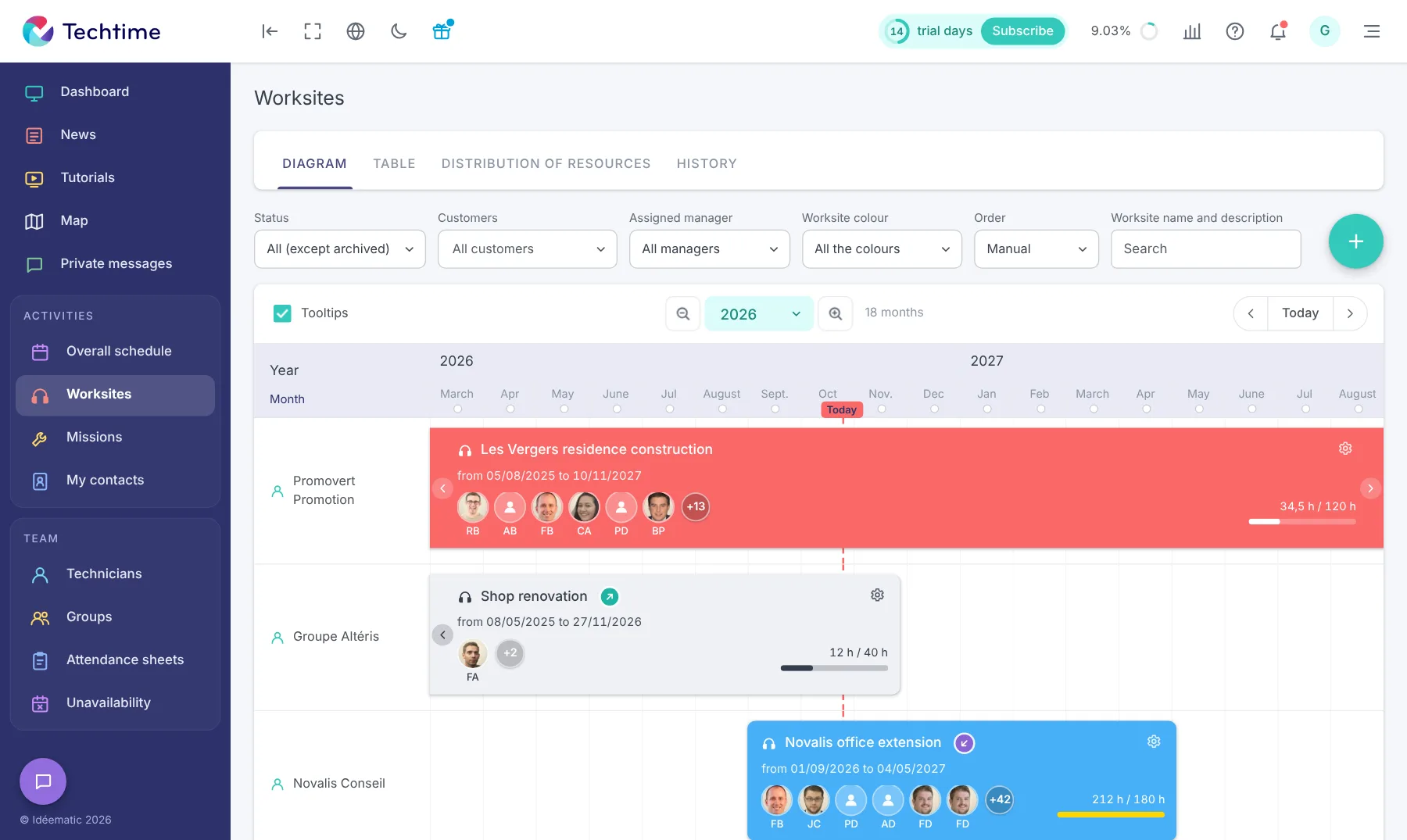
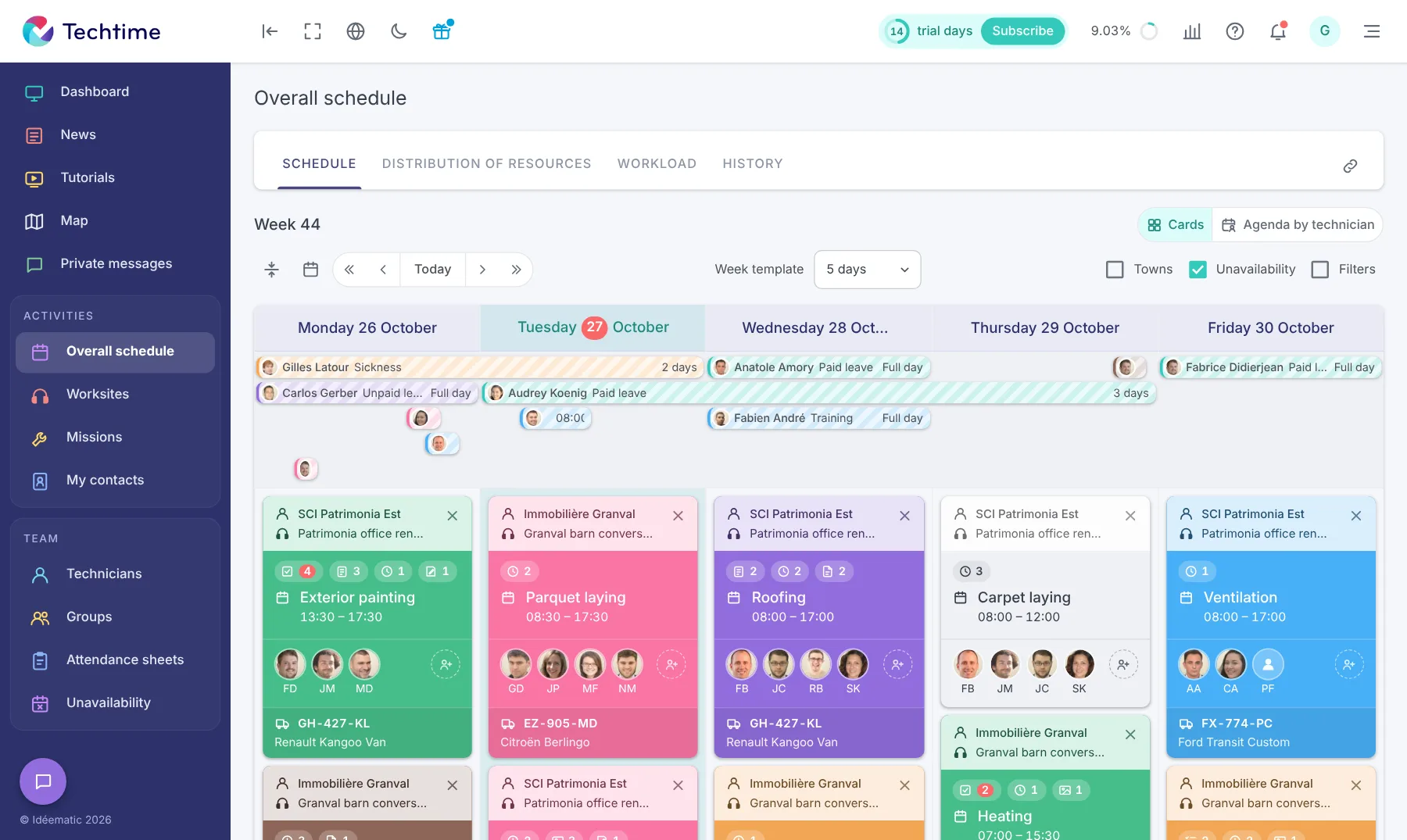
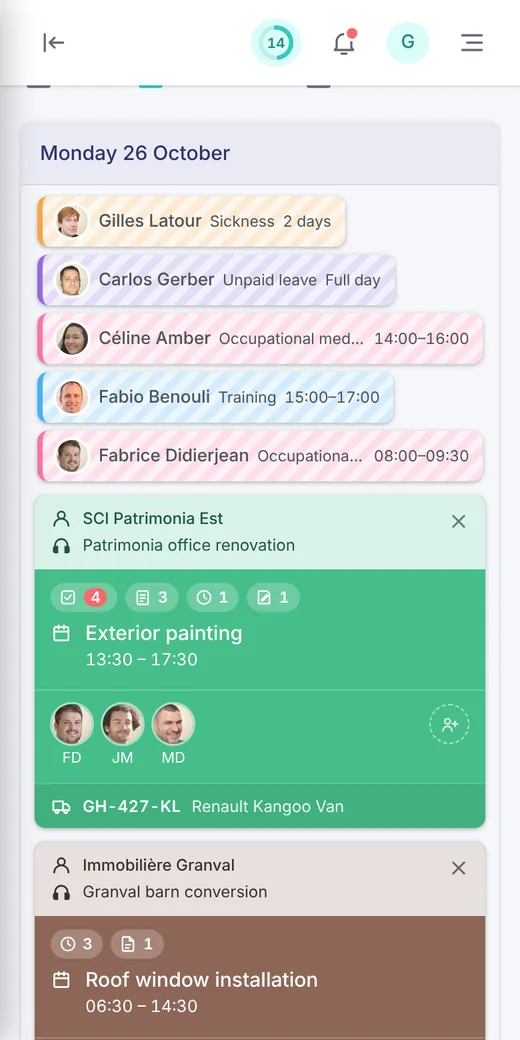
Techtime makes day-to-day worksite management easier with better visibility of hours worked, journeys, vehicle allocation and worksite progress. Site managers can spot organisational drift more quickly, which indirectly increases operating costs. This responsiveness makes day-to-day decisions easier and helps protect margins when fuel prices rise.
With costs rising, the profitability of your worksites comes down to every litre. To organise your teams better, cut unnecessary journeys, track hours on the ground and have more reliable worksite data, discover Techtime.
Request your free Techtime demo in 2 minutes
7Key points
- The 2026 GNR aid targets construction companies with 20 employees at most
- The amount is set at €0.20 per litre
- The cap is €4,000
- Applications must be submitted between 8 June 2026 and 3 July 2026
- An EBE-related clause can require the aid to be repaid in full
- The Prêt Flash Carburant and TP indices are additional levers
- Controlling consumption remains the best protection against future price rises
As eligibility rules may depend on your exact situation, have your application checked by your accountant or adviser before submitting it.
FAQ
Can the GNR aid be combined with other public aid?
Yes, within the EU de minimis ceiling of €300,000.
Are GNR invoices issued in June 2026 taken into account?
No. Only GNR invoiced between 1 and 31 May 2026 inclusive is eligible for the aid calculation.
Can a profitable company keep the aid?
Not necessarily. If the EBE conditions are met and the aid exceeds €600, repayment may be required.
What happens if there is an error in the application?
The authorities may request additional documents or reject the application if the eligibility conditions are not met.
Can the DGFiP check the information declared?
Yes. The DGFiP can check the information submitted, request additional supporting documents and recover sums unduly received in the event of an inaccurate declaration.